“This industry is all about relationships,” says Danilo Gambini, the director and producer whose staging of Samuel D. Hunter’s A Case for the Existence of God just opened at Mosaic Theater. Gambini is not merely repeating a show business adage, but offering one of his keys to working virtually non-stop, sometimes between multiple cities at once, living his dream as an artist.
“For me, it’s really all about honest, truthful relationships [with] people that I like and I want to be close with and want to be collaborating with, people that are writing exciting plays, or being exciting designers, or just great actors,” he says, explaining how one spark leads to another.
“Whenever I feel there’s someone that I find exciting or interesting, I’m like, ‘Hey, let’s connect and see if there’s something in the future for us.’ And also, sometimes there isn’t, and it’s also fine. Let me just be around you and see what you’ve been doing and let’s be friends.”
Originally from São Paulo, Brazil, Gambini has carried some of those friendships across continents, immigrating to the U.S. eight years ago to attend the Yale School of Drama. “I was the first Brazilian that ever went to the school,” he recalls. “Brazilian from Brazil — in the directing department.”
Word got around quickly. Gambini’s first week at Yale, he met second-year acting student Arturo Luís Soria. “He had heard that, ‘Oh, there’s a Brazilian director coming,'” remembers Gambini. “Then he was, ‘Oh, are you the Brazilian director? I have this solo show. It’s about my mom. My mom is Brazilian. We should do it.’ I was like, ‘Yes.’ Because I wanted friends. ‘For sure, let me read it.'”
Gambini and Soria would eventually become friends, “like brothers,” he says. And that show would subsequently, a few years later, become Soria’s acclaimed Ni Mi Madre. Gambini staged the world premiere at the Rattlestick Theater in New York, a production “that won the Obie Award and then sort of launched my career in the U.S.,” says the director.
“It’s because we just connected in the hallway. This is how it goes. It’s just like making friends.” Modestly put, but of course more diligence, talent, and taste go into building a thriving career than just choosing the right friends. “So I graduated from Yale School of Drama. This was 2020, so right in COVID,” Gambini says. “And as I’m an immigrant from Brazil, I really needed some stability, both professional and financial. So, I started at Rattlestick.”
Gambini stayed there for three years, first as a directing fellow, then associate artistic director. “Then [I] came to the Studio Theatre as associate artistic director for the last three years,” he says. “During this whole process it has always been me learning how to operate within artistic leadership in these institutions, and pushing my directing career forward.”
While at Studio, led by artistic director David Muse, Gambini directed Wipeout, an inter-generational comedy by Aurora Real de Asua, and, earlier this fall, Lloyd Suh’s comedic immigrant tale The Heart Sellers. Now, as a free agent for the first time in his professional career, he is putting up A Case for the Existence for God at Mosaic.
Appropriately enough, the drama by The Whale playwright Hunter explores a new friendship between two very different men, one gay, one straight.
Rehearsing the play with the show’s two actors, Lee Osorio and Jaysen Wright, Gambini says, “we realized that this is two profoundly lonely men who need to be taken care of, need to be paid attention to, or are hungry for connection that, it’s not romantic or sexual, it’s just, ‘I need someone, a friend. I feel so lonely.'”
Also exploring the intersections of class, race, sexuality, masculinity, and fatherhood, the play finds each man navigating complicated life changes, from home ownership to single-parent adoption, operating with limited resources or facing steep systemic obstacles.
But they inspire something in each other that helps them both keep going. And, as Gambini observes, they create something unexpected. “The beautiful thing in this play is that we are looking at the beginning of a friendship that will last both of their lives.”
Danilo Gambini – Photo: Chris Banks
METRO WEEKLY: They let me see the show before opening. So, I was there on Friday night and I saw you there, watching the show, taking notes. I once sat behind Philip Seymour Hoffman at a show he was directing a couple of nights before it opened, and I was so fascinated to see what notes he was taking. So, what kind of things do you notice two nights before the show opens?
DANILO GAMBINI: I have my notebook here. I just have to see what I was writing about on Friday. Ah, yeah, I know. So you saw one of the previews. So I’m mostly just looking at some technical adjustments. Some light cues or sound cues — like “That cricket is too loud,” which I think is what happened on Friday. Or “Is that prop correct? Did we forget to put that prop in the right place?” Because the show is still not in its final form. We were working on trying to make the transitions a little shorter, so it was just taking note of which transitions we could rehearse to make them a little shorter. Some notes on acting as well, but at that point the show is pretty much set — or frozen, as we say. So, just some notes that I can give to the actors as final adjustments before we’re ready to go. At that point, I think I had less than a page of notes.
MW:It’s funny you mentioned transitions, because I took just a couple of notes myself, and one of my notes was “snappy transitions.” Another thing I thought was that it features two really strong performances from Lee Osorio and Jaysen Wright. Did you see many other actors for those two parts? What was it about these two that got them the part?
GAMBINI: Yeah, we had auditions. I don’t remember the exact numbers, but maybe five to 10 actors for each character. I did know Jaysen already, because I worked at Studio Theater. And during my tenure, he did a show with us called Downstage, so I knew him already.
I did not know Lee. I knew of Lee, because we have some friends in common, but I met him through auditions. To be fair, there were a lot of amazing actors who came through the audition. And at some point it just becomes finding the right duo, and they have the exact same age, as they say in the play, so they also have to feel like they’re at the same age.
MW:In addition to opening this play, you had a play at Studio earlier this season. Two plays opening within eight weeks of each other, crazy pace, it’s not unheard of, but it’s still got to be really, really tough. How did you work that out?
GAMBINI: I love it! It’s just like, “Give me more.” I say it’s like living the dream in a way. As a working director, and now as a freelance director, this is all that we want to do. But of course, it takes some pretty demanding organizational skills, because the plays are always in different stages. It’s very exciting to be rehearsing a show and then dreaming about the design of another show while you’re casting another show. It takes you just being very organized and to organize creatively and to make sure that I have enough creative energy to put in every show. But again, this is what I love to do. So, just send me more.
MW:I like that answer, because I was going to ask you point-blank if you feel like maybe you’re a workaholic. I’m looking at your credits. You’ve been doing a lot of back-to-back-to-back work. Before we talk about being a workaholic or not, do you already know what your next production is going to be?
GAMBINI: Well, yes.
MW:Of course you do.
GAMBINI: You could say workaholic. Before our meeting today, I had a meeting with this playwright that sent me her play for us to possibly do a workshop maybe sometime in the next two years. And then I have this meeting with you, and then I have a remote rehearsal of a workshop in San Diego, because I’m developing a new show in the Latinx New Play Festival, at La Jolla Playhouse. And then I have an opening night tonight, and then early morning tomorrow, I catch a flight, because I need to be in that rehearsal tomorrow in person. But again, it’s very exciting to me!
This project that I’m rehearsing at La Jolla is with the playwright Arturo Luíz Soria, who is a very close collaborator. I call him like my brother at this point. And it’s this play, we did a reading of it here in D.C. at Woolly Mammoth at Pride Plays. So we continued developing it. And then December 8, I’m working with him on another show, this in New York — a solo show about his brother. But my next [full] production is going to be in April. It’s called Beauty Freak. It’s going to happen Off-Off-Broadway in New York in a theater called The Cell. It’s about Leni Riefenstahl, a filmmaker who directed Hitler’s propaganda movies. It’s a very complicated play.
MW:Do you have your Leni cast?
GAMBINI: No, not yet, but I have some ideas already.
MW:As much as you like working, do you like to take time off? What do you do with time off?
GAMBINI: Well, as of now, in the eight years that I’ve been living here in the U.S., it’s going to be the first time that I don’t have an institutional job. I’m going to spend a month and a half in Brazil. So I’ll go to Brazil to visit family and visit my husband. My husband still lives in Brazil.
MW:Oh, wow.
GAMBINI: Yeah, we are on his green card process. I’ll spend a month and a half there. But again, and I was talking to him, I was like, “Oh, I have this idea of these two plays that I want to write.” So I’m going to see if I can write at least one of the plays while I’m on my “time off” in Brazil. Because also what I want to do is I want to go back and direct in Brazil. I’ve been very far from Brazil professionally since I moved here. So, in this month I will try to also meet with some Brazilian producers to see if we can figure something out for me there.
MW:I know that before you were in the States, you were directing a lot of opera in Brazil, among other things. What are the big differences between directing a play or musical versus putting up an opera?
GAMBINI: I’ve been directing operas here in the U.S., too. I think there are a lot of things that are different, and a lot of things that are similar. The whole thing is that we are telling stories to an audience, so essentially it has the same soul. I think the specificity of opera is that music is in the forefront. So there is sort of a co-leadership, which is the maestro and the director, meaning that the maestro really takes care of the sonic environment and also the pace, because the pace of the opera is dictated by the music. So I have this sort of co-leader that really shapes that.
Then my jurisdiction, I will say, is really the visuals and choreography and really helping the singers to get in touch with their expanding hearts, while the maestro really is taking care of the beauty and the purity of the sounds. When I’m doing theater, it’s really like I am sort of the solo leader that is responsible for all of these things, including the pace, for example. But again, I have a lot of pleasure in navigating different styles. I also direct musical theater, which is also a mix of both, because again, music is in the forefront of musicals, but a little bit less than in opera. Then again, the partnership with the music director and the conductor is really close. It has to be. And I would say everything influences one another. When I’m in opera, I’m the theater guy, and when I’m in theater, I’m the opera guy. And then again, I’m possibly, hopefully, the guy for all the things. It’s the dream to be able to navigate all these spaces.
MW:Were you ever a performer?
GAMBINI: Oh, yeah. So I have a classical acting training back in Brazil. Brazil’s most famous conservatory is called the School of Dramatic Art, in University of São Paulo. So yeah, it’s four-year training, it’s a big, important, intense conservatory. That’s where I met, actually, Iacov Hillel, who was my mentor, who taught me how to direct opera. He was my teacher there. He was actually the teacher for Acting for Camera, so there you go. But yeah, then after school, I had a theater group as an actor. We existed for, I think, four or five years. I had a very, very brief career as a musical theater performer. I did only one musical professionally in Brazil —
MW:Which was?
GAMBINI: Which was Andrew Lloyd Webber’s version of The Wizard of Oz.
MW:Okay. I haven’t seen that.
GAMBINI: Because, oh, I need to fact-check, but I know it happened in London. I don’t know if it happened in the United States at all, but it did happen in Brazil. I was with the musical, I think, four months or so.
MW:Were you a resident of Oz? Or were you in Kansas?
GAMBINI: Oh, god. There are pictures — I will not send them. But well, I’m six four and I was a munchkin at some point. We were on our knees and I was still taller than one of the dancers. And I was the understudy for the Wizard. And I was dressed as a poppy in the ensemble, mostly, which was very fun.
MW:Something I think A Case for the Existence of God does really well is pointing out that you are not born with financial literacy and understanding of the legal and banking processes. You learn that, and obviously, it’s easier to learn that if you’re part of an economic class where adults are involved in these things. It’s such a simple, profound thing that people don’t tell you as you’re growing up, that class will affect how you understand this stuff. Tell me about working on the class issues. Because everybody comes from something, right?
GAMBINI: So, that is the thing. How do you learn how to be an adult? And what are the systems in place to sometimes advance some people and not advance some people? How do you learn how to invest, for example? You have to have money. How do you have money? If your family has money or if you made enough money, then at one point you’re like, “Oh, I need to figure out how to invest.” And then, how do you figure out how to invest? You talk to friends and then you read books. Or either you learned from when you were a teenager and your parents or grandparents are teaching you these things, because you certainly don’t learn that in schools. Or maybe some schools you do. I surely didn’t.
And the whole thing is because the class system is in place, I think, intentionally — or not intentionally — but it is for a reason that class mobility is not as easy as the American Dream makes it sound it is. There’s a very strong learning curve that you need at each step as you grow towards wealth. And of course, if you are born into wealth, you understand money as something that is not to buy food or buy things but “I need to invest and make it grow.” It’s the same money, but it’s not the same money.
Again, it’s class differences, and how would you know? It’s a difference between these two guys. One guy needs money to pay rent and buy a house, and the other guy actually understands the economic systems of how capitalism works. This is at the center of it.
I can give you such a silly example, but again, I’m an immigrant to this country. And for me, I said I cannot as a student of theater and knowing that there was a lot of money that I would need to invest on my immigration process, I didn’t want to have any debt. So I did not have a credit card. And I actually had some money saved once I graduated Yale, and then I needed to rent an apartment in New York, and they were like, “What’s your credit score?” “My what?” That’s how I learned that. No one talks about credit score. I had never heard of credit score in four years living here. And then I went to see what mine was. I didn’t have one, it was like two little dots, because I didn’t have debt. I was like, “But that makes no sense.”
And then I went on a lot of YouTube videos and asked people, “How do I grow my credit score?” Because I needed a credit score to be able to rent an apartment in New York. But no one told me. And again, I was like an operational adult who is smart enough to exist in society, but I couldn’t rent an apartment, because I had never heard of this thing. I think for me it was a very clear example of, “No one ever told me.” And who tells you these things? Because this doesn’t come up in conversations very often, if at all.
MW:One of the characters is straight, one is gay. And there are scenes that deal humorously, and also in seriousness, with the awkwardness of physical contact between a straight man and a gay man. Unromantic physical contact, which I thought was really well played. Tell me about working on what their relationship is like as guys who are not the same in that regard?
GAMBINI: The conversation is about, how does physical intimacy look like between two men? And then there are all sorts of types of physical intimacy. And actually, a tender physical intimacy can be perceived as a gendered-woman thing, which makes absolutely no sense, which is what the play also discusses. And then sometimes, for example, why do men sometimes need to — the way that men can get physical contact is by sort of hitting each other and slapping each other. “Yeah!” and you punch each other. But actually, it’s the human desire to touch and connect, but in a way not perceived as a straight thing. So, you kind of have to hit the person to be able to touch them.
MW:Yeah, they can’t just hug each other.
GAMBINI: Or it’s like it’s a violent, shaky hug, when actually the need is, “I really like you, dude, let’s just actually hug.” But this is of course the homophobia of our society, in which if I’m just hugging tenderly my friend, that means that this is sexualized. So, there is this limit of acceptability, which is ridiculous, and this is what they are struggling with. Because Ryan, who is the straight guy who first offers, “Do you want to be held?” He is trying to bridge this difference. But then Keith is the one that is like, “No, wait, no,” because also there’s the individuality of like, Keith is not a person that really likes to be touched. Or in a way feels like “I don’t need to be taken care of by this straight man.” This feels patronizing to him. Because also, again, the whole time is the discussion about vulnerability. And vulnerability can be perceived as a multitude of things. It can be perceived as weakness, it can be perceived as a lot of things.
For some people, the construction of your manhood is based on not being vulnerable. Specifically, it depends on where you live and who you are. And again, your race, your ethnicity, your class, what you need to put on to be a man is like this perception that you are unwavering or that you are this pile of responsibility. And that really denies our humanity and denies our ability to be flexible, our ability to be vulnerable, our ability to actually sometimes be weak in a powerful way.
The expectations that we have as we are becoming adults is what Keith says in the first scene. “This is what it means to be an adult.” And what it means to be a human that exists in society. And the beautiful thing in this play is that we are looking at the beginning of a friendship that will last both of their lives. And sometimes, how hard it is to actually find these people who are sort of like your root people, people that are on the root of who you are.
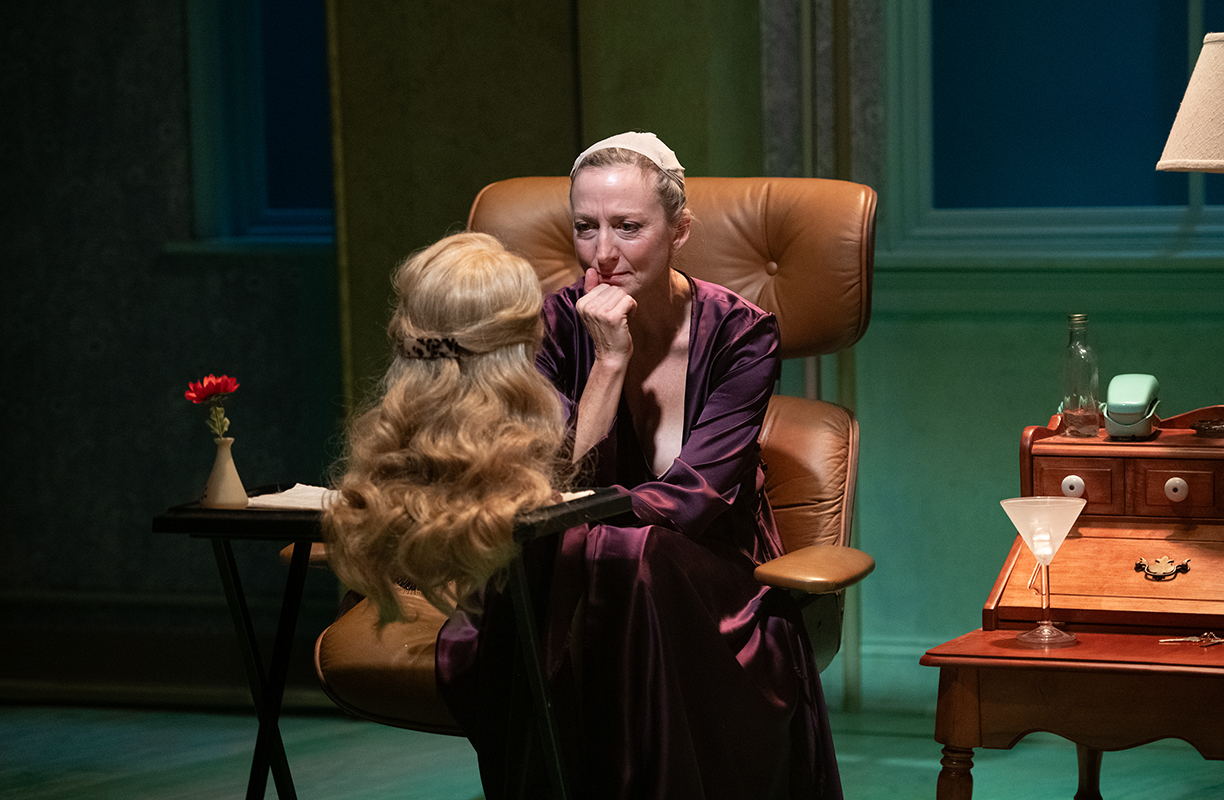
A Case for the Existence of God – Photo: Chris Banks
MW:The awkwardness around their physical contact, also a part of it is — and it’s not something that’s stated explicitly in the play — that it’s an American male thing. I won’t say exclusively. But my husband’s Argentinian. They have no trouble showing physical affection, straight men, straight women, in general. I think there are lots of cultures where you can see that. American men — a straight guy and a gay guy — are going to have the awkwardness that we see in this play.
GAMBINI: I can tell you, I’m Brazilian. I remember the first time that I was faced with this, it was also in school, and I hug people, and then I know that Americans like to say, “I’m a hugger,” and you kind of have this disclaimer, which for me feels crazy that you have to disclaim, because then, “Oh, okay, you’re a hugger.” And for me, a hug and a kiss on the cheek is independent of gender.
I remember this one friend of mine in school. After a year or so of us knowing each other, he was like, “You’re very flirty.” And I’m like, “What?” He was like, “You’re always hugging and kissing.” And I was like, “Oh, oh, wait, what? No, I actually never flirted with anyone here, really.” And I actually kind of had to rationalize it. It was like, “Oh no. So, how I’m behaving, which I never gave it a second thought, could be perceived as me being flirty or hitting on people.” It was clearly being perceived like that, at least to one person. Then it kind of sent me on a spiral of like, “Oh, my God, I need to change my behavior.” Like the whole assimilation thing. And then I decided, “Actually, I’m not going to do it.” Because this feels an essential part of how I exist and how I relate to people.
So I decided at that point — I wouldn’t say that it was that day, because it took me a while — to be like, “I’m going to continue doing this, and at some point people will perceive that this is how to relate to me.” And some people actually do not want that, but at some point, I feel people get to know me enough to appreciate that this is how I show my connection, how I show that I like the person, that I’m friends with the person, and I establish these relationships myself. Again, and for me, I really like that I create my own intimacy with the people that I love and the people that I care about.
MW:You must have had notions or a vision of what the United States would be like before you got here. And maybe it’s changed some in the eight years since. Has the America you’ve experienced changed much from the America you envisioned before you got here?
GAMBINI: Yeah. I have to think back to what I envisioned. My move here was very professional. It was for me to establish myself professionally as a working theater director that could make a life of just directing. So, it was more based on career sustainability and being able to achieve professional creative goals rather than an idealistic vision of what this country is.
I was not escaping anything from Brazil. I had a great life with a beautiful family and friends and situation. What I will say is, when I was about to move here, I have a friend who was living in Houston, and he said, “Just be prepared, because you will never feel fully American, and you will never feel fully Brazilian again.” And this is very true, because the Brazil that I really know doesn’t exist anymore. And I still feel like being Brazilian plays an important part in my relationships in America. So, it’s interesting, because you’re always framed as other, so you are other. So always in relationships there is this framing that comes from my name, and people sometimes being able to pronounce my name, sometimes not. And this is — not that I get hurt by it — almost always like a reminder of I’m not from here. When I go to Brazil, I don’t need to sort of clearly enunciate my name and spell it. I just say my name, and people are, “Great.” It’s different, there’s a different feeling of just, of plain belonging.
What I can say of the United States, of course, on all the complicated tumultuous times that we are [experiencing] politically and all the persecutions that a lot of people are experiencing — what I have experienced is that I have met so many wonderful people, and I have met so many generous, creative, empathetic people that actually make my America worth it. I will say, everywhere is made of everything. You will find horrible people and you will find wonderful people. You will find horrible and wonderful people in Brazil and here, and in theater, and in I think every industry.
I make it a point for myself to attach myself to the people that I find wonderful. And again, so many people have been so incredible and so generous and so creative and challenging in beautiful ways and helped me grow and grew with me, and I possibly helped some people succeed too. So, this is, for me, what’s exciting, and I’m glad that it’s happening in America.
MW:At what point in this journey, between nations, between schools, between stages, at what point did you come out, personally and professionally?
GAMBINI: I was in college, I was in film school, I was around 20 years old. I think my class, actually, we were all sort of discovering things together. This was around 2004, 2005. And really when I decided to come out was after a backpack through Europe. I went 45 days backpacking through Europe with friends, but mostly by myself. And towards the very end of the trip I saw Brokeback Mountain in Italy, in Rome, and that kind of kicked me out of the closet, that movie.
The whole actual thing is because of Michelle Williams, because one of the ways that I learned English was watching series — mainly Friends, Charmed, and Dawson’s Creek. I have a very intense relationship with Dawson’s Creek because Dawson also wanted to be a filmmaker. And Michelle Williams was in that series. And in the last episode, spoiler alert, she dies of cancer. I had this whole relationship with Michelle Williams, but also in Dawson’s Creek in the very last episode is the very first gay couple that end together happily that I’ve ever seen in fiction myself. And that really threw me for a loop. So, those two things were really tied into my subconscious, like Jen — I mean Michelle Williams’ character — and the gay couple, they’re both very hot and handsome.
Then, somewhere also in my subconscious was a decision that I had made that I would have a wife and have male lovers on the side. My teenager brain trying to come to terms with my sexuality. And then again, I had gone to film school. I had met the first friends of mine who were gay, who were out, who were coming out. So, of course, at that time, early 2000s, it was not really common, or at least not where I came from, to come out as a teenager in high school. It was mostly in college. That was the first time I was like, oh, that I had friends who were out, which I didn’t have until that point. Then I think I started to allow myself to think like that.
But when I saw Brokeback Mountain and I saw Heath Ledger doing to Michelle Williams what I had subconsciously decided to do myself, I was like, “Oh, I cannot do that. I cannot do that.” Then at the very end that he says, “I promise,” and he doesn’t have anything to promise, is the last line of the movie. And that was like, “Oh God, this is not good.” So after that, I decided to come back to Brazil and just come out to my friends. And then it really has never been an issue ever since. Even in the beginning of my career as an actor I was always out, and as a director always. And then again, after that it was never something that I gave any other thought.
MW:So, here’s your last question then, and it goes back to the subject of being a workaholic or not being a workaholic. I think you work like you’re a man on a mission. What is your mission?
GAMBINI: Okay, I have another story for you. Here’s another anecdote. The first play that I ever did was RENT. I was in film school. I had directed my first short film. I didn’t know how to talk to actors. I decided that I needed to become an actor myself, and I went to this musical theater conservatory in this summer program that was RENT, and it really shifted me, it shifted my molecules. It was a very special production for all of us involved, but it really gave me a sense of community, a sense of there were these amazing young people, the original production of RENT, that they were doing something important and impactful, really talking about something that was happening in New York at that time. But also expanding to all of these people who were dealing or had dealt with HIV and all of the things that came with it. And also for me, it was like, “Oh, there is a power in theater,” which is the presence of being together in a room with each other onstage and with the audience that really feels like, “Oh, this is sort of what life is about, is just to be together.”
I always say this: if music is the art of sounds, and dance is the art of movement, and painting is the art of colors, then theater is the art of togetherness. I think this room was like, “Oh, I want this. This is really what I want.” And ever since, this was when I was 19, I’ve been searching for places to just be together, to just create these experiences of togetherness.
If I have a mission, my hope still is that I am able to be part of a community that creates something as powerful as RENT was. I think if I have a mission, it’s trying to find my way into creating a piece of theater that has as broad an impact as RENT had. For example, RENT happened in New York and it had this impact on this closeted queer kid in the suburbs of São Paulo and Brazil. So, this is what I want to do.
MW:I wish you the best with that, and I want to be in the room where that happens. You’re not necessarily attached to any institution here in D.C. right now. Are you hoping to continue working in the theater scene here?
GAMBINI: I will go wherever people invite me to come. This is the thing, it’s like whatever rooms invite me to be a leader — which is the director, or a collaborator — I will be there.
A Case for the Existence of God runs through Dec. 7 at the Atlas Performing Arts Center, 1333 H St. NE. Tickets are $42 to $70, with economy ticket options for each performance. Call 202-399-7993, ext. 2 or visit www.mosaictheater.org.
Years ago, on a plane, I met a woman who mentioned she was the mother of three gay sons. She sounded well-adjusted to this fact of her life, and spoke lovingly of all her children, all grown.
Without her mentioning it, I understood that, however well she may have accepted or adjusted to her gay kids, at some point, somebody else, relatives or strangers, probably believed she had some explaining to do. They probably blamed her, for something, because she's the mother.
Paula Vogel's eloquent The Mother Play: A Play in Five Evictions, now at Studio Theatre, evokes memories of that well-adjusted mom with its incisive depiction of a sorely maladjusted mother of two queer siblings, who have to spend their lives adjusting to their mama's sundry moods and episodes.
These are challenging times for news organizations. And yet it’s crucial we stay active and provide vital resources and information to both our local readers and the world. So won’t you please take a moment and consider supporting Metro Weekly with a membership? For as little as $5 a month, you can help ensure Metro Weekly magazine and MetroWeekly.com remain free, viable resources as we provide the best, most diverse, culturally-resonant LGBTQ coverage in both the D.C. region and around the world. Memberships come with exclusive perks and discounts, your own personal digital delivery of each week’s magazine (and an archive), access to our Member's Lounge when it launches this fall, and exclusive members-only items like Metro Weekly Membership Mugs and Tote Bags! Check out all our membership levels here and please join us today!





You must be logged in to post a comment.