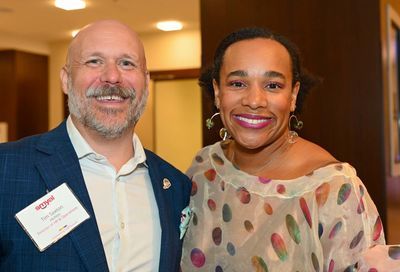
Claire Green (left) is featured in “Young, Trans and Looking for Love” — Image via Barcroft TV/BBC 3
Claire Green is moving from Virginia’s gorgeous Blue Ridge mountains to Richmond, the state capital, because she wants to “make a future for myself…move on from the past.”
Green is a transgender YouTuber who has posted a number of videos about her transitional experience. This week, she’s making a much bigger public splash in a new Barcroft/BBC documentary, Young, Trans and Looking for Love. A teaser shows Claire with her friend Zoe, donning a bikini at the beach and meeting a couple of guys. The young men are initially interested, but then treat the women with “silence” after their transgender status is revealed.
“In a lot of ways,” Green says, “I don’t like telling a guy, because, once I tell him, it’s like, all respect goes out the window. Straight guys just can’t get over you having the male…parts.” Metro UK quotes Green as saying she’s “never had an actual relationship.”
Green has legally changed her name and had hormone and laser hair treatments. However, she is now bothered by unpleasant encounters with people in her home community. “Someone yelled across the [gas station] parking lot, ‘Yo, like that’s a dude….’ And it’s just situations like that, that I run into, because people know me,” she added.
High school acquaintances, for example, have a difficult time addressing Claire as the woman she is now, rather than the male classmate they grew up with. “[I] run into so many people who are like — automatically, if I haven’t seen them for a while — ‘Hi, Dylan…’ or ‘he, him….’ And I will have to put them in their place.”
Claire recognizes that others may experience difficulty in changing their language, but she is hurt by their mistakes. It makes her feel as though all the work she has undertaken to transition has been undone by other people’s feelings of awkwardness or laziness.
“I understand that we knew each other for so long. And you knew me as this way before, for so long,” she says. “But I feel like, out of respect — because trans people go through so much — that that is the one thing you should do for a trans person: Call them by the right pronouns. Call them by the name they chose.”
Young, Trans and Looking for Love begins airing on BBC3 at 9pm, Monday, November 23, 2015. The program will also features Arin Andrews and Katie Rain Hill, two transgender teenagers, who previously shared their story of love on 20/20.
Justine Lindsay, the NFL's first out transgender cheerleader, recently revealed that she was fired this year, a decision she alleges was motivated by transphobia and Donald Trump's election as president.
"I was cut because I'm trans," Lindsay said in an Instagram Live with Gaye Magazine. "I don't wanna hear nobody saying, 'She didn't wanna come back.' Why the hell would I not wanna come back to an organization that I've been a part of for three years? That makes no sense to me. So I was cut. I was devastated. It stung. I was hurt."
Lindsay, who made history as the NFL's first transgender cheerleader when she tried out and made the Carolina Panthers's TopCats squad in 2022, told the magazine that her teammates "know the truth" about the decision to cut her from the squad.
Lucien Bates, a transgender man, says security guards threatened to arrest him after he used the women’s restroom at a Round1 arcade inside the North Riverside Park Mall in suburban Chicago. Bates, an Indiana resident, was visiting the venue on September 28 with his fiancé and a friend to play Dance Dance Revolution.
Bates, who presents as alt-masculine with facial hair and piercings, had just arrived at the arcade when he needed to use the restroom. He chose the women’s restroom, a decision he often makes in public because he feels safer there and is less likely to be harassed.
Ahead of Transgender Day of Remembrance on Thursday, November 20, Advocates for Trans Equality, a national organization, released a report honoring the 58 known transgender people who have died in the United States over the past year.
First held in 1999, Transgender Day of Remembrance was initially intended to mourn those transgender people lost to violence. The first organizers memorialized Rita Hester, killed in November 1998 in Boston, and Chanelle Pickett, murdered in November 1995 in Watertown, Mass.
Since that first memorial service, cities and regions throughout the world have adopted November 20 as a day to commemorate transgender and nonbinary individuals who have died -- whether due to murder, suicide, or natural causes.
These are challenging times for news organizations. And yet it’s crucial we stay active and provide vital resources and information to both our local readers and the world. So won’t you please take a moment and consider supporting Metro Weekly with a membership? For as little as $5 a month, you can help ensure Metro Weekly magazine and MetroWeekly.com remain free, viable resources as we provide the best, most diverse, culturally-resonant LGBTQ coverage in both the D.C. region and around the world. Memberships come with exclusive perks and discounts, your own personal digital delivery of each week’s magazine (and an archive), access to our Member's Lounge when it launches this fall, and exclusive members-only items like Metro Weekly Membership Mugs and Tote Bags! Check out all our membership levels here and please join us today!
You must be logged in to post a comment.