
WATCH: Barack Obama gives transgender activist message of hope at town hall
Former President was in New Delhi to give a talk on activism

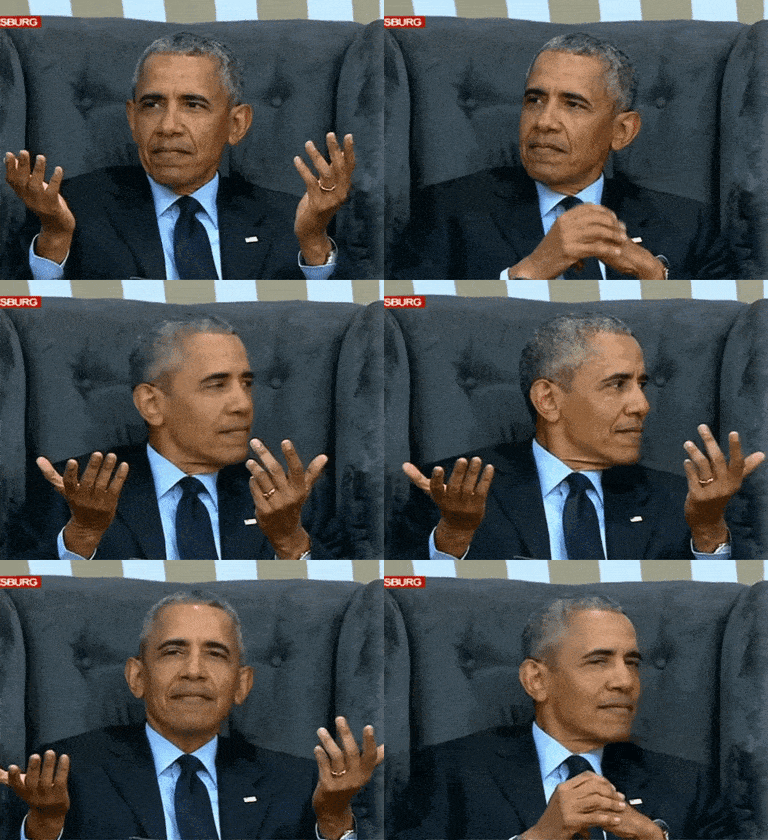
Former President Barack Obama has given a transgender activist in India an inspiring message of hope, after she asked him how she could find acceptance for her gender identity.
Last week, Obama hosted a town hall-style meeting in New Delhi, India, part of an Obama Foundation talk about activism and being an active citizen.
Akkai Padmashali asked Obama how she could find acceptance after facing discrimination and stigma.
“I was a sex worker, I was a beggar, I was rejected by all sections of society,” she said, before asking Obama, “How can I speak up in front of a society when I am a criminal under Section 377, which criminalizes you as a transgender, gay, lesbian, or bisexual? How do I raise [my] voice against this?”
Obama responded by telling Padmashali that she had already taken the first step by speaking out about it.
“It begins with what you just did,” Obama said, “which is to find your voice and to be able to articulate your views and your experiences and tell your story. And that’s true of any group that is marginalized, stigmatized. Finding that voice and being able to tell a story so that the perceptions that somehow you are different are broken down, because people start recognizing their own experiences in you — they see your humanity.”
Obama told Padmashali that by sharing her experiences, Padmashali could motivate others to do the same.
“Once that voice is there, hopefully others join you. And so now you have networks and organizations and allies,” Obama said.
He noted that it can be easy to become discouraged by incremental change, but that activists should take “some measure of hope” by looking at the advancement of LGBTQ rights in the United States and other countries.
“When I was in college, this would be back in the early ’80s, it was just beginning for persons who were openly gay or lesbian to have student organizations,” he said. “The laws on the books were still discriminatory across many states in the United States. Now there is just an open acknowledgement, even among many conservative parties, that we should not be discriminating agaisnt persons because of sexual orientation.
“And that happened, with respect to human history, amazingly quickly,” he continued. “In the span of 20 years basically. Now, in the span of one person’s lifetime, that can seem painfully long, but it requires a steady education of the public, and then a political strategy that puts pressure on elected officials. And that’s going to take some time.”

Padmashali, whose organization Ondede focuses on awareness of LGBTQ rights and people, told India’s The News Minute prior to the event that she wanted to use her opportunity to focus on the LGBTQ community.
She also noted the difference between Obama’s presidency and that of his successor, who has made attacking LGBTQ rights a core part of his first year in office.
“In the present situation in India and the United States, we don’t see an enabled environment where people have the right to expression, right to identity, right to privacy, all the fundamental, civil and human rights guaranteed to us,” she said. “We are not following that now.”
More from Metro Weekly:





Support Metro Weekly’s Journalism
These are challenging times for news organizations. And yet it’s crucial we stay active and provide vital resources and information to both our local readers and the world. So won’t you please take a moment and consider supporting Metro Weekly with a membership? For as little as $5 a month, you can help ensure Metro Weekly magazine and MetroWeekly.com remain free, viable resources as we provide the best, most diverse, culturally-resonant LGBTQ coverage in both the D.C. region and around the world. Memberships come with exclusive perks and discounts, your own personal digital delivery of each week’s magazine (and an archive), access to our Member's Lounge when it launches this fall, and exclusive members-only items like Metro Weekly Membership Mugs and Tote Bags! Check out all our membership levels here and please join us today!


You must be logged in to post a comment.