Three transgender women have filed a civil suit challenging a Texas law that prohibits current and former transgender federal prison inmates from legally changing their names to match their gender identity.
The lawsuit takes issue with a provision within the state’s Family Code that prohibits a name change within two years of a person’s discharge from prison, community supervision, or parole. During that time, any formerly incarcerated person must be referred to by their “deadname,” or the one assigned to them at birth — even if they otherwise fully transition.
The challenge to the law, which names Texas Gov. Greg Abbott and Attorney General Ken Paxton as defendants, alleges that it is not only discriminatory, but carries potentially bad ramifications for transgender individuals, including an increased risk of depression, increased feelings of gender dysphoria, and harassment at the hands of other inmates — who are often egged on or encouraged by prison officials’ refusal to acknowledge an inmate’s gender identity.
The suit also challenges the law’s application to anyone confined to a state-run facility who wishes to change their name, reports The Austin American-Statesman.
Abbott and Paxton’s offices have thus far declined to comment on the lawsuit.
According to the Trans Pride Initiative, Texas is among 10 states that restrict name changes based on a person’s conviction history.
While the Federal Bureau of Prisons released protocol in 2017 that outline provisions for changing transgender inmates’ names, name changes fall under the purview of state officials. As such, inmates in Texas are barred from having their name reflect their gender identity, while those in other states, like Connecticut, are allowed to legally change their names, without incident.
Each of the three plaintiffs in the case claims that they have been harmed or will be harmed by this restriction in the future.
Donna Langan, who is serving life without the possibility of parole in a federal facility in Carswell, argues that she has been unfairly barred from changing her name, even though the federal Bureau of Prisons acknowledges that she is transgender, keeps her housed in a women’s facility, and provides her with hormones to assist in her transition.
Teresa De Barbarac, an inmate at Federal Correctional Institution, Texarkana, who transitioned prior to her incarceration, alleges that she almost died because of the discrepancy between her name and her gender presentation after emergency medical technicians refused to touch her or assist her after realizing she was transgender.
Alexandra Carson, a former inmate who was recently released, says she is barred from changing her name until 2025 — two years after her parole ends. Unfortunately, in the meantime, because she cannot legally change her name or the gender marker on her official state ID and other documents, it makes it more difficult to maintain housing or a job without outing herself as transgender.
The incongruence between Carson’s official name and her gender identity also opens her up to fraud accusations from bank tellers, police officers and landlords, further complicating her ability to go about her daily life, reports the Texarkana Gazette.
According to the 2015 U.S. Trans Survey, 32% of transgender individuals with documentation not matching their gender identity reported that they had been verbally attacked, physically assaulted, or denied services and benefits for which they were otherwise eligible.
Brian McGiverin, an Austin civil rights attorney representing the women, has filed a petition with the U.S. District Court for the Western District of Texas asked U.S. District Judge Robert Pitman to strike down the 1995 act as unconstitutional, as it violates his clients’ Eight Amendment right to be free from “cruel and unusual punishment.”
In his brief, McGiverin compared the harmful psychological effects of being unable to obtain a name change with being placed in solitary confinement, writing: “Being misnamed and misgendered is a kind of intense gas-lighting that amounts to psychological torture.”
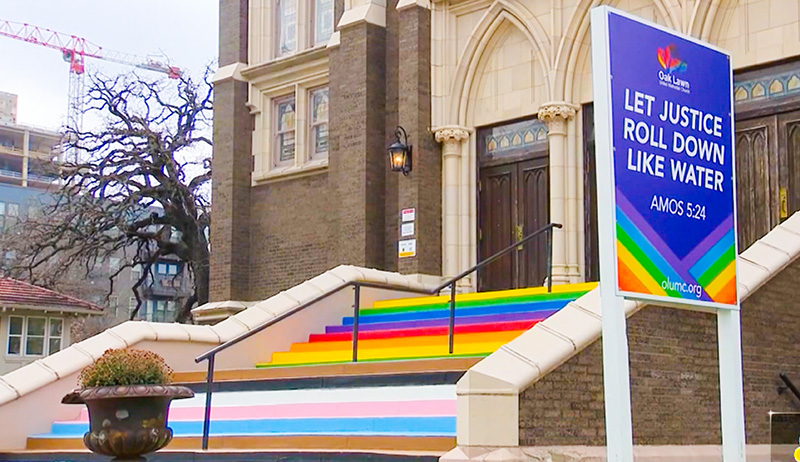
The Dallas Landmark Commission unanimously approved rainbow-colored steps outside Oak Lawn United Methodist Church as a temporary art installation, allowing the display to remain for up to three years despite objections that they violate historic preservation codes.
As a designated historic site, Oak Lawn United Methodist Church is required to seek city approval before making major exterior changes, including paint colors, according to Dallas-area PBS/NPR affiliate KERA.
The LGBTQ-welcoming church did not submit an application to the landmark commission before repainting its exterior steps in the colors of the "Progress Pride" flag, incorporating the traditional rainbow along with black and brown stripes and the blue, pink, and white of the transgender Pride flag.
A transgender woman has filed a lawsuit against hotel giant Hilton, alleging that she was assaulted by a security guard at the Hilton Dallas Lincoln Centre while she was a registered guest.
According to the complaint, filed in the 192nd Civil District Court in Dallas County, Kimberly Barnett, an Afro-Latina transgender woman from Nebraska, was staying at the hotel in late June while attending Dallas Pride Weekend and other LGBTQ events.
Barnett returned to the Hilton Dallas Lincoln Centre around 3:45 a.m. on June 24 and attempted to "valet her vehicle," according to the lawsuit.
In late November, the University of Oklahoma placed Mel Curth on administrative leave after the transgender graduate teaching assistant gave a student a zero on an essay about gender roles.
The essay cited the Bible to defend traditional gender roles and described transgender people as "demonic." Curth and the course's instructor, Megan Waldron, said the paper failed to meet basic academic standards due to a lack of empirical evidence. Both noted that the paper cited no scholarly sources and failed to offer an evidence-based critique of the assigned article, which argued that children who do not conform to rigid gender stereotypes are more likely to face bullying and negative mental health outcomes.
These are challenging times for news organizations. And yet it’s crucial we stay active and provide vital resources and information to both our local readers and the world. So won’t you please take a moment and consider supporting Metro Weekly with a membership? For as little as $5 a month, you can help ensure Metro Weekly magazine and MetroWeekly.com remain free, viable resources as we provide the best, most diverse, culturally-resonant LGBTQ coverage in both the D.C. region and around the world. Memberships come with exclusive perks and discounts, your own personal digital delivery of each week’s magazine (and an archive), access to our Member's Lounge when it launches this fall, and exclusive members-only items like Metro Weekly Membership Mugs and Tote Bags! Check out all our membership levels here and please join us today!









You must be logged in to post a comment.