A Republican state lawmaker in Alabama has been accused of liking a transgender adult performer’s tweet, just a week after voting in favor of a bill to make it a felony for transgender youth under age 19 to receive gender-affirming health care.
Alabama State Sen. Tom Whatley (R-Auburn) allegedly liked an explicit tweet by a Philadelphia-based performer known as “Bambi Blonde” or “Baphomet Barbie,” with the Twitter handle @bblgumbaphomet, whose profile name is listed as “Bambi Hardcore TG 18+,” and describes themself as an “enbi [nonbinary] trans girl faerie princess.” Their Twitter feed includes a host of short “teaser” videos showing transgender women engaged in sexual acts.
According to LGBTQ Nation, Bambi posted a nude picture of their chest with the caption: “Love my new, fat, G-cup tiddies.”
Whatley’s official Twitter account showed up in the list of Twitter users who had “liked” the post, according to a screenshot obtained by the LGBTQ website.
Bambi later tweeted another photo with a caption, in apparent reference to the controversy, reading: “US Senator (sic) approved tiddies and dick.”
LGBTQ Nation claims it asked Whatley why he liked the tweet. He did not respond, but un-liked the tweet in question.
The fact that Whatley — or someone operating his work Twitter account — was allegedly looking at an explicit adult-themed Twitter page on government time may raise some eyebrows in the state, especially since Whatley was one of 23 Republican lawmakers to vote for SB 10, the Senate version of a bill to bar trans youth from receiving gender-affirming care.
The bill would make it a felony — punishable by up to 10 years in prison and a $15,000 fine — for doctors to prescribe puberty blockers or hormones, or recommend gender confirmation surgery (which, in practice, rarely occurs before a person is 18 and considered a legal adult), one any person under age 19.
The Senate bill has since been sent to the House of Representatives, which passed HB 1, its own version of the ban on transition-related care. If the House approves the Senate bill, or the bill goes to conference and gets approved by each chamber, it would then head to Gov. Kay Ivey (R) for her signature into law.
If signed into law, Alabama would become the first state in recent years to explicitly ban access to transgender health care such as puberty blockers, and the only state to ban legal adults (18-year-olds are considered adults, capable of voting, serving in the military, and making other legal decisions, under American law) from accessing medical treatments, even if hormones or surgery are recommended to treat their gender dysphoria.
The bill also contains provisions that would force school officials to “out” transgender students to their parents if a teacher or administrator believes a student is struggling with their gender identity or objects to a student’s failure to conform to gender norms or behaves contrary to traditional gender-based stereotypes.
The Senate version also prevents therapists from providing “talk therapy” to discuss a youth’s feelings of gender dysphoria, while the House version seeks to create an exemption for therapists.
“We don’t want [therapists] affirming that ‘Hey, yeah, you’re right, you should be a boy if you are a born a female,'” Sen. Shay Shelnutt (R-Trussville), the lead sponsor of the bill, said during debate.
Whatley was the senator who had offered an amendment, similar to provisions in the House bill, to exempt counselors from being prosecuted under the law, but when that amendment was defeated, he voted in favor of the bill.
Even though the Senate and House bills condemn puberty blockers as “dangerous and uncontrolled medical experimentation” that can cause “irreversible consequences,” one study from last year showed that transgender youth who receive the drugs — which delay the onset of puberty until a person can determine whether they wish to undergo a gender transition — are at reduced risk of suicidal ideation compared to youth that do not receive puberty blockers.
A New Jersey school district has agreed to pay $950,000 to settle a wrongful death lawsuit filed by the mother of a transgender student who died by suicide after allegedly enduring years of bullying and harassment.
Danielle Warshefski will receive $603,664.78, while the law firm that represented her will receive the remainder to cover legal costs and attorneys' fees.
According to the lawsuit, Warshefski's son, Myles Fitzpatrick, came out as transgender in December 2020, while Manville High School was holding classes virtually due to the COVID-19 pandemic.
The U.S. House of Representatives rejected an amendment to the National Defense Authorization Act, the annual defense policy bill, that would have barred transgender people from serving in the military.
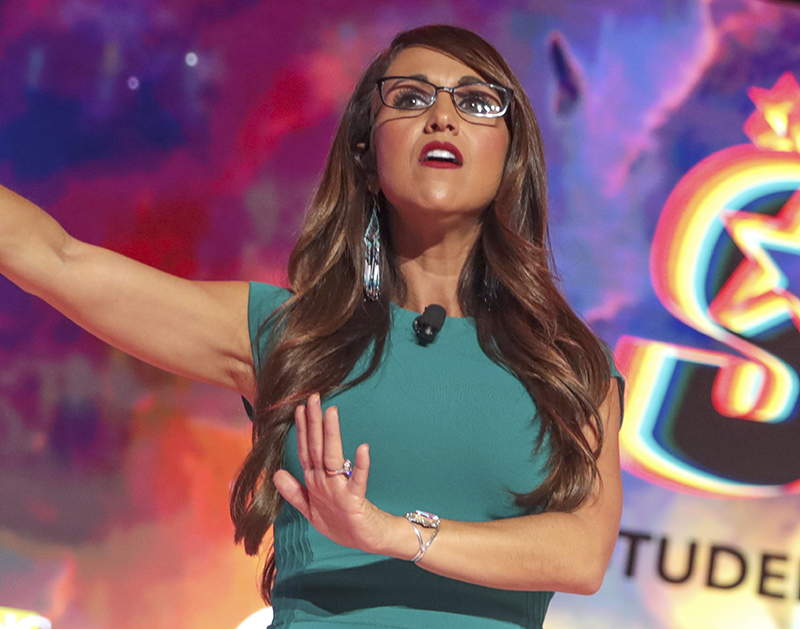
Introduced by U.S. Rep. Lauren Boebert (R-Colo.), the amendment sought to codify President Trump's executive order barring transgender people from enlisting and requiring the discharge of active-duty transgender service members.
Trump's executive order, issued in January 2025, claims that the "medical, surgical, and mental health constraints" associated with gender dysphoria, including time away from duty for treatment, are incompatible with military readiness. It also asserts that using pronouns that do not reflect a person's assigned sex at birth conflicts with military values and hinders unit cohesion.
Republicans in Congress have added six anti-LGBTQ riders to the annual State Department funding bill for fiscal year 2027.
Democrats have denounced the riders as "poison pills" that could jeopardize the bill's passage and unfairly target LGBTQ people.
"None of these riders make our world any safer," U.S. Rep. Mark Takano (D-Calif.), chair of the Congressional Equality Caucus, said in a statement. "It's beyond shameful that the Republican majority has again tainted this vitally important bill with these poison pill riders."
These are challenging times for news organizations. And yet it’s crucial we stay active and provide vital resources and information to both our local readers and the world. So won’t you please take a moment and consider supporting Metro Weekly with a membership? For as little as $5 a month, you can help ensure Metro Weekly magazine and MetroWeekly.com remain free, viable resources as we provide the best, most diverse, culturally-resonant LGBTQ coverage in both the D.C. region and around the world. Memberships come with exclusive perks and discounts, your own personal digital delivery of each week’s magazine (and an archive), access to our Member's Lounge when it launches this fall, and exclusive members-only items like Metro Weekly Membership Mugs and Tote Bags! Check out all our membership levels here and please join us today!








You must be logged in to post a comment.