“Justice” – Photo: Nejron, via Dreamstime. Altered by Todd Franson.
A federal judge has dismissed a lawsuit challenging a Florida “parental rights” law restricting instruction on LGBTQ issues in schools, which opponents have dubbed the “Don’t Say Gay” law.
U.S. District Judge Allen Winsor, of the Northern District of Florida, a Trump appointee, has issued a 25-page order dismissing the case, finding that the plaintiffs in the case — which include parents, current and former students, teachers, and LGBTQ groups Equality Florida and Family Equality — did not show they had legal standing to sue.
However, he said the plaintiffs can file a revised lawsuit by Oct. 13 seeking to block the law if they better address their standing and how the enforcement of the law harms them, reports WUSF Public Media.
The law, signed into law by Gov. Ron DeSantis after being passed by Florida’s Republican-controlled Legislature, prohibits instruction on sexual orientation and gender identity in kindergarten through third grade and requires that such instructions be “age-appropriate” or “developmentally appropriate” in older grades.
But opponents of the law claim the law is rife with opportunities for teachers and administrators to discriminate against LGBTQ students and children of same-sex parents in order to avoid offending conservative parents, who are empowered to sue for alleged violations of the law.
In the lawsuit, first filed in March and amended in May, the plaintiffs claimed that the law violates their First Amendment and due process rights. They claim that, in order to comply with the law, teachers will restrict students’ free speech rights, ban LGBTQ-related books from libraries or classrooms, and prohibit student-run LGBTQ clubs, such as Gender and Sexuality Alliances from either forming or from receiving equal access to resources as other student clubs.
For example, Zander Moricz, a plaintiff and 18-year-old former senior class president at Pine View School in Osprey, Florida, said he was told by teachers that he would be restricted from discussing LGBTQ rights in class — even before the law officially went into effect.
For example, when he was slated to address his class at his graduation ceremony, Moricz clams administrators told him they would cut his microphone if he dared to talk about his activism on behalf of LGBTQ rights. So Moricz gave a graduation speech using the euphemism “curly hair” as a stand-in for the term “gay.”
Another plaintiff, known as “M.A.,” from Palmetto, Florida, claims administrators have sought to block him from establishing a GSA at his school, using the “Don’t Say Gay” law as justification.
In their amended complaint, the plaintiffs’ lawyers argued that the measure is unconstitutional, discriminatory and “clearly the produce of animus towards Florida’s LGBTQ community.” The lawsuit named DeSantis, the State Board of Education, the Florida Department of Education, Education Commissioner Manny Diaz, Jr., and seven country school boards.
“[The ‘Don’t Say Gay’ law] piles one [constitutional] violation on top of another,” lawyers for the plaintiffs wrote. “It offends principles of free speech and equal protection by seeking to censor discussions of sexual orientation or gender identity that recognize and respect LGBTQ people and their families. It offends due process by using broad and vague terms to define its prohibitions — thus inviting discriminatory enforcement and magnifying its chilling effect on speech. And it arises from discriminatory purposes and outdated sex-based stereotypes that offend deeply rooted constitutional and statutory requirements.”
But lawyers representing the state argued, in June, the the plaintiffs did not have legal standing and had not demonstrated that the Legislature “acted out of animus” toward LGBTQ people.
“The bill reflects no governmental preference about what students should learn about sexual orientation and gender identity,” they wrote. “Those subjects must be taught appropriately, and, for the youngest children, they may be taught by parents, not in public-school classroom settings. That is a legitimate [state] interest.”
While Winsor did not rule on the constitutionality of the law, he did side with the state’s lawyers in ruling the plaintiffs lacked standing.
“The principal problem is that most of plaintiffs’ alleged harm is not plausibly tied to the law’s enforcement so much as the law’s very existence,” Winsor wrote in his opinion. “Plaintiffs contend the law’s passage, the sentiment behind it, the legislators’ motivation, and the message the law conveys all cause them harm. But no injunction can unwind any of that.”
For example, he noted that violations of the law would be enforced against school districts, not individual teachers.
“With or without the law, school districts direct teachers as to what they may and may not teach,” the judge wrote. “Plaintiffs do not allege otherwise; they do not assert, for example, that Florida’s public-school teachers may teach whatever lessons they wish. So to the extent plaintiffs allege that some teachers or others wish to provide ‘classroom instruction . . . on sexual orientation or gender identity’ to students ‘in kindergarten through grade 3,’ they would have to show (at a minimum) that without the law their individual school district would allow it. Yet plaintiffs offer no specific allegation that any teacher would be providing such classroom instruction absent HB 1577.”
A second lawsuit challenging the law was filed in July in U.S. District Court for the Middle District of Florida against four school boards on behalf of same-sex and heterosexual couples and their children, Will Larkins, an gay and nonbinary rising senior at Winter Park High School in Orange County, Florida; and Centerlink, Inc., an organization that supports local LGBTQ groups and community centers.
That lawsuit alleges that the law restricts the plaintiffs’ right to free speech and expression under the First Amendment to the U.S. Constitution, and deprives them of their rights to due process and equal protection under the Fourteenth Amendment. The four school districts are required to submit their response to the charges against them by Oct. 18.
For the first time in Salt Lake City’s history, a majority of the seven-member council is made up of out LGBTQ members, following last year’s municipal elections that produced a notably diverse governing body.
Erika Carlsen, a gay Latina, was elected to represent District 5, which includes Ballpark, Central Ninth, East Liberty Park, and Liberty Wells. Voters also reelected District 3’s Chris Wharton, who represents Capitol Hill, the Avenues, and City Creek Canyon.
Other LGBTQ members include Alejandro Puy, a gay Latino who represents District 2, which includes parts of downtown as well as Fairpark, Poplar Grove, and Glendale, and Eva Lopez Chavez, a gay Latina and the first Mexican American elected to the council, who represents District 4, covering parts of downtown, Central City, and East Central.
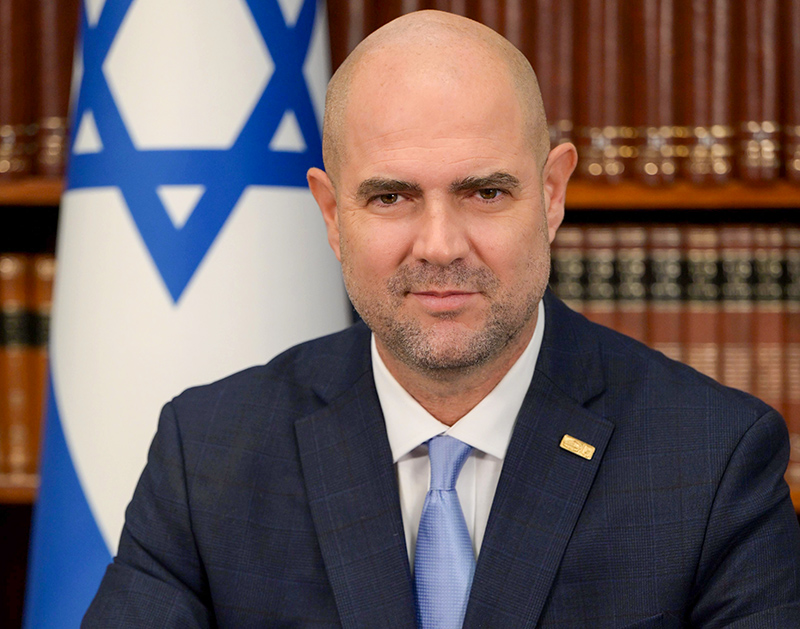
Knesset Speaker Amir Ohana, the first out gay leader of the Israeli parliament, angered the ultra-Orthodox parties within the conservative Likud-led governing coalition after voting in favor of a civil marriage bill last week.
The proposed bill, which was ultimately defeated, was introduced by the centrist Yesh Atid party, the largest faction in the opposition. It would have established a legal framework for regulating same-sex partnerships in Israel, including a couples registry, eligibility requirements, registration procedures, and mechanisms for dissolving civil marriages.
The federal lawsuit alleges Chelsea Zahn was denied over $50,000 in commissions by team owner Art Rooney II after she complained about systemic pay disparity.
Chelsea Zahn, a gay woman who served as a corporate sales manager for the Pittsburgh Steelers, has filed a lawsuit against the team, alleging she was underpaid compared to male colleagues and targeted for discrimination based on her gender and sexual orientation.
The 6-count lawsuit, Zahn v. Pittsburgh Steelers LLC, was filed in the U.S. District Court for the Western District of Pennsylvania on January 13. It alleges the Steelers organization created a hostile work environment after learning Zahn is gay and that team owner Arthur J. Rooney II specifically denied her more than $50,000 in commissions owed for 2024.
These are challenging times for news organizations. And yet it’s crucial we stay active and provide vital resources and information to both our local readers and the world. So won’t you please take a moment and consider supporting Metro Weekly with a membership? For as little as $5 a month, you can help ensure Metro Weekly magazine and MetroWeekly.com remain free, viable resources as we provide the best, most diverse, culturally-resonant LGBTQ coverage in both the D.C. region and around the world. Memberships come with exclusive perks and discounts, your own personal digital delivery of each week’s magazine (and an archive), access to our Member's Lounge when it launches this fall, and exclusive members-only items like Metro Weekly Membership Mugs and Tote Bags! Check out all our membership levels here and please join us today!









You must be logged in to post a comment.