Russian police raided several LGBTQ venues in Moscow following a recent ruling by the country’s Supreme Court deeming the “global LGBTQ+ movement” as an extremist organization.
On the evening of December 1, police entered the venues — including a nightclub, a male sauna, and a bar that hosted LGBTQ parties — and demanded documents of those inside.
They then photographed the documents as evidence.
According to the Associated Press, police entered the venues under the guise of cracking down on illicit drugs.
In response, other LGBTQ venues in the country announced their closure over fears of continued raids.
The St. Petersburg-based gay club Central Station wrote on its social media that its owner would no longer allow the bar to operate since the ruling, which now gives law enforcement license to persecute — and potentially prosecute — any organizations that support LGBTQ rights.
Under Russian law, participating in or financing any organization deemed “extremist” by the government is punishable by up to 12 years in prison.
Any person found displaying an extremist group’s symbols or banner can face up to 15 days in prison for the first offense, and up to four years in prison for repeat offenses. The government may also place individuals suspected of involvement with such organizations on a list and freeze their bank accounts.
The Supreme Court’s ruling came in response to a lawsuit filed by the country’s Justice Ministry, which asked the court to outlaw the LGBTQ “international public movement” as extremist, alleging LGBTQ-related organizations have been engaged in “incitement of social and religious discord.”
Activists have noted that the lawsuit was lodged against a movement that is not an official entity, thereby allowing police to arbitrarily take action against any LGBTQ-related individuals or groups under the guise of national security.
Max Olenichev, a human rights lawyer who works with the LGBTQ community, told the AP that the ruling effectively bans any organizing on behalf of LGBTQ rights or causes.
“In practice, it could happen that the Russian authorities, with this court ruling in hand, will enforce [the ruling] against LGBTQ+ initiatives that work in Russia, considering them a part of this civic movement,” he said.
Tanya Lokshina, the associate Europe and Central Asia director at Human Rights Watch, warned in a recent statement that the push to declare the LGBTQ movement as “extremist” has two purposes — to scapegoat the LGBTQ community in an effort to appeal to conservative voters ahead of the March 2024 presidential election, and to make it nearly impossible for groups advocating for LGBTQ rights to make progress in countering discrimination.
The Supreme Court’s decision, and the resulting police crackdown, continue a history of hostility toward LGBTQ people that has been embraced by the Russian government, especially under President Vladimir Putin, who frequently demonizes the LGBTQ community to appeal to religious conservatives and curry favor with the Orthodox Church.
In 2013, Putin’s government adopted a law prohibiting the spread of “propaganda” related to “nontraditional sexual relations” among minors.
In 2022, the law was expanded to apply to all citizens, including adults. That update effectively outlawed public expression of LGBTQ identity, even targeting depictions of homosexuality or gender identity on television, online, and in various forms of media.
The Russian government also passed a law earlier this year prohibiting the spread of information about gender transitions or gender-affirming care for transgender people, which resulted in at least one transgender blogger being prosecuted for sharing personal information about her transition.
Additionally, Russia has been accused of failing to take action while local authorities in Chechnya carried out a years-long campaign of kidnappings, detentions, torture, and murder of gay men and other LGBTQ people.
The journalist who first broke the story of that anti-LGBTQ purge has since been attacked multiple times, with Russian authorities even claiming the incidents are an attempt by outsiders to “discredit” Russia as it is engaged in a war with Ukraine.
Olga Baranova, the director of the Moscow Community Center for LGBTQ+ Initiatives, said that the Supreme Court ruling will likely convince LGBTQ people to consider fleeing the country for fear of persecution.
“It is clear for us that they’re once again making us out as a domestic enemy to shift the focus from all the other problems that are in abundance in Russia,” Baranova told the AP.
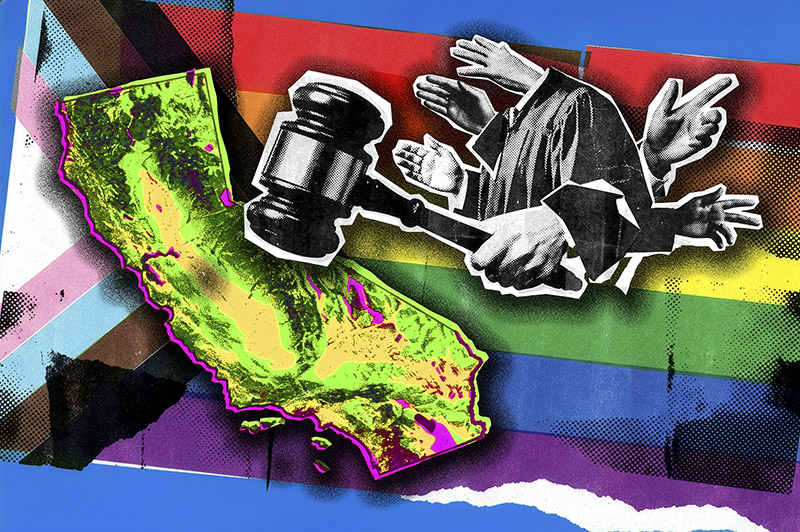
The U.S. Supreme Court granted an emergency appeal from a conservative legal group, blocking enforcement of a California law that prohibits teachers and school staff from outing transgender or gender-nonconforming students to their parents.
Under the state's anti-"forced outing" law, teachers are barred from notifying parents without a student's permission when that student asks to change their pronouns or gender expression at school.
The plaintiffs include religious parents and educators, among them two sets of Catholic parents represented by the Thomas More Society, who claim the prohibition on parental notification misled parents and helped facilitate their children's social transition in defiance of their religious beliefs.
A Florida woman has been arrested on a felony child abuse charge after allegedly cutting a young family member with a knife upon discovering messages indicating he is gay.
According to South Florida TV station WPLG, police began investigating Grether Leidy Guadarramas Pena, 41, after the boy told a teacher what had happened at his home on March 14. The teacher then reported the incident to authorities.
An arrest report from the Florida City Police Department states that the boy -- whose age was not specified -- told detectives his brother discovered Discord messages about his sexual orientation and took the computer away. The brother then gave it to another family member, who "made him stand facing the wall" until Guadarramas arrived home.
Senegal's National Assembly has passed a bill doubling the maximum prison term for same-sex relations to 10 years and criminalizing pro-LGBTQ advocacy.
The bill passed by a vote of 135-0, with three lawmakers abstaining, and now heads to President Bassirou Diomaye Faye for his signature.
The law -- delivering on a campaign promise by the ruling government led by Faye and Prime Minister Ousmane Sonko -- imposes harsher penalties under a colonial-era statute criminalizing "acts against nature," reports Reuters.
These are challenging times for news organizations. And yet it’s crucial we stay active and provide vital resources and information to both our local readers and the world. So won’t you please take a moment and consider supporting Metro Weekly with a membership? For as little as $5 a month, you can help ensure Metro Weekly magazine and MetroWeekly.com remain free, viable resources as we provide the best, most diverse, culturally-resonant LGBTQ coverage in both the D.C. region and around the world. Memberships come with exclusive perks and discounts, your own personal digital delivery of each week’s magazine (and an archive), access to our Member's Lounge when it launches this fall, and exclusive members-only items like Metro Weekly Membership Mugs and Tote Bags! Check out all our membership levels here and please join us today!










You must be logged in to post a comment.