The U.S. Supreme Court has granted a petition for divided argument in U.S. v. Skrmetti, the federal challenge to Tennessee’s law prohibiting doctors from prescribing treatments for gender dysphoria to transgender youth.
The court previously agreed in June to take up the case, as well as its companion case, L.W. v. Skrmetti, during the 2024-2025 court session.
The outcome of the case will likely determine the fate of similar laws in 23 other states, where Republican lawmakers have sought to criminalize the provision of gender-affirming care, like puberty blockers or hormones, to transgender youth to help them transition and assuage their feelings of gender dysphoria.
Two other states — Arizona and New Hampshire — have only banned surgical interventions on minors. Oral arguments in the case have been set for December 4, 2024.
A federal judge initially blocked the law from taking effect, but Tennessee appealed the ruling and asked that it be reversed. The 6th U.S. Circuit Court of Appeals subsequently lifted that injunction, thereby allowing the law to take effect. A few months later, the 6th Circuit rejected a separate request seeking to block enforcement of the law.
The Justice Department intervened, asking the U.S. Supreme Court to review the 6th Circuit’s rationale for the decision, in hopes of reversing it.
The plaintiffs in the original L.W. v. Skrmetti lawsuit challenging the ban — three families with transgender children and a Memphis-based doctor — are being represented by a coalition of legal organizations and firms, including Lambda Legal, the AmericanCivilLibertiesUnion, the ACLU of Tennessee, and Akin Gump Strauss Hauer & Feld LLP.
Lawyers for the plaintiffs recently petitioned the court for divided argument, enabling them to split time with the U.S. Department of Justice in arguing for the ban to be overturned. On October 21, the court granted that request.
As a result, Chase Strangio, the co-director of the ACLU’s LGBTQ & HIV Project, will now appear before the high court to argue for overturning the Tennessee ban — and others like it — on behalf of his clients, with those arguments becoming part of the case’s official record.
Strangio’s appearance will make him the first out transgender person to argue a case before the prestigious legal body.
Strangio is the leading U.S. legal expert on transgender rights, ACLU Legal Director Cecillia Wang told Reuters.
“He brings to the lectern not only brilliant constitutional lawyering, but also the tenacity and heart of a civil rights champion,” Wang said.
The U.S. Supreme Court has ruled that state bans prohibiting transgender athletes from competing on girls' and women's sports teams in high school and college are constitutional and do not violate transgender athletes' right to equal protection under the law.
The 6-3 decision does not apply to intramural mixed-gender sports teams, such as voluntary adult leagues that do not receive federal funding.
The nation's highest court found that Title IX -- the federal law prohibiting sex-based discrimination in educational settings -- allows schools to maintain separate women's and men's sports teams based on biological sex due to the inherent physical differences between biological men and biological women.
A proposed amendment to enshrine the right to marry, regardless of the spouses' gender, in the Delaware Constitution failed to secure the two-thirds majority needed to pass the House of Representatives.
The proposed amendment, sponsored by State Sen. Russ Huxtable (D-Lewes), passed the State Senate on a 16-5 vote on June 10. It marked the first step in the lengthy process of amending the constitution to declare that marriage is "a fundamental right that may not be denied or abridged on the basis of gender," as well as race, color, national origin, or sex.
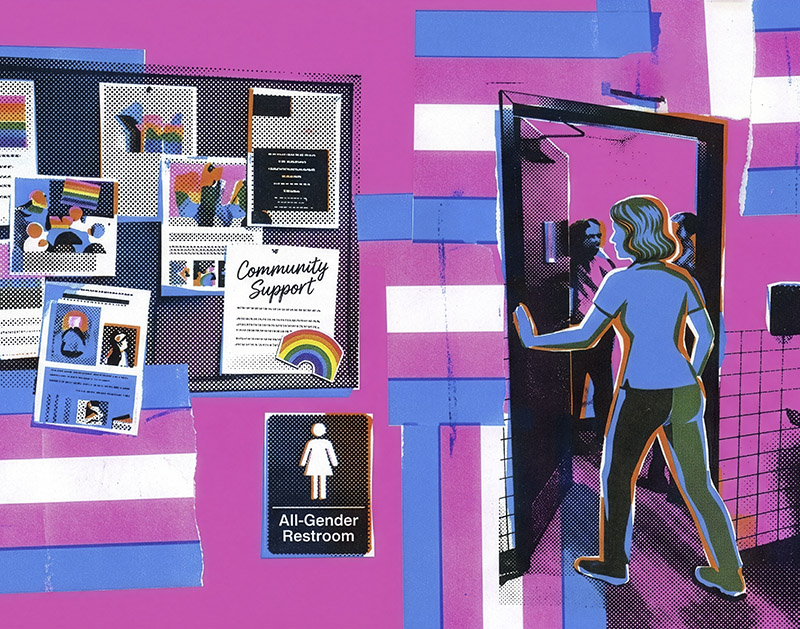
A federal judge has granted a preliminary injunction blocking Idaho from enforcing a law that could penalize transgender people with up to five years in prison for using public bathrooms that do not align with their assigned sex at birth.
The law, known as HB 752, was set to take effect on July 1 after being signed by Republican Gov. Brad Little earlier this year. However, the injunction bars police from enforcing the law's bathroom restrictions. It does not apply to similar restrictions on access to changing rooms, which the lead plaintiffs -- six transgender Idahoans -- have not challenged.
These are challenging times for news organizations. And yet it’s crucial we stay active and provide vital resources and information to both our local readers and the world. So won’t you please take a moment and consider supporting Metro Weekly with a membership? For as little as $5 a month, you can help ensure Metro Weekly magazine and MetroWeekly.com remain free, viable resources as we provide the best, most diverse, culturally-resonant LGBTQ coverage in both the D.C. region and around the world. Memberships come with exclusive perks and discounts, your own personal digital delivery of each week’s magazine (and an archive), access to our Member's Lounge when it launches this fall, and exclusive members-only items like Metro Weekly Membership Mugs and Tote Bags! Check out all our membership levels here and please join us today!









You must be logged in to post a comment.