U.S. Supreme Court building – Photo: Jimmy Woo, via Unsplash
The U.S. Supreme Court has allowed the administration of President Donald Trump to implement its preferred ban on transgender military personnel while legal challenges to the policy are working their way through the courts.
On Tuesday, May 6, the high court granted an emergency request from the Trump administration to lift a federal judge’s nationwide injunction blocking the Pentagon from enforcing the ban. The court’s three liberal justices — Sonia Sotomayor, Elena Kagan, and Ketanji Brown Jackson — dissented, saying they would have denied the request.
The preliminary injunction that has since been stalled by this latest ruling was issued in March by U.S. District Judge Benjamin Settle, a George W. Bush nominee, of the Western District of Washington.
Settle ruled that the Trump administration’s ban on transgender service members was “unsupported, dramatic, and facially unfair,” and said that there was no evidence of harm resulting from transgender people serving openly in the military.
The Trump administration appealed to the Supreme Court, arguing that allowing transgender individuals to serve openly would undermine military effectiveness and lethality.
The administration also urged the court to show “substantial deference” to the judgment of Pentagon leaders when it comes to determining who should serve in the Armed Forces.
Unlike the ban on transgender military members implemented during Trump’s first term, the current iteration of the ban disqualifies all service members who have been diagnosed with gender dysphoria or attempted to undergo medical transition, declaring them “unfit to serve,” even if they meet all other physical, academic, and character requirements for service.
It also bans transgender individuals from enlisting in the military in the future.
After Trump issued the executive order barring transgender service members from the military, seven transgender service members enlisted the help of Lambda Legal and the Human Rights Campaign and sued to overturn the ban by having it declared unconstitutional. The lawsuit, Shilling v. Trump, challenges the ban on the grounds that it violates the Constitution’s guarantee of equal protection under the law.
The high court’s ruling constitutes a setback for the seven plaintiffs in the case, including lead plaintiff Emily Shilling, a Naval commander.
It could also be viewed as a setback for an estimated 15,000 service members who have been diagnosed with gender dysphoria or have undergone hormonal treatments or surgical procedures to help them transition.
“[The] Supreme Court ruling is a devastating blow to transgender service members who have demonstrated their capabilities and commitment to our nation’s defense,” Lambda Legal and the Human Rights Campaign Foundation said in a joint statement. “By allowing this discriminatory ban to take effect while our challenge continues, the Court has temporarily sanctioned a policy that has nothing to do with military readiness and everything to do with prejudice.”
The case now goes back to the 9th U.S. Circuit Court of Appeals, which will rule on whether to uphold Settle’s finding that the ban is discriminatory and unconstitutional. In the meantime, the Pentagon will be able to begin discharging transgender service members from the Armed Forces.
While some service members may be able to obtain a waiver to stay in the military, they will be barred from changing rooms, bathrooms, showers, and other single-sex spaces that don’t match their assigned sex at birth. They will also be required to meet the physical standards based on their assigned sex at birth.
Two other lawsuits challenging the ban are being litigated in the courts.
In one case, Talbott v. Trump, filed on behalf of 32 transgender plaintiffs, U.S. District Judge Ana Reyes, of the District of Columbia, issued a nationwide preliminary injunction blocking the Pentagon from discharging transgender service members.
Reyes ruled that the ban — which she called “soaked in animus” — is unconstitutional because it discriminates against trans service members on the basis of their transgender status and sex. But the U.S. Court of Appeals for the District of Columbia has since blocked Reyes’ order from taking effect.
In the other case, Ireland v. Hegseth, a federal judge in New Jersey granted a temporary restraining order in March prohibiting the Pentagon from attempting to expel Staff Sgt. Nicholas Bear Bade and Master Sgt. Logan Ireland, two transgender service members who were targeted for “separation,” or removal, from the Air Force. That case is still working its way through the courts.
GLAD Law and the National Center for Lesbian Rights, which are representing the plaintiffs in the Talbott and Ireland cases, blasted the Supreme Court’s ruling in the Shilling case as “devastating.”
“History will confirm the weight of the injustice done today,” Jennifer Levi, GLAD Law’s senior director of transgender and queer rights, said in a statement.
“The Court has upended the lives of thousands of service members without even the decency of explaining why,” NCLR Legal Director Shannon Minter added. “This is a deeply sad day for our country.”
A new analysis suggests the ratio between the index and ring fingers may reflect prenatal hormone exposure -- and could be linked to sexual orientation later in life.
Dozens of studies over the past several decades have explored the idea, often with conflicting results. Many also failed to account for bisexuality or sexual fluidity when classifying sexual orientation, according to the New York Post.
In the new analysis, published in Frontiers in Medicine, researchers from Memorial University of Newfoundland and Labrador reviewed 51 prior studies to assess whether finger length ratios could indicate prenatal hormone exposure and predict sexual orientation.
Nepal has elected its first-ever transgender woman to parliament, with the election commission confirming last week that 37-year-old LGBTQ rights advocate Bhumika Shrestha will serve as a lawmaker from the centrist Rastriya Swatantra Party, which secured 182 of 275 seats earlier this month.
In Nepal, voters cast two ballots in parliamentary elections: one elects 165 members from single-member constituencies using first-past-the-post voting, while the other fills 110 seats from party lists distributed proportionally based on the overall vote.
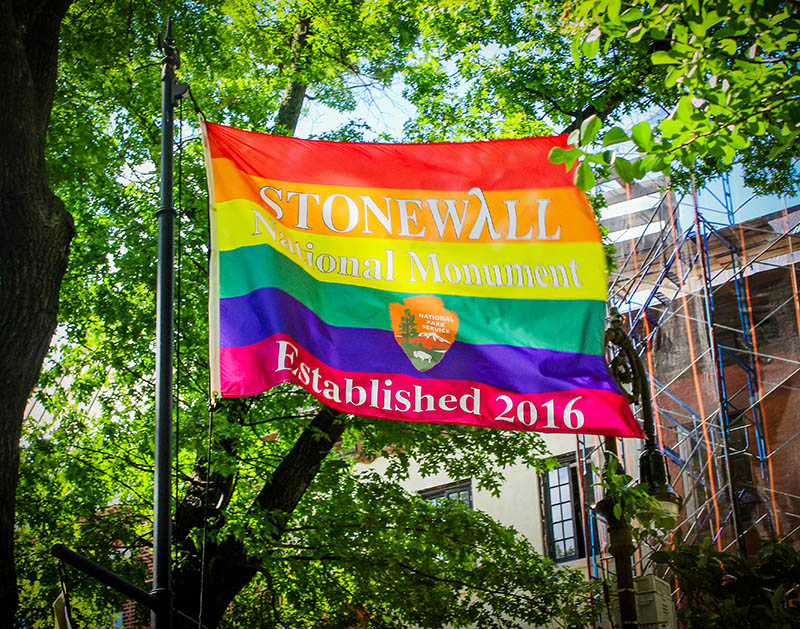
In what has become a familiar pattern, the Trump administration once again took aim at the LGBTQ community by removing a Pride flag from a flagpole at the Stonewall National Monument.
The historic site, designated a national monument by former President Barack Obama in 2016, spans 7.7 acres and encompasses the Stonewall Inn, Christopher Park, and several nearby streets and sidewalks. Portions of the site are also protected as both a New York City landmark and a New York state historical site.
The removal of the rainbow-colored Pride flag follows federal guidance issued by the U.S. Department of the Interior barring the display of so-called "non-agency" flags within the National Park System. The memo, issued last month, states that "only the U.S. flag and other congressionally or departmentally authorized flags are flown on NPS-managed flagpoles, with limited exceptions."
These are challenging times for news organizations. And yet it’s crucial we stay active and provide vital resources and information to both our local readers and the world. So won’t you please take a moment and consider supporting Metro Weekly with a membership? For as little as $5 a month, you can help ensure Metro Weekly magazine and MetroWeekly.com remain free, viable resources as we provide the best, most diverse, culturally-resonant LGBTQ coverage in both the D.C. region and around the world. Memberships come with exclusive perks and discounts, your own personal digital delivery of each week’s magazine (and an archive), access to our Member's Lounge when it launches this fall, and exclusive members-only items like Metro Weekly Membership Mugs and Tote Bags! Check out all our membership levels here and please join us today!







You must be logged in to post a comment.