No Kings March: Oct. 18, Washington, D.C. – Photo: Judy Schloss /Metro Weekly
My first protest, as my mother tells it, was as a toddler. In our Pacific Beach neighborhood of San Diego, circa 1970, she was moved to join a small group in opposition to some new construction. As she was moved, so was I, on four stroller wheels. My birth may have coincided with the weekend of the Stonewall Riots, but I didn’t learn about that till much later.
And, of course, I have no memory of this inaugural outing with Mom to fight the power. Today, my mother looks at current events, disgusted by the White House, and wonders aloud whether protests such as the Oct. 18 No Kings Day actions across the country and beyond do much. At her age, she’s certainly entitled to be winding down. Not that she was ever big on protests to begin with — my first was her last, possibly her only.
In her recently adopted home of Tyler, Texas — one of the reddest districts in the U.S. — the political landscape can make it easy to forget the outside world. In Tyler, gender affirmation seems largely reserved for the cisgender men suckinguptestosterone boosters. Seriously, this is former-Rep. Louie Gohmert country. He joined the Human Rights Campaign’s “Hall of Shame” in 2014. Though, even in Tyler, some noble residents rustled up a respectable No Kings Day showing.
While Mom’s protesting days — or day, rather — are behind her, I grew into someone who can’t stop attending. Three foundational influences were Tiananmen Square in 1989, the anti-Apartheid movement, and the inspiring actions of ACT-UP (AIDS Coalition to Unleash Power). These were powerful lessons. The young Chinese proponents of democracy were slaughtered. Nelson Mandela went from prisoner to president. The AIDS activists secured wins. The lesson was that protesters can win the day eventually but they may also be crushed, used as an example to deter anyone else who may challenge authority or the status quo. Or both.
Unlike China, where the oppression has grown to extinguish democratic ideals and imprison those who fought for them in Hong Kong, America’s history is more encouraging. We have been protesting since the beginning. Against British tyranny. For women’s suffrage. For labor rights. For racial justice. For the environment. We’ve made heroes of those leading the fight, from Martin Luther King Jr. to Cesar Chavez to Gloria Steinem.
On the right, there’s been a contemporary argument that America is defined as much by place and shared experiences, as it is an idea expressed in a document. I never put much stock in purple mountains majesty and amber waves. They’re pretty and all, but our planet offers up boundless beauty on every continent. While America may refer to a fixed spot of geography, the ideas of the Constitution are not constrained by it. Some plot on the moon could easily become a state, adding to the richness and diversity of our imperfect, ever-evolving democratic experiment.
As for shared experiences, though, I’m grateful that protesting is among them. We need this bellicose bulwark if we’re to foster our experiment toward a meaningful future. Consider that while Americans may also share a democratic history, not everyone seems fully on board with continuing that legacy in a meaningful way.
This is when we look to Hungary, not as a guide but as a warning. Hungary, really just tasting democracy for the first time after the fall of the Soviet Union, has become the aspirational idol of America’s MAGA minority — of its thought leaders at least.
When you think of the Conservative Political Action Conference, better known as CPAC, chances are you think of that tedious few days every year when the ever-more-MAGA conservative cabal lets loose at the Gaylord National Resort & Convention Center at National Harbor. It’s called D.C. home since its 1974 inception. But CPAC has not remained a domestic affair.
Welcome to Budapest, the annual site of CPAC Hungary since 2022. Not that it’s the only international iteration, but it is arguably the most unsettling. CPAC Hungary is closely aligned with Prime Minister Viktor Orbán’s Fidesz political party. It’s also aligned, if loosely, with the primary drafters of the notorious Project 2025, the D.C.-based Heritage Foundation.
“We are especially proud of our relationship with Prime Minister Orbán, whose leadership in Hungary on immigration, family policy, and the importance of the nation-state is a model for conservative governance,” proclaimed Heritage President Kevin Roberts in a 2024 statement.
Orbán’s “leadership” is a model for a society where few of us would want to live. His government banned Budapest’s LGBTQ Pride festival this year. At least, he tried, threatening attendees with fines and facial-recognition technology to hunt them down. What he got was a massive, defiant turnout of more than 100,000 people. Here in D.C., it was also reason to protest, with a few dozen of us gathered at the Hungarian Embassy ahead of Budapest Pride, thanks to the Council for Global Equality and Amnesty International.
Orbán may not have won the day, but he’s won MAGA hearts. “There’s nobody that’s better, smarter or a better leader than Viktor Orbán,” Donald Trump told a Mar-a-Lago crowd in 2024, as he hosted the autocratic leader, according to CNN. “He’s fantastic.”
More recently, Trump responded to No Kings Day with an AI video of himself as king, flying over protesters and bombing them with apparent poop. As Marie Antoinette, deserved or not, will forever be associated with “Let them eat cake,” history will remember lame-duck Donald as the “Let them eat shit” president.
If he didn’t care about the protests, he would’ve posted nothing, merely offering comment when pressed by reporters. Obviously, the massive protest got his attention. How could it not? But does it change anything? Who knows? We do know that minus protests, nothing happens. Frederick Douglass put the fine point on it in an 1857 speech: “Power concedes nothing without a demand.”
That’s about as American as a statement can get. We’ve been making demands since the beginning. Our right wing might want to pull us in a direction that looks like democracy, but essentially trades freedom and progress for passivity and profit. But that’s not us. While plenty of so-called democracies — Hungary, Turkey, Russia, for example — have allowed authoritarianism, America has not. Human rights may have been trampled plenty in the course of our history, but never under the trappings of a monarchy, dictator, or empire.
And we’ve taken to the streets in opposition at every turn. Protest is an American birthright. Should we ever lose it, we may still be called Americans, but we will have failed our forebears — particularly Bayard Rustin, the gay architect of the 1963 March on Washington for Jobs and Freedom. As Rustin said, “We need, in every community, a group of angelic troublemakers.” Can I get an American amen?
Will O’Bryan is a former Metro Weekly managing editor, living in D.C. with his husband. He is online at www.LifeInFlights.com.
Patagonia, the outdoor clothing and gear retailer, has sued drag performer Pattie Gonia for trademark infringement, claiming that similarities in their names and branding have caused “confusion and deception” among consumers.
In the lawsuit, filed January 21 in the U.S. District Court for the Central District of California, the company is seeking $1 in nominal damages and asking the court to block Pattie Gonia -- the drag persona of Wyn Wiley -- from registering her name as a trademark or selling merchandise bearing it, reports The Independent.
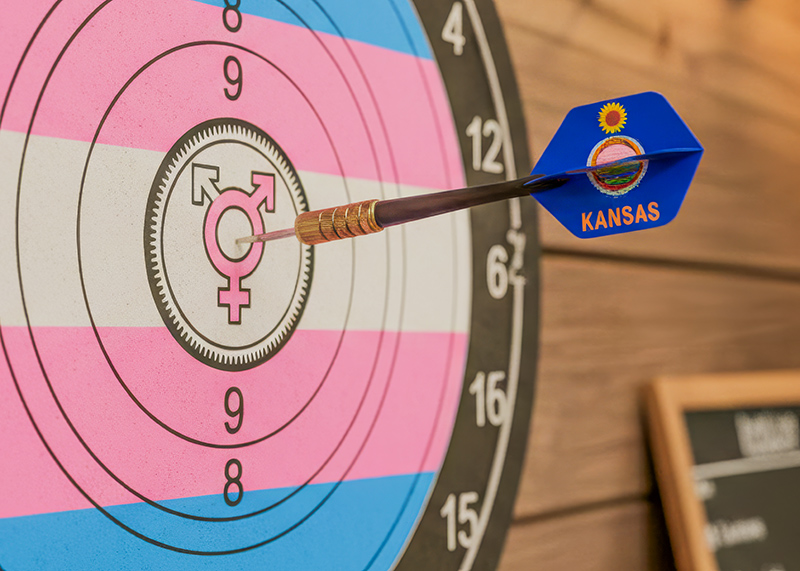
Kansas lawmakers have passed a sweeping anti-trans bill that restricts which public restrooms and locker rooms transgender people may use.
The bill requires driver’s licenses and birth certificates to reflect a person’s assigned sex at birth and defines “gender” under Kansas law as biological sex determined at birth, including chromosomes, hormones, gonads, and internal and external genitalia.
Under the bill, Kansans would be barred from amending the gender marker on their original birth certificate, and driver’s licenses could only display a gender marker that aligns with a person’s assigned sex at birth, reports Topeka-based CBS affiliate WIBW.
Greater Than, a recently launched campaign seeking to overturn marriage equality nationwide, is facing backlash from pro-LGBTQ activists for using a quote from former President Barack Obama in a way critics say falsely implies he supports the effort.
The campaign’s website displays Obama’s image alongside several prominent opponents of same-sex marriage, including the late Charlie Kirk, Allie Beth Stuckey, and Seth Dillon.
The photos appear beneath two lines reading, "Children's Rights Aren't Up for Debate" and "Be a voice that refuses to stay silent -- stand up for kids."
These are challenging times for news organizations. And yet it’s crucial we stay active and provide vital resources and information to both our local readers and the world. So won’t you please take a moment and consider supporting Metro Weekly with a membership? For as little as $5 a month, you can help ensure Metro Weekly magazine and MetroWeekly.com remain free, viable resources as we provide the best, most diverse, culturally-resonant LGBTQ coverage in both the D.C. region and around the world. Memberships come with exclusive perks and discounts, your own personal digital delivery of each week’s magazine (and an archive), access to our Member's Lounge when it launches this fall, and exclusive members-only items like Metro Weekly Membership Mugs and Tote Bags! Check out all our membership levels here and please join us today!







My first protest, as my mother tells it, was as a toddler. In our Pacific Beach neighborhood of San Diego, circa 1970, she was moved to join a small group in opposition to some new construction. As she was moved, so was I, on four stroller wheels. My birth may have coincided with the weekend of the Stonewall Riots, but I didn’t learn about that till much later.
And, of course, I have no memory of this inaugural outing with Mom to fight the power. Today, my mother looks at current events, disgusted by the White House, and wonders aloud whether protests such as the Oct. 18 No Kings Day actions across the country and beyond do much. At her age, she’s certainly entitled to be winding down. Not that she was ever big on protests to begin with — my first was her last, possibly her only.
In her recently adopted home of Tyler, Texas — one of the reddest districts in the U.S. — the political landscape can make it easy to forget the outside world. In Tyler, gender affirmation seems largely reserved for the cisgender men sucking up testosterone boosters. Seriously, this is former-Rep. Louie Gohmert country. He joined the Human Rights Campaign’s “Hall of Shame” in 2014. Though, even in Tyler, some noble residents rustled up a respectable No Kings Day showing.
While Mom’s protesting days — or day, rather — are behind her, I grew into someone who can’t stop attending. Three foundational influences were Tiananmen Square in 1989, the anti-Apartheid movement, and the inspiring actions of ACT-UP (AIDS Coalition to Unleash Power). These were powerful lessons. The young Chinese proponents of democracy were slaughtered. Nelson Mandela went from prisoner to president. The AIDS activists secured wins. The lesson was that protesters can win the day eventually but they may also be crushed, used as an example to deter anyone else who may challenge authority or the status quo. Or both.
Unlike China, where the oppression has grown to extinguish democratic ideals and imprison those who fought for them in Hong Kong, America’s history is more encouraging. We have been protesting since the beginning. Against British tyranny. For women’s suffrage. For labor rights. For racial justice. For the environment. We’ve made heroes of those leading the fight, from Martin Luther King Jr. to Cesar Chavez to Gloria Steinem.
On the right, there’s been a contemporary argument that America is defined as much by place and shared experiences, as it is an idea expressed in a document. I never put much stock in purple mountains majesty and amber waves. They’re pretty and all, but our planet offers up boundless beauty on every continent. While America may refer to a fixed spot of geography, the ideas of the Constitution are not constrained by it. Some plot on the moon could easily become a state, adding to the richness and diversity of our imperfect, ever-evolving democratic experiment.
As for shared experiences, though, I’m grateful that protesting is among them. We need this bellicose bulwark if we’re to foster our experiment toward a meaningful future. Consider that while Americans may also share a democratic history, not everyone seems fully on board with continuing that legacy in a meaningful way.
This is when we look to Hungary, not as a guide but as a warning. Hungary, really just tasting democracy for the first time after the fall of the Soviet Union, has become the aspirational idol of America’s MAGA minority — of its thought leaders at least.
When you think of the Conservative Political Action Conference, better known as CPAC, chances are you think of that tedious few days every year when the ever-more-MAGA conservative cabal lets loose at the Gaylord National Resort & Convention Center at National Harbor. It’s called D.C. home since its 1974 inception. But CPAC has not remained a domestic affair.
Welcome to Budapest, the annual site of CPAC Hungary since 2022. Not that it’s the only international iteration, but it is arguably the most unsettling. CPAC Hungary is closely aligned with Prime Minister Viktor Orbán’s Fidesz political party. It’s also aligned, if loosely, with the primary drafters of the notorious Project 2025, the D.C.-based Heritage Foundation.
“We are especially proud of our relationship with Prime Minister Orbán, whose leadership in Hungary on immigration, family policy, and the importance of the nation-state is a model for conservative governance,” proclaimed Heritage President Kevin Roberts in a 2024 statement.
Orbán’s “leadership” is a model for a society where few of us would want to live. His government banned Budapest’s LGBTQ Pride festival this year. At least, he tried, threatening attendees with fines and facial-recognition technology to hunt them down. What he got was a massive, defiant turnout of more than 100,000 people. Here in D.C., it was also reason to protest, with a few dozen of us gathered at the Hungarian Embassy ahead of Budapest Pride, thanks to the Council for Global Equality and Amnesty International.
Orbán may not have won the day, but he’s won MAGA hearts. “There’s nobody that’s better, smarter or a better leader than Viktor Orbán,” Donald Trump told a Mar-a-Lago crowd in 2024, as he hosted the autocratic leader, according to CNN. “He’s fantastic.”
More recently, Trump responded to No Kings Day with an AI video of himself as king, flying over protesters and bombing them with apparent poop. As Marie Antoinette, deserved or not, will forever be associated with “Let them eat cake,” history will remember lame-duck Donald as the “Let them eat shit” president.
If he didn’t care about the protests, he would’ve posted nothing, merely offering comment when pressed by reporters. Obviously, the massive protest got his attention. How could it not? But does it change anything? Who knows? We do know that minus protests, nothing happens. Frederick Douglass put the fine point on it in an 1857 speech: “Power concedes nothing without a demand.”
That’s about as American as a statement can get. We’ve been making demands since the beginning. Our right wing might want to pull us in a direction that looks like democracy, but essentially trades freedom and progress for passivity and profit. But that’s not us. While plenty of so-called democracies — Hungary, Turkey, Russia, for example — have allowed authoritarianism, America has not. Human rights may have been trampled plenty in the course of our history, but never under the trappings of a monarchy, dictator, or empire.
And we’ve taken to the streets in opposition at every turn. Protest is an American birthright. Should we ever lose it, we may still be called Americans, but we will have failed our forebears — particularly Bayard Rustin, the gay architect of the 1963 March on Washington for Jobs and Freedom. As Rustin said, “We need, in every community, a group of angelic troublemakers.” Can I get an American amen?
Will O’Bryan is a former Metro Weekly managing editor, living in D.C. with his husband. He is online at www.LifeInFlights.com.
More from Metro Weekly: