Emily Dickinson – Daguerreotype of Emily Dickinson taken at Mount Holyoke, December 1846 or early 1847, Amherst College Archives & Special Collections – Public Domain
When Martha Nell Smith was a child, she was given a book called The Golden Treasury of Poetry. “I was a nerdy kid, I liked to read,” the 72-year-old academic says, adding, “I also liked to play. I was a very sporty kid too. I was a tomboy.”
The book contained several poems by Emily Dickinson. “I thought these look so simple, but when you think about it, they are really weird,” she says. “But you could say that about almost any Dickinson poem.”
Smith recounts the long and winding path that led her to become one of the foremost experts on Emily Dickinson, with a particular focus on the poet’s secretly romance-laden letters to her sister-in-law, Susan Dickinson.
“The experience of figuring out Dickinson’s love for her sister-in-law, Susan, was an adventure,” says Smith, flashing a captivating smile. “I always knew, in what I call the still small voice inside myself — my gut — that they were the love of one another’s lives, or loves. And that people had tried to hide it.”
Smith chronicles that journey in her 1998 book Open Me Carefully: Emily Dickinson’s Intimate Letters to Susan Dickinson. On Tuesday, December 9, she will join fellow scholar Aia Yousef and contemporary romance author Nikki Payne to discuss Dickinson’s life, work, and legacy at the Folger Shakespeare Library’s annual Emily Dickinson Birthday Tribute.
Smith, who teaches at the University of Maryland and is a member of the LGBTQ community, wonders whether her early dive into Dickinson’s secret love life stirred her own inclinations.
“It may have,” she says. “It may have. In a former life, I was married to a male person. Now, I was a very young person when this happened, and so was he. We’re still good friends, but I realized my senior year of college, ‘Oh, I really like kissing girls. It’s different for me.’ But it was hard to realize that. As soon as I’d realized that, I’d go, ‘No, you can’t think that.’ For one thing, I was still married. But he had his own attractions to men. I don’t think they’re cause and effect. I think they’re more recognition.”
Poetry is often seen as a higher literary art form, one many people shy away from, considering it impenetrable.
“I think people are trained to say that from a very young age,” says Smith. “I really do. I think they’re taught.” But she notes that poetry is already part of our daily lives. “We call them lyrics. Some of my colleagues who shall not be named get furious with me for talking about lyrics as poems, but they are. I think Bruce Springsteen writes poems, Lucinda Williams writes poems. Nancy Griffith certainly did. Lyrics are poems. They’re definitely poems.”
I ask whether Dickinson would approve of academics mining her personal letters to uncover her proclivities, and Smith just laughs. “I think she would ask why we care, and why we would seek her approval? But I think that she would love the curiosity. She was, after all, a very curious person herself.”
The Folger’s annual Emily Dickinson Birthday Tribute, which will also honor Jane Austen on her 250th birthday, takes place Tuesday, Dec. 9, from 7:30 to 8:30 p.m. The event is sold out, but virtual access remains available on a pay-what-you-will basis with a $10 minimum. Visit folger.edu.
After more than a decade of fan pressure, Nintendo is finally allowing players of Tomodachi Life to choose the sexual orientation and gender identity of the characters they control -- a long-requested change for the popular social simulation game.
First introduced in 2009, Tomodachi Life lets players create customizable human characters, known as "Miis," who explore virtual worlds, play mini-games, and form social relationships. Until now, however, the social simulation game only allowed Miis to be heterosexual and cisgender.
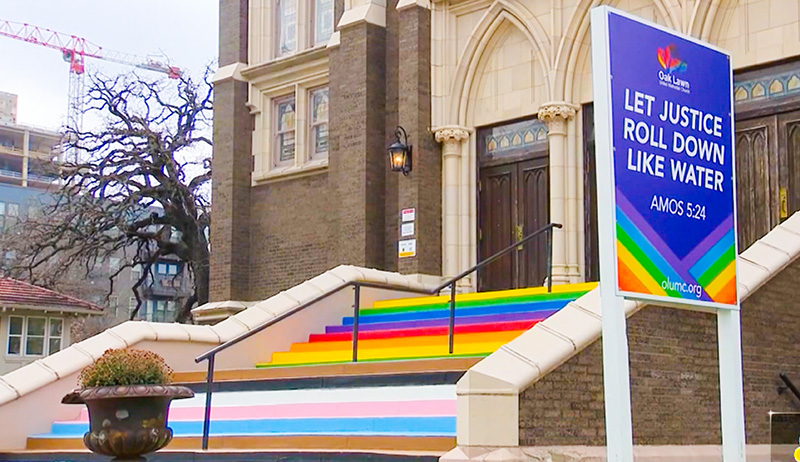
The Dallas Landmark Commission unanimously approved rainbow-colored steps outside Oak Lawn United Methodist Church as a temporary art installation, allowing the display to remain for up to three years despite objections that they violate historic preservation codes.
As a designated historic site, Oak Lawn United Methodist Church is required to seek city approval before making major exterior changes, including paint colors, according to Dallas-area PBS/NPR affiliate KERA.
The LGBTQ-welcoming church did not submit an application to the landmark commission before repainting its exterior steps in the colors of the "Progress Pride" flag, incorporating the traditional rainbow along with black and brown stripes and the blue, pink, and white of the transgender Pride flag.
After years of playing while closeted, Jesse Kortuem says the HBO series Heated Rivalry helped him finally reconcile his identity with the sport he loves.
Jesse Kortuem, a hockey player who has competed in several adult leagues but never at the professional level, says he was inspired to come out after watching HBO's Heated Rivalry, a romance centered on closeted gay hockey players.
In a Facebook post, Kortuem recalled growing up in Minnesota as the youngest of four boys and playing hockey from a young age, while struggling to reconcile his love for the sport with his sexuality.
"To any hockey player, the sounds of the rink and the feel of cold air are unmistakable. The slapshots, the pucks hitting the boards, the skates carving fresh ice, and the high-pitched clang of a puck hitting the post bring immense comfort," Kortuem wrote. "For a long time, however, the rink did not feel like a place where I could be all of me. I felt I had to hide parts of myself for far too long."
These are challenging times for news organizations. And yet it’s crucial we stay active and provide vital resources and information to both our local readers and the world. So won’t you please take a moment and consider supporting Metro Weekly with a membership? For as little as $5 a month, you can help ensure Metro Weekly magazine and MetroWeekly.com remain free, viable resources as we provide the best, most diverse, culturally-resonant LGBTQ coverage in both the D.C. region and around the world. Memberships come with exclusive perks and discounts, your own personal digital delivery of each week’s magazine (and an archive), access to our Member's Lounge when it launches this fall, and exclusive members-only items like Metro Weekly Membership Mugs and Tote Bags! Check out all our membership levels here and please join us today!







You must be logged in to post a comment.