A new report finds that acceptance of LGBTQ people is declining across the United States, with nearly three in ten LGBTQ adults saying attitudes toward their community have worsened.
On Thursday, January 15, the Human Rights Campaign Foundation released findings from its Annual LGBTQ+ Community Survey, which drew responses from nearly 15,000 U.S. adults — roughly two-thirds of whom identified as LGBTQ.
In addition to the survey, HRC last year launched its “American Dreams Tour,” traveling to 10 cities and engaging more than 5,000 people through town halls, trainings, and community meetings with local LGBTQ leaders and activists. Those on-the-ground conversations informed the report, which aims to assess the state of LGBTQ life in the United States one year into the second Trump administration.
Taken together, the findings suggest that actions taken by the Trump administration — including efforts to reduce LGBTQ visibility, cut funding to organizations serving LGBTQ communities, and restrict access to gender-affirming care for both youth and adults — have contributed to a broader decline in acceptance and a range of negative consequences in LGBTQ people’s daily lives.
Here are five key findings from the report:
LGBTQ people are increasingly closeting themselves and reducing their visibility in certain environments.
Nearly half of LGBTQ adults say they are less out in at least some aspect of their lives — including at work, in health care settings, or in public spaces — since Trump took office last year. More than half also report being less visible about their sexual orientation or gender identity, including parents who conceal same-sex relationships from teachers or school administrators.
LGBTQ workers feel less safe at work, especially where diversity and inclusion efforts have been scaled back.
Nearly four in ten workers report seeing at least one diversity, equity, and inclusion-related change at their workplace over the past year. Workers at companies that rolled back DEI policies — regardless of sexual orientation or gender identity — were more than three times as likely as those at workplaces that did not to experience stigma, bias, or discrimination on the job.
Among LGBTQ workers whose employers scaled back DEI practices, 57% reported experiencing stigma, bias, or discrimination at work. LGBTQ workers who reported workplace stigma were also nine times more likely than their non-LGBTQ counterparts to describe their workplace as “hostile” over the past 12 months.
LGBTQ people report worsening financial security over the past year.
LGBTQ adults are nearly twice as likely as their straight and cisgender counterparts to say their financial situation has worsened over the past 12 months, according to the survey. Among LGBTQ adults who experienced discrimination during that period — either at work or while interacting with financial institutions — respondents were twice as likely to describe themselves as financially unwell.
Lower-income LGBTQ adults are especially vulnerable. Those earning less than $75,000 a year were five times more likely than those earning above that threshold to say they were financially insecure. LGBTQ adults who recently lost a job or experienced a drop in household income were also twice as likely to report financial insecurity.
Adults who reported experiencing discrimination were nearly twice as likely to say current policies have made it harder to find employment. Among LGBTQ Americans, that effect nearly triples.
Cuts to SNAP have increased food insecurity among LGBTQ families.
LGBTQ people — particularly people of color, transgender individuals, and those raising children — are more likely to rely on Supplemental Nutrition Assistance Program benefits than the general population. As a result, cuts to SNAP under the Trump administration have left an estimated 2.1 million LGBTQ Americans struggling to meet basic food needs.
The report finds that some LGBTQ people affected by the cuts — including seniors and children being raised by same-sex couples — are skipping meals or going without food altogether.
Access to LGBTQ-affirming and LGBTQ-competent health care has become more difficult.
LGBTQ adults who experience discrimination when seeking health care are twice as likely as their straight and cisgender counterparts to report being in only fair or poor health. One-third of LGBTQ adults who encountered such discrimination said their health worsened over the past year.
Access has become especially difficult for transgender and nonbinary Americans, nearly two-thirds of whom report being unable to obtain needed health care due to the Trump administration’s efforts to restrict gender-affirming care or prohibit federal funds and employer-based insurance plans from covering such treatments.
LGBTQ people seeking HIV prevention or treatment also report growing barriers. LGBTQ adults enrolled in Medicare or Medicaid were more than twice as likely to report difficulty accessing HIV prevention or treatment, while more than 40% of those earning less than $75,000 a year reported trouble obtaining prevention tools such as PrEP or antiretroviral medications. The report warns that reduced access threatens to worsen the HIV epidemic and could lead to otherwise preventable deaths.
In response to the findings, HRC President Kelley Robinson said the administration’s actions have had immediate and measurable consequences for LGBTQ Americans.
“Trump and his allies made no secret about their plans; they laid it out for all to see in Project 2025,” Robinson said in a statement. “Over the past year, his administration has pushed forward efforts to eliminate civil rights protections for LGBTQ+ Americans — through funding cuts, regulatory changes, and bullying from the bully pulpit. Now, LGBTQ+ Americans are deeply hurting.”
At a January 15 event at the National Press Club in Washington, D.C., the Human Rights Campaign unveiled a new messaging playbook for pro-equality campaigns ahead of the 2026 midterm elections, alongside the release of the report.
The playbook offers guidance to pro-LGBTQ candidates on how to define themselves early, counter attacks rooted in anti-trans bias — a tactic Trump and Republicans have signaled will feature prominently in their 2026 messaging — and go on offense by emphasizing pro-equality values and broader issues such as cuts to the social safety net and threats to civil liberties.
“We need and deserve leaders that treat everyone with dignity, give everyone the chance to thrive, and advance equality for all,” Robinson said. “If we’ve learned anything, it’s that silence is not the answer. This messaging playbook is about giving those allies the tools to stop playing defense and lead with conviction — to be unapologetically pro-equality and to win elections.”
The full report detailing the Human Rights Campaign Foundation’s findings from its Annual LGBTQ+ Community Survey can be read here.
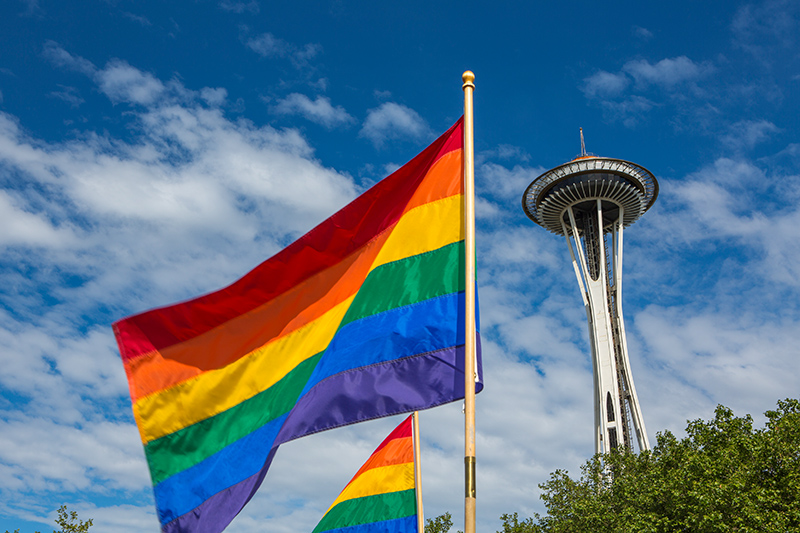
Seattle's local organizing committee for the 2026 FIFA World Cup is moving ahead with a first-of-its-kind "Pride Match" at Lumen Field on June 26, coinciding with the city's Pride Weekend, even though the scheduled game will feature Iran and Egypt, two countries that criminalize homosexuality.
The Pride-adjacent branding was created by the host city, not FIFA, the governing body of international soccer, which has not endorsed the designation.
When FIFA was planning the match schedule, Seattle was in line to host either New Zealand versus Belgium or Egypt versus Iran on June 26. Vancouver ultimately received the New Zealand-Belgium game, leaving Seattle with Egypt versus Iran, reports Outsports.
In a surprise appearance on Sunday, Nicki Minaj addressed Turning Point USA’s AmericaFest 2025, an annual conference aimed at younger MAGA activists, where she reaffirmed her recent anti-transgender views.
The rapper built her career with the help of a deeply devoted fanbase known as “Barbz,” many of whom are gay men. At the event, the “Super Bass” singer repeated the phrase “Boys, be boys” while seated on stage beside conservative lightning-rod Erika Kirk.
She continued her attacks on California Governor Gavin Newsom at the December 21 event, while offering effusive praise for the president and vice president.
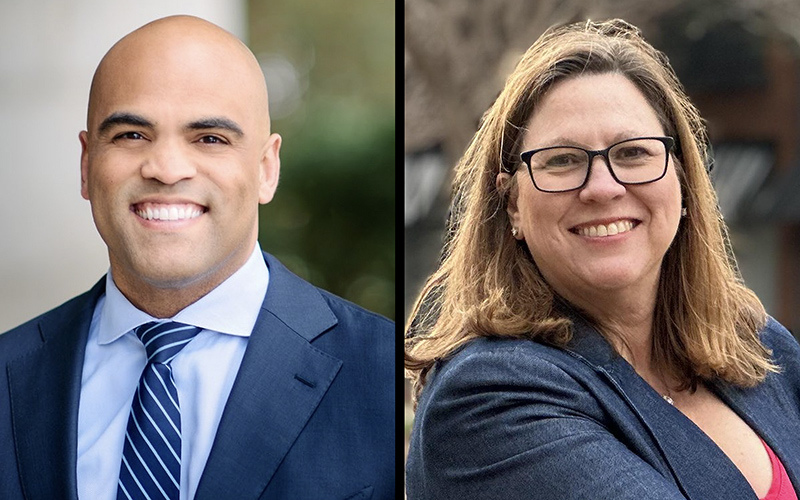
In a political shakeup, former U.S. Rep. Colin Allred (D-Texas), the Democratic nominee for U.S. Senate in 2024, has exited the 2026 Senate race and will instead run for the U.S. House of Representatives -- setting up a high-stakes primary showdown with his successor, out lesbian U.S. Rep. Julie Johnson.
Allred had been one of two Democrats, along with State Rep. James Talarico (D-Austin), seeking to challenge incumbent Republican U.S. Sen. John Cornyn. Either Democrat faced an uphill climb in a state that has grown more conservative after briefly appearing to trend Democratic about a decade ago.
These are challenging times for news organizations. And yet it’s crucial we stay active and provide vital resources and information to both our local readers and the world. So won’t you please take a moment and consider supporting Metro Weekly with a membership? For as little as $5 a month, you can help ensure Metro Weekly magazine and MetroWeekly.com remain free, viable resources as we provide the best, most diverse, culturally-resonant LGBTQ coverage in both the D.C. region and around the world. Memberships come with exclusive perks and discounts, your own personal digital delivery of each week’s magazine (and an archive), access to our Member's Lounge when it launches this fall, and exclusive members-only items like Metro Weekly Membership Mugs and Tote Bags! Check out all our membership levels here and please join us today!








You must be logged in to post a comment.