After Texas A&M University barred philosophy professor Dr. Martin Peterson from teaching parts of Plato’s Symposium involving same-sex love, he replaced the censored lessons with lectures on free speech and academic freedom, using coverage of the university’s own actions as course material.
Peterson teaches the introductory philosophy course “Contemporary Moral Problems.” He was told he would have to remove the Plato readings under new Texas A&M University policies restricting course content that references sexual orientation or gender identity.
Under the new policy — adopted by Texas A&M’s regents following pressure from Texas Republican lawmakers — professors must submit syllabi to department leaders for approval ahead of each semester. They are expected to adhere strictly to the approved material and avoid classroom discussions that stray from it. The restrictions apply across all 12 institutions within the Texas A&M University System.
When Peterson initially submitted his syllabus for “Contemporary Moral Problems,” it outlined modules focused on debates over contemporary issues such as abortion, capital punishment, economic justice, and race and gender ideology.
Peterson, who chairs Texas A&M University’s Academic Freedom Council, shared emails with the website Daily Nous detailing exchanges with Kristi Sweet, the chair of the philosophy department, who told him that university officials had flagged his syllabus because the Plato readings violated the new course-content restrictions.
“[T]he Board of Regents has clarified that core curriculum courses, which includes PHIL 111 Contemporary Moral Issues, cannot include issues related to race ideology, gender ideology, or topics related to sexual orientation or gender identity,” Sweet wrote in an email to Peterson.
Peterson appealed the decision in an email to university officials, arguing that his coursework “does not ‘advocate’ any ideology.” Instead, he said, “I teach students how to structure and evaluate arguments commonly raised in discussions of contemporary moral issues.”
The university claimed Peterson added the contested coursework after the regents adopted the new content restrictions last year, but Peterson told the New York Times he was not trying to be provocative.
“I’m aware that many members of the Board of Regents probably disagree with Plato,” he said. “They may not be aware of that, because they haven’t read Plato — who knows? — but it’s still a valuable alternative perspective.”
Peterson also warned that agreeing to the censorship would dilute the quality of the course and the education his students receive.
“We cannot have just one perspective in the classroom,” he said. “Then there’s nothing to discuss. There’s nothing to learn. It’s indoctrination. It’s Soviet-style education.”
After his appeal was rejected, Sweet emailed Peterson offering two final options — he could either “mitigate” the course content by removing the flagged lessons or be reassigned to an ethics and engineering course. He ultimately chose to revise his syllabus and replace the censored material with lectures on “free speech and academic freedom.”
“I’m thinking of using this as a case study and [to] assign some of the texts written by journalists covering the story to discuss,” Peterson told Inside Higher Ed. “I want [students] to know what is being censored.”
The Texas A&M chapter of the American Association of University Professors condemned the university’s censorship of Peterson’s course.
“At a public university, this action raises serious legal concerns, including viewpoint discrimination and violations of constitutionally protected academic freedom,” the chapter said in a statement. “Beyond the legal implications, the moral stakes are profound.
“Silencing 2,500-year-old ideas from one of the world’s most influential thinkers betrays the mission of higher education and denies students the opportunity to engage critically with the foundations of Western thought. A research university that censors Plato abandons its obligation to truth, inquiry, and the public trust — and should not be regarded as a serious institution of higher learning.”
The Foundation for Individual Rights and Expression — a free speech organization that often sides with conservatives who accuse colleges of censorship and ideological “indoctrination” — criticized the university.
“Texas A&M now believes Plato doesn’t belong in an introductory philosophy course,” spokesperson Lindsie Rank said in a statement. “This is what happens when the board of regents gives university bureaucrats veto power over academic content. The board didn’t just invite censorship, they unleashed it with immediate and predictable consequences. You don’t protect students by banning 2,400-year-old philosophy.”
In late November, the University of Oklahoma placed Mel Curth on administrative leave after the transgender graduate teaching assistant gave a student a zero on an essay about gender roles.
The essay cited the Bible to defend traditional gender roles and described transgender people as "demonic." Curth and the course's instructor, Megan Waldron, said the paper failed to meet basic academic standards due to a lack of empirical evidence. Both noted that the paper cited no scholarly sources and failed to offer an evidence-based critique of the assigned article, which argued that children who do not conform to rigid gender stereotypes are more likely to face bullying and negative mental health outcomes.
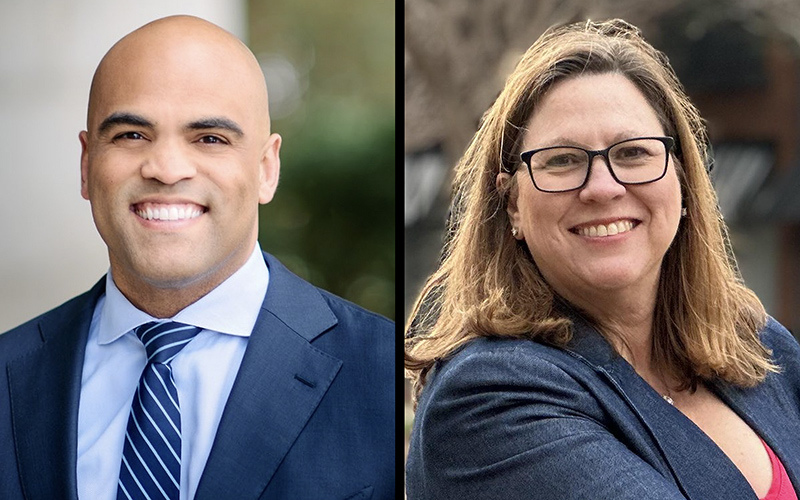
In a political shakeup, former U.S. Rep. Colin Allred (D-Texas), the Democratic nominee for U.S. Senate in 2024, has exited the 2026 Senate race and will instead run for the U.S. House of Representatives -- setting up a high-stakes primary showdown with his successor, out lesbian U.S. Rep. Julie Johnson.
Allred had been one of two Democrats, along with State Rep. James Talarico (D-Austin), seeking to challenge incumbent Republican U.S. Sen. John Cornyn. Either Democrat faced an uphill climb in a state that has grown more conservative after briefly appearing to trend Democratic about a decade ago.
Russia's federal media regulator has blocked access to the U.S.-based children's gaming platform Roblox, accusing it of violating the country's ban on distributing so-called "LGBT propaganda."
The platform allows users to create their own games or play games made by others, drawing millions of young players worldwide.
Roskomnadzor, Russia's Federal Service for Supervision of Communications, Information Technology and Mass Media, announced the ban on December 3, telling Reuters the platform is "rife with inappropriate content that can negatively impact the spiritual and moral development of children."
These are challenging times for news organizations. And yet it’s crucial we stay active and provide vital resources and information to both our local readers and the world. So won’t you please take a moment and consider supporting Metro Weekly with a membership? For as little as $5 a month, you can help ensure Metro Weekly magazine and MetroWeekly.com remain free, viable resources as we provide the best, most diverse, culturally-resonant LGBTQ coverage in both the D.C. region and around the world. Memberships come with exclusive perks and discounts, your own personal digital delivery of each week’s magazine (and an archive), access to our Member's Lounge when it launches this fall, and exclusive members-only items like Metro Weekly Membership Mugs and Tote Bags! Check out all our membership levels here and please join us today!










You must be logged in to post a comment.