After more than a decade of fan pressure, Nintendo is finally allowing players of Tomodachi Life to choose the sexual orientation and gender identity of the characters they control — a long-requested change for the popular social simulation game.
First introduced in 2009, Tomodachi Life lets players create customizable human characters, known as “Miis,” who explore virtual worlds, play mini-games, and form social relationships. Until now, however, the social simulation game only allowed Miis to be heterosexual and cisgender.
In a January 29 presentation previewing the latest iteration of the game, Tomodachi Life: Living the Dream, Nintendo of America confirmed that players will be able to select each Mii’s “dating preferences,” allowing them to date or marry people of multiple genders.
Players will also be able to select from three gender options: male, female, or nonbinary.
As reported by Kotaku, offering a third gender option marks a significant shift for Nintendo, which has previously sidestepped explicit discussions of gender identity in games likeAnimal Crossing: New Horizons by allowing players to choose from two gender-coded “styles.” In the 2014 version of Tomodachi Life, some players worked around the game’s heterosexual and binary constraints by assigning Miis a different gender and ignoring the game’s pronouns.
Nintendo previously clashed with fans in 2014, after players petitioned the company to allow Miis to engage in same-sex relationships and marry characters of the same gender. At the time, the company responded by saying it “never intended to make any form of social commentary with the launch of Tomodachi Life.”
“The relationship options in the game represent a playful alternate world rather than a real-life simulation,” Nintendo said in a statement at the time. “The ability for same-sex relationships to occur in the game was not part of the original game that launched in Japan, and that game is made up of the same code that was used to localize it for other regions outside of Japan.”
After receiving significant online backlash from gamers, the company issued an apology.
“At Nintendo, dedication has always meant going beyond the games to promote a sense of community, and to share a spirit of fun and joy,” the company said in a statement. “We pledge that if we create a next installment in the Tomodachi series, we will strive to design a game-play experience from the ground up that is more inclusive and better represents all players.”
Fans of the game quickly celebrated Nintendo’s announcement, praising the new features in posts on a Reddit forum dedicated to the series.
“The game looks SO GOOD from start to finish. It really seems like the people who made it, and even the people who made the trailer, know what fans of the series want!!! I’m just glad that they let you pick rather than making it random and untouchable. That way everyone gets what they want,” wrote one fan.
“I was so surprised they just used the word nonbinary just plain and simple. But seriously this is all that I ever wanted when it comes to choosing gender/sexuality in the game because not only can we have nonbinary miis, we can also choose their sexuality AND they also added aro/ace [aromantic/asexual] miis which is something else I really wanted,” wrote another fan.
“WOKE MIIS. WE ARE SO BACK,” wrote a third.
Other fans mocked what they predicted would be the response from right-wing critics.
Wrote one: “The most annoying people on the planet are going to complain about this… and I’m going to enjoy every second of their suffering.”
A new report finds that acceptance of LGBTQ people is declining across the United States, with nearly three in ten LGBTQ adults saying attitudes toward their community have worsened.
On Thursday, January 15, the Human Rights Campaign Foundation released findings from its Annual LGBTQ+ Community Survey, which drew responses from nearly 15,000 U.S. adults -- roughly two-thirds of whom identified as LGBTQ.
In addition to the survey, HRC last year launched its "American Dreams Tour," traveling to 10 cities and engaging more than 5,000 people through town halls, trainings, and community meetings with local LGBTQ leaders and activists. Those on-the-ground conversations informed the report, which aims to assess the state of LGBTQ life in the United States one year into the second Trump administration.
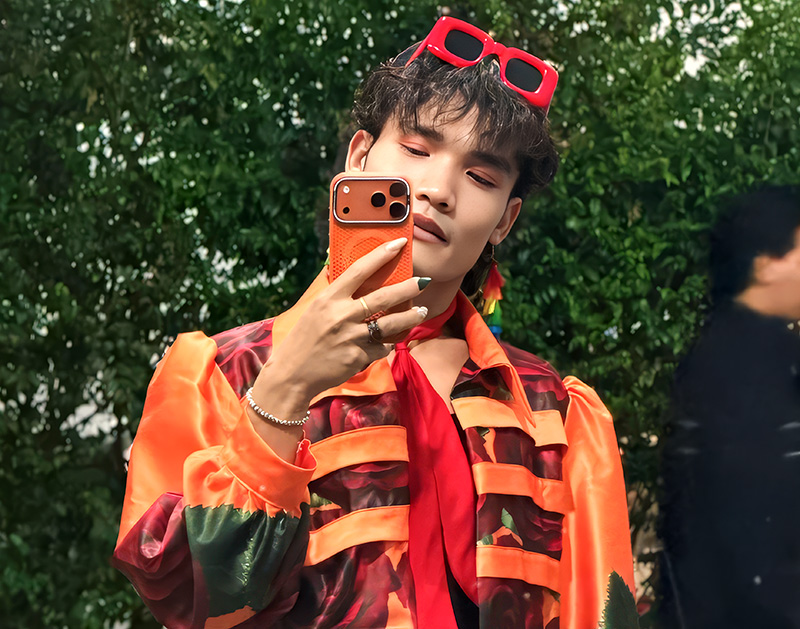
Police in Thailand have arrested a suspect in connection with the violent murder of an LGBTQ TikTok influencer from Myanmar, who was found beaten to death in a remote forest on January 20.
Authorities were alerted after a villager herding animals discovered a body beneath a tree in a forested area near Phathong village in Thailand’s Mae Sot District, roughly 300 miles northwest of Bangkok.
The deceased was identified as 25-year-old Ko Tin Zaw Htwe, a prominent LGBTQ TikTok influencer with more than 1.1 million followers who posted under the handle "Irrawaddy Ma." He had been missing for two days before his body was discovered. His final video, uploaded on January 19, showed him lip-syncing to a popular song.
In late November, the University of Oklahoma placed Mel Curth on administrative leave after the transgender graduate teaching assistant gave a student a zero on an essay about gender roles.
The essay cited the Bible to defend traditional gender roles and described transgender people as "demonic." Curth and the course's instructor, Megan Waldron, said the paper failed to meet basic academic standards due to a lack of empirical evidence. Both noted that the paper cited no scholarly sources and failed to offer an evidence-based critique of the assigned article, which argued that children who do not conform to rigid gender stereotypes are more likely to face bullying and negative mental health outcomes.
These are challenging times for news organizations. And yet it’s crucial we stay active and provide vital resources and information to both our local readers and the world. So won’t you please take a moment and consider supporting Metro Weekly with a membership? For as little as $5 a month, you can help ensure Metro Weekly magazine and MetroWeekly.com remain free, viable resources as we provide the best, most diverse, culturally-resonant LGBTQ coverage in both the D.C. region and around the world. Memberships come with exclusive perks and discounts, your own personal digital delivery of each week’s magazine (and an archive), access to our Member's Lounge when it launches this fall, and exclusive members-only items like Metro Weekly Membership Mugs and Tote Bags! Check out all our membership levels here and please join us today!








You must be logged in to post a comment.