Queen, “I Want to Break Free” – YouTube screenshot
A Russian man has been fined for posting a photo of the iconic rock band Queen dressed in drag on social media, with authorities accusing him of “destroying family values” and violating Russia’s law banning the dissemination of so-called “LGBT propaganda.”
David Gevondyan posted the offending photo — showing members of the band dressed in women’s clothing and posing by a stairwell in a femininely decorated home during the filming of the music video for the song “I Want to Break Free” — to VKontakte (VK), Russia’s equivalent of Facebook.
The photo caught the attention of Russian authorities, who prosecuted him in March under the country’s anti-LGBTQ “propaganda” law, which prohibits the dissemination of information, images, or symbols representing the LGBTQ community or portraying LGBTQ individuals, same-sex relationships, non-traditional relationships, or gender nonconformity in a positive or neutral light.
The trial court found the 22-year-old guilty of violating the law, charging him with publishing images of “men dressed in women’s clothing and accessories (children’s hair clips in their hair),” “men dressed in women’s clothing,” and men kissing on social media.
The court said each of those images constituted LGBTQ propaganda and fined the Moscow resident for each offense, according to reporting from Mediazona at the time. The total amount of fines assessed against Gevondyan was not specified in the rulings.
Gevondyan appealed the trial court’s ruling to the Moscow City Court, arguing that the photo of the Queen band members did not constitute “LGBT propaganda,” but was simply a still from the filming of the “I Want to Break Free” music video, reports Verstka.
But the Moscow City Court rejected the appeal and upheld the fines, noting that Gevondyan’s VK page also contained other images for which he had been fined, including photos of two men kissing and two men dressed in miniskirts, women’s stockings, and wigs.
“The posting of a photograph of Queen members dressed in women’s clothing on the website has no musical connotation, given the general meaning of the information disseminated by D. M. Gevondyan,” the court stated in its opinion.
As stated in the decision, Gevondyan’s actions were assessed as “propaganda,” with the court alleging the photos provide a “positive assessment of the rationale for non-traditional sexual relations, characterized as natural” and “distort” the idea of the ideal relationship between a man and a woman, thereby “destroying family values.”
“Public approval and the promotion of the attractiveness of non-traditional sexual relations is dangerous not only for children and young people who are not yet capable of critical thinking, but also for society as a whole, as it poses a threat to the country’s demographic growth and economic development,” the court wrote.
Gevondyan’s VK profile is currently private.
The minimum fine for “LGBT propaganda” is 50,000 rubles, with the maximum reaching as high as 2 million rubles. In the first six months of 2025 alone, Russian courts imposed fines totaling at least 20.7 million rubles for alleged violations of the country’s 2013 anti-“propaganda” law, which was expanded in 2022 to apply not only to children but also to adults. Critics say the expanded law has effectively outlawed any public expression of LGBTQ identity.
Under the law as currently enforced, individuals and corporations alike can be charged with violations for having colored hair or rainbow-colored items, wearing what authorities deem “unmasculine” clothing, creating or screening films featuring same-sex romance, or posting photos — or even “liking” content — believed to be associated with the LGBTQ community on social media.
The anti-“propaganda” law was further reinforced by a 2023 Russian Supreme Court decision declaring the so-called “international LGBT social movement” to be an “extremist organization.” Russian politicians aligned with the authoritarian regime of President Vladimir Putin have since portrayed the LGBTQ community as a network of “paramilitary groups” calling for an “open gender war” and engaging in “dehumanization” and devil worship.”
USA Hockey has quietly adopted a new policy barring transgender athletes from participating in single-sex programs that do not align with their assigned sex at birth.
On November 15, 2025, the organization approved a participant eligibility policy requiring that in any programs restricted by sex -- including adult recreational "beer" leagues -- athletes may only compete against others of the same biological sex, according to The Athletic.
Under the policy, transgender men who have undergone hormone therapy are barred from competing in both men’s leagues and women’s leagues at the high school or adult levels.
The federal lawsuit alleges Chelsea Zahn was denied over $50,000 in commissions by team owner Art Rooney II after she complained about systemic pay disparity.
Chelsea Zahn, a gay woman who served as a corporate sales manager for the Pittsburgh Steelers, has filed a lawsuit against the team, alleging she was underpaid compared to male colleagues and targeted for discrimination based on her gender and sexual orientation.
The 6-count lawsuit, Zahn v. Pittsburgh Steelers LLC, was filed in the U.S. District Court for the Western District of Pennsylvania on January 13. It alleges the Steelers organization created a hostile work environment after learning Zahn is gay and that team owner Arthur J. Rooney II specifically denied her more than $50,000 in commissions owed for 2024.
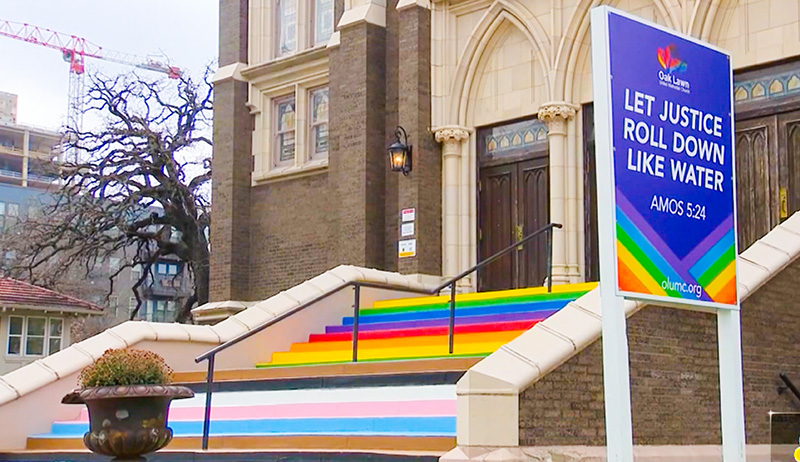
The Dallas Landmark Commission unanimously approved rainbow-colored steps outside Oak Lawn United Methodist Church as a temporary art installation, allowing the display to remain for up to three years despite objections that they violate historic preservation codes.
As a designated historic site, Oak Lawn United Methodist Church is required to seek city approval before making major exterior changes, including paint colors, according to Dallas-area PBS/NPR affiliate KERA.
The LGBTQ-welcoming church did not submit an application to the landmark commission before repainting its exterior steps in the colors of the "Progress Pride" flag, incorporating the traditional rainbow along with black and brown stripes and the blue, pink, and white of the transgender Pride flag.
These are challenging times for news organizations. And yet it’s crucial we stay active and provide vital resources and information to both our local readers and the world. So won’t you please take a moment and consider supporting Metro Weekly with a membership? For as little as $5 a month, you can help ensure Metro Weekly magazine and MetroWeekly.com remain free, viable resources as we provide the best, most diverse, culturally-resonant LGBTQ coverage in both the D.C. region and around the world. Memberships come with exclusive perks and discounts, your own personal digital delivery of each week’s magazine (and an archive), access to our Member's Lounge when it launches this fall, and exclusive members-only items like Metro Weekly Membership Mugs and Tote Bags! Check out all our membership levels here and please join us today!










You must be logged in to post a comment.