Olympics Logo – Photo: fotofritz16 via iStockphoto
The International Olympic Committee has barred transgender women from competing in women’s events and will require all athletes in female categories to undergo genetic sex testing, a sweeping policy shift that will take effect at the 2028 Summer Olympics in Los Angeles.
The decision marks the most high-profile move since Kirsty Coventry, a former Olympic champion swimmer from Zimbabwe, was elected IOC president in June 2025.
“At the Olympic Games, even the smallest margins can be the difference between victory and defeat,” Coventry said in a statement announcing the new policy. “So, it is absolutely clear that it would not be fair for biological males to compete in the female category. In addition, in some sports it would simply not be safe.”
Coventry defended the eligibility changes as science-based and developed in consultation with medical experts. Under the new policy, athletes seeking to compete in female-designated events must undergo a one-time SRY (sex-determining region Y gene) screening to determine whether they are male or female. The test, already used in track and field, is conducted via a cheek swab or saliva sample.
The IOC consulted a range of experts as it navigated a contentious issue that regularly stirs strong reactions among social conservatives and those skeptical of transgender identity. Even some left-leaning politicians, mindful of public opinion, have opposed or shifted their positions on transgender athletes competing in women’s sports.
Late last year, Dr. Jane Thornton, the IOC’s medical and scientific director and a former Olympic rower for Canada, presented initial findings from a 2024 review of transgender athletes and those with differences of sex development (DSD) in women’s sports. The analysis, which has not been made public, found that athletes without typical XX chromosomes retained physical advantages — even after treatment to reduce testosterone levels.
Several high-profile cases have involved athletes with DSD who were assigned female at birth but have male sex markers and elevated testosterone levels, including South African middle-distance runner Caster Semenya, a two-time Olympic gold medalist in the 800 meters, and Imane Khelif, the Algerian welterweight gold medalist at the 2024 Paris Olympics. Many of these athletes are unaware of their chromosomal makeup — a point proponents of sex testing cite in arguing for its use to determine eligibility.
The IOC’s announcement comes just days after international boxing officials cleared Lin Yu-ting, Taiwan’s 2024 Olympic featherweight champion, to return to competition following a review of her sex eligibility. The exact results of her test were never released.
Lin — who, like Khelif, was believed to have DSD and was barred from the 2023 IBA Women’s World Championships after allegedly failing an unspecified eligibility test — is expected to compete at the Asian Boxing Championships, which begin March 29 in Ulaanbaatar, Mongolia. The event will mark her first international competition since winning gold in Paris.
Semenya, the South African Olympic champion, spent years challenging rules requiring athletes with higher testosterone levels to take medication to remain eligible, losing at the Court of Arbitration for Sport but later winning a partial victory at the European Court of Human Rights.
Semenya was one of nine African athletes who signed a letter to Coventry detailing the “cruel and degrading treatment” they say they were subjected to, including invasive physical examinations, forced surgeries, and harmful hormone treatments that took a physical, emotional, and financial toll.
“Reintroducing genetic screening is not progress — it is walking backward,” Semenya said in a statement to the New York Times. “This is just exclusion with a new name.”
Only one transgender woman, New Zealand weightlifter Laurel Hubbard, has competed in the Olympics after transitioning. She competed at the Tokyo Games in 2021 but did not place, failing all three snatch attempts.
Previously, the IOC allowed transgender women to compete with reduced testosterone levels, leaving eligibility decisions to individual sports federations. In response, governing bodies in track and field, swimming, boxing, and rugby have introduced their own bans on transgender women competing in women’s events.
“This kind of brutal language doesn’t protect sports — it polices women’s bodies,” Payoshni Mitra, executive director of Humans of Sport, told The New York Times. “It fuels suspicion, invites public scrutiny and puts already vulnerable athletes at risk.”
President Donald Trump has threatened to bring the government to a standstill by refusing to sign any legislation until Congress passes the SAVE America Act, a bill requiring voters to prove their citizenship.
The bill, approved by the U.S. House of Representatives last month, is currently stalled in the Senate. It would require voters to prove their citizenship by submitting a U.S. passport or birth certificate matching the name on their voter ID when registering and present valid photo identification before casting a ballot. The measure would also require states to share voter information with the Department of Homeland Security to verify citizenship.
French ice dancer Guillaume Cizeron is at the center of a judging controversy after winning gold in the ice dance competition at the 2026 Milan Cortina Olympics.
Cizeron and partner Laurence Fournier Beaudry captured the top prize following a free dance that observers criticized for visible errors in their twizzle sequences during both the Rhythm and Free Dance segments. By contrast, silver medalists Madison Chock and Evan Bates were widely praised for delivering what CNN Sports described as a "nearly perfect" performance.
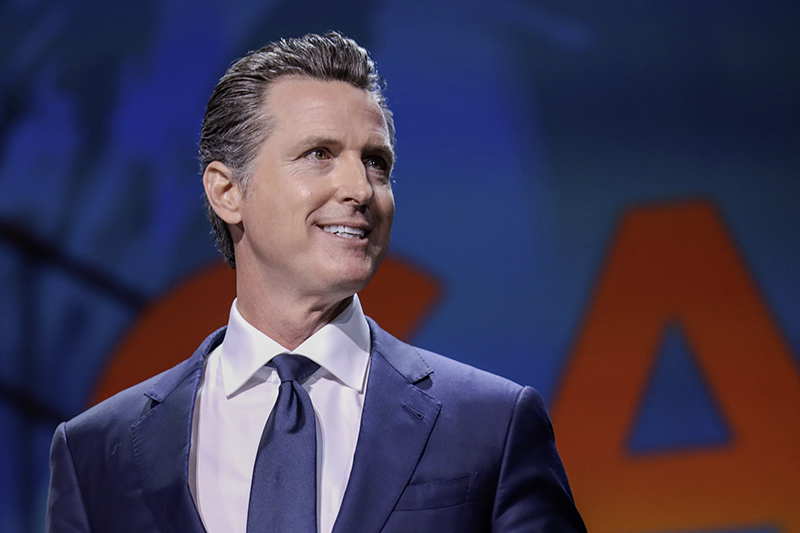
California Gov. Gavin Newsom is defending his support for the transgender community amid criticism of his stance opposing transgender women competing on women's sports teams.
In an interview with Katie Couric on the podcast Next Question with Katie Couric, the Democrat responded to a question about his past comments that it is "deeply unfair" to allow transgender women to compete in female athletic competitions.
Citing a comment from one of her Substack subscribers, Couric asked the governor about those remarks, as well as advice he gave Democrats in an interview last month with CNN's Dana Bash to spend less time focusing on pronouns and identity politics.
These are challenging times for news organizations. And yet it’s crucial we stay active and provide vital resources and information to both our local readers and the world. So won’t you please take a moment and consider supporting Metro Weekly with a membership? For as little as $5 a month, you can help ensure Metro Weekly magazine and MetroWeekly.com remain free, viable resources as we provide the best, most diverse, culturally-resonant LGBTQ coverage in both the D.C. region and around the world. Memberships come with exclusive perks and discounts, your own personal digital delivery of each week’s magazine (and an archive), access to our Member's Lounge when it launches this fall, and exclusive members-only items like Metro Weekly Membership Mugs and Tote Bags! Check out all our membership levels here and please join us today!










You must be logged in to post a comment.