The Trump administration is pushing FIFA to adopt a policy barring transgender athletes from competing in women’s professional soccer.
FIFA delayed approval of a joint bid by the United States, Mexico, Costa Rica, and Jamaica to host the 2031 Women’s World Cup, pushing it from the April 30 FIFA Congress to later this year. The delay stems from the Trump White House’s failure to provide required government guarantees, including commitments on visas, tax exemptions, and security measures needed for the bid to proceed.
Those guarantees are typically processed through the host federation — in this case, U.S. Soccer — before being included in the formal bid to FIFA. But despite the bid being presented in October, FIFA has yet to receive them, stalling the process.
Because the joint bid is the only one for the 2031 Women’s World Cup, it gives the host nations — particularly the United States — significant leverage, with the Trump White House demanding that FIFA follow the International Olympic Committee’s lead and ban transgender competitors in women’s soccer before providing any guarantees.
FIFA has said the delay in awarding the 2031 bid is intended to create a “standalone event” later this year that it hopes “will highlight the growing power and influence of women’s football and FIFA’s flagship women’s tournament,” according to The Athletic.
Andrew Giuliani, executive director of the White House Task Force on the FIFA World Cup, issued a boilerplate statement reiterating Trump’s push to ban transgender athletes in response to an inquiry from The Athletic.
“President Trump’s…decisive action has codified that it shall ‘be the policy of the United States to oppose male competitive participation in women’s sports more broadly, as a matter of safety, fairness, dignity, and truth,” Giuliani said. “We urge the entire sports world to commit to this principle and ensure fair competition for female athletes to thrive in this golden age of sports.”
Representatives from U.S. Soccer, speaking to The Athletic on condition of anonymity, said the guarantees for the 2031 bid have not arrived but cited “positive dialogue” with government officials and said they see “a path forward.”
Regulations for U.S. national teams are governed by FIFA. At the amateur level, U.S. Soccer had previously allowed players to register based on gender identity, with documentation such as a government-issued ID or verification from a health care provider or counselor. In 2021, the National Women’s Soccer League adopted a policy allowing transgender athletes to compete in women’s leagues if they lowered their testosterone to specified levels.
But in November, U.S. Soccer added a clause — aligning with Trump’s executive order and changes by the U.S. Olympic & Paralympic Committee, which bar transgender women from female-designated teams — promising to “ensure that women have a fair and safe competition environment.”
Some soccer players have protested efforts to ban transgender athletes, with retired U.S. women’s national team star Megan Rapinoe saying right-wing politicians are weaponizing women’s sports to justify broader restrictions.
In 2025, Angel City FC player Elizabeth Eddy, who retired this year, wrote in the New York Post that the National Women’s Soccer League — which currently has no transgender players — should restrict eligibility by confirming players were born with ovaries or subjecting them to genetic testing. Team captain Sarah Gorden and vice captain Angelina Anderson later made statements at a press conference that appeared to rebut Eddy’s claims.
Several other sports governing bodies have moved to ban transgender athletes at the elite level, underscoring a broader shift toward tighter eligibility rules. Some — including World Aquatics — have proposed a third “open” category for competition. Others that have restricted transgender athletes from competing as women include World Athletics; the World Boxing Council; UCI, cycling’s governing body; and, in the United States, organizations such as USA Rugby and the United States Tennis Association.
The International Olympic Committee has barred transgender women from competing in women’s events and will require all athletes in female categories to undergo genetic sex testing, a sweeping policy shift that will take effect at the 2028 Summer Olympics in Los Angeles.
The decision marks the most high-profile move since Kirsty Coventry, a former Olympic champion swimmer from Zimbabwe, was elected IOC president in June 2025.
"At the Olympic Games, even the smallest margins can be the difference between victory and defeat," Coventry said in a statement announcing the new policy. "So, it is absolutely clear that it would not be fair for biological males to compete in the female category. In addition, in some sports it would simply not be safe."
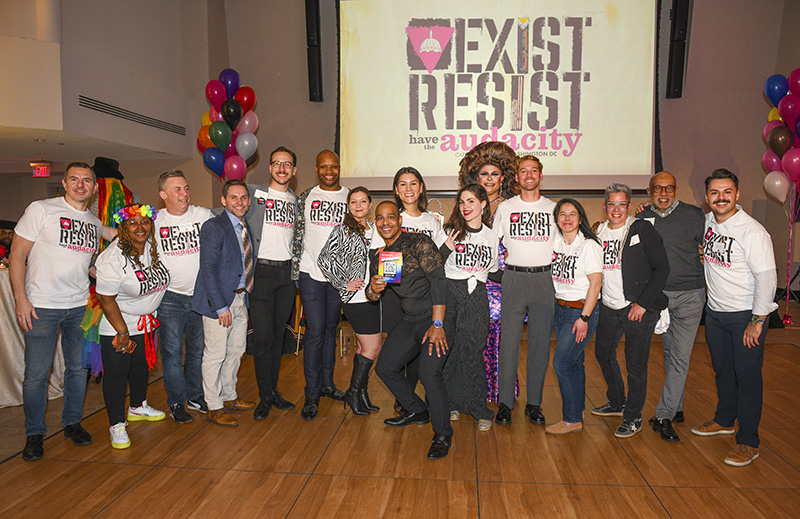
At its annual reveal party, the Capital Pride Alliance unveiled the theme for 2026 Capital Pride: "Exist. Resist. Have the Audacity!"
The theme is rooted in what the organization calls "the undeniable truth that our existence is not up for debate," and serves as a call for the community to "live loudly and proudly, stand firm against injustice and erasure, and embody the collective strength that has always defined the LGBTQ+ community."
"This year's theme is both a declaration and a demand," said Ryan Bos, CEO and president of the Capital Pride Alliance, in a statement. "'Exist. Resist. Have the Audacity!' reflects the resilience of our community and our responsibility to protect the progress we've made. As we look toward our nation's 250th anniversary, we affirm that LGBTQ+ people have always been and always will be a part of the United States' history, and we will continue shaping its future with strength and resolve."
Arkansas Gov. Sarah Huckabee Sanders was asked to leave a Little Rock restaurant, with the owner citing concerns from LGBTQ employees over her political positions.
On March 13, Sanders dined at The Croissanterie, arriving unannounced with two guests, staff members, and her State Police Executive Protection Detail.
Her party had been seated for more than an hour and had already paid and tipped when she said the restaurant owner asked a member of her security detail to have them leave.
These are challenging times for news organizations. And yet it’s crucial we stay active and provide vital resources and information to both our local readers and the world. So won’t you please take a moment and consider supporting Metro Weekly with a membership? For as little as $5 a month, you can help ensure Metro Weekly magazine and MetroWeekly.com remain free, viable resources as we provide the best, most diverse, culturally-resonant LGBTQ coverage in both the D.C. region and around the world. Memberships come with exclusive perks and discounts, your own personal digital delivery of each week’s magazine (and an archive), access to our Member's Lounge when it launches this fall, and exclusive members-only items like Metro Weekly Membership Mugs and Tote Bags! Check out all our membership levels here and please join us today!





You must be logged in to post a comment.