USA Powerlifting has settled a lawsuit with JayCee Cooper, a transgender woman who sued in 2021 after being barred from two women’s competitions in 2018, following a Minnesota Supreme Court ruling last October that the organization discriminated against her.
Cooper was undergoing hormone therapy in 2018 to lower her testosterone levels and sought a medical exemption, as the treatment is prohibited by the World Anti-Doping Agency.
Although USA Powerlifting did not have a policy on transgender competitors when Cooper applied, it soon issued a blanket ban prohibiting transgender women from competing in female-designated competitions and barring transgender men from competing if they were taking testosterone as part of their transition.
In her lawsuit, Cooper argued that USA Powerlifting’s rules violated Minnesota’s nondiscrimination laws, which explicitly protect sexual orientation and gender identity. USA Powerlifting countered that she had an unfair advantage due to having undergone male puberty prior to transitioning.
Cooper also cited International Olympic Committee rules — since revoked — that allowed transgender women to compete if their testosterone levels remained below a certain threshold for at least 12 months. The International Powerlifting Federation, USA Powerlifting’s parent organization, had a similar rule but did not require individual affiliates to follow it. Cooper submitted documentation showing that her testosterone levels had remained below the IOC’s threshold for two years.
In 2023, Cooper won at trial, with a state judge finding that USA Powerlifting’s ban on transgender athletes in women’s competitions violated her civil rights. The organization appealed, and the Minnesota Court of Appeals reversed the decision, ruling that USA Powerlifting had based its policy on Cooper’s physiology rather than her gender identity.
Cooper then appealed to the Minnesota Supreme Court, which in 2025 ruled in her favor, finding that USA Powerlifting’s policy was discriminatory on its face. The court sent the case back to a lower court to determine whether USA Powerlifting had a legitimate business interest in its policy.
USA Powerlifting ultimately chose to settle the lawsuit rather than continue with legal proceedings. The details of the settlement have not been made public but reportedly include a financial remedy, according to Twin Cities FOX affiliate KMSP-TV.
USA Powerlifting said its future in Minnesota remains unclear but that it will continue to operate in other states. Officials said they will review their options in the coming weeks. The organization’s policy would likely be easier to enforce in states with laws prohibiting transgender participation in women’s sports.
In a statement reeking of bitterness, USA Powerlifting’s former president, Larry Maile, acknowledged the settlement but criticized Minnesota’s nondiscrimination law for lacking a carve-out for athletics.
“The state Supreme Court ruling has created legal dissonance for Minnesota sporting organizations, where complying with state law risks creating federal liability and vice versa,” Maile said in the statement. “We would like to avoid becoming an agent of discrimination against the largest protected class in the country — women.”
In a separate statement, Maile said, “What the plaintiffs cast as a victory for transgender rights is a ruling that has forced Minnesota to take a step backward for women, fair competition and common sense.”
Jess Braverman, legal director of Gender Justice, a Minnesota-based group that helped represent Cooper, hailed the settlement as a victory for transgender athletes.
“We celebrate this victory, but we also remain vigilant,” she said. “We will continue to ensure that all Minnesotans, including transgender Minnesotans, can participate in sports, schools, employment, and health care without facing discrimination because of who they are.”
FCC Chair Brendan Carr is seeking public comment on proposed changes to the parental ratings system that would flag content related to gender identity.
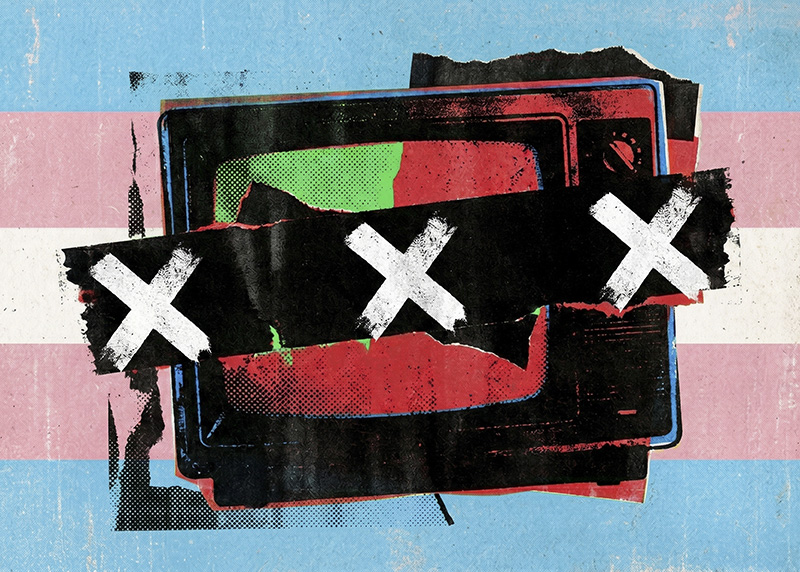
Federal Communications Commission Chair Brendan Carr is seeking public input on whether television programs that address transgender issues or feature trans or nonbinary characters should carry warning labels.
The FCC oversees broadcast and cable TV companies and helps shape the ratings system that guides parents on whether shows are appropriate for children.
In 1996, Congress gave TV companies the option to create their own voluntary ratings system or adopt one imposed by the FCC. The companies chose to create their own system, forming the TV Oversight Management Board, which developed the TV Parental Guidelines still used today for cable, satellite, and streaming services.
A Kentucky bill that sought to bar transgender people from teaching has failed.
State Sen. Gex ("Jay") Williams (R-Verona) introduced SB 351 in early March to prevent transgender people from obtaining or keeping teaching certifications.
Under the bill, anyone reported to state education officials as potentially transgender would have been required to undergo medical exams and submit the results to obtain or renew a teaching license.
The bill also would have barred teaching certificates for anyone "who has been treated for or diagnosed with any disorder that is excluded from the American with Disabilities Act of 1990 by a licensed medical professional, as these disorders were defined in the Diagnostic and Statistical Manual of Mental Disorders at the time."
The Tennessee State Senate has approved a bill requiring clinics to report detailed data on patients receiving gender-affirming care, a move critics warn could enable the state to track transgender people and the doctors who treat them.
The measure requires all gender clinics in Tennessee to submit monthly reports to the Department of Health on patients who receive transition-related treatments or surgery. The state would then publish annual reports based on that data.
The reports would exclude patients’ names but include details such as age, sex assigned at birth, prescribed medications, and the dates prescriptions were written or surgical referrals made. The requirement would apply not only to those receiving gender-affirming care, but also to patients seeking treatment for side effects or those who later experience "regret" and pursue "detransition."
These are challenging times for news organizations. And yet it’s crucial we stay active and provide vital resources and information to both our local readers and the world. So won’t you please take a moment and consider supporting Metro Weekly with a membership? For as little as $5 a month, you can help ensure Metro Weekly magazine and MetroWeekly.com remain free, viable resources as we provide the best, most diverse, culturally-resonant LGBTQ coverage in both the D.C. region and around the world. Memberships come with exclusive perks and discounts, your own personal digital delivery of each week’s magazine (and an archive), access to our Member's Lounge when it launches this fall, and exclusive members-only items like Metro Weekly Membership Mugs and Tote Bags! Check out all our membership levels here and please join us today!










You must be logged in to post a comment.