While clinical journals are informative tools for their intended professional audience, they’re fairly bland reading for most. Anyone, however, would likely have been chillingly unsettled reading pages 250 and 251 of the June 5, 1981, issue of the Morbidity and Mortality Weekly Report, prepared by the Centers for Disease Control. (Now Centers for Disease Control and Prevention.)
“In the period October 1980-May 1981, 5 young men, all active homosexuals, were treated for biopsy-confirmed Pneumocystis carinii pneumonia at 3 different hospitals in Los Angeles, California,” begins the particular report. “Two of the patients died.”
Each merited his own paragraph. “Patient 1: A previously healthy 33-year-old man….” “A previously healthy 30-year-old man….” And so on. As the months passed, this terrible trickle became a deluge of despair and death. It became the HIV/AIDS pandemic, tearing through lives and communities around the world.
Marking this grave anniversary, Whitman-Walker Health — which traces its start back to 1973 as the Gay Men’s VD Clinic — along with partners the Center for Black Equity, Food & Friends, HIPS, and Us Helping Us, People Into Living — presents the 2012 Oscar-nominated documentary, How to Survive a Plague.
The June 5 screening at Lisner Auditorium will be followed by a candlelight vigil in Dupont Circle, as part of the “Seven Days in June” action protesting massive cuts of more than $1 trillion to health care.
David France, a renowned documentarian and journalist, directed the film, which follows several activists through archival footage and interviews, recounting the birth of a movement that changed how affected communities and the medical establishment interact. And the story he tells with the film, as well as with a 2016 book of the same title, is one he’s been writing since it began.
“I started writing in the gay press in ’81, which is the first year of the first inkling of the pandemic,” France recalls. “I was working for the New York Native, which really broke ground on the AIDS epidemic more than any other publication, at least for a number of years. As editor, I brought Randy Shilts to New York for some of our coverage, and that’s what comprised a lot of his East Coast chapters in his book [And the Band Played On].”
How to Survive a Plague
While France often charges into covering fraught topics such as the horrific persecution LGBTQ communities have suffered in Chechnya and post-war Iraq, he shares that the message of How to Survive a Plague shouldn’t be perceived as one of despair. There is no denying the pain and scars HIV/AIDS has left in its wake, including France losing his partner Doug Gould to the disease. But France chooses to put the emphasis on a more positive message.
“The film reminds the world of what the queer community was facing then, what it took on and what it accomplished,” France says. “The people — the ‘stars,’ if you will — of How to Survive a Plague are all in their 20s and were given death sentences, and managed not to just go home and bemoan that, but to organize in an effective way, and to take on power in ways that our community had never taken on before. There’s an inspiration in the film that says it is possible to seize power — even when you are as disenfranchised and despised as we were in the 1980s and 1990s — and use that power for these tremendous kinds of history-changing impacts.”
That impact — largely driven by ACT UP (AIDS Coalition to Unleash Power) and TAG (Treatment Action Group) — remains today. The now-routine relationships between pharmaceutical companies, researchers, regulators, and patient advocates are part of the legacy of activists who loudly and forcefully challenged the institutional status quo when the AIDS crisis hit.
“They demanded a voice, a role in every aspect of research, and they got it,” France says of the hard-fought wins AIDS activists secured, as detailed in How to Survive a Plague. “They won it through force, though this strategy called the ‘inside/outside strategy.’ The loud mobs in the streets were forcing open the doors of ‘Big Pharma’ to allow their own elite, self-trained science geeks to go through those doors and begin conversations with people who were forced to listen to them.
“Now, with almost every disease, there’s a community panel of people impacted by the disease brought in to form a community advisory board. CABs are now part of the expected structure of research. That’s one of the lasting impacts of the work that this small handful of people did that you see in the film. This film is about what people were able to accomplish despite everything else.”
How to Survive a Plague screens Friday, June 5, 5:30 to 7:45 p.m., at George Washington University’s Lisner Auditorium, 730 21st St. NW. Doors open at 5 p.m. The event is free, but a reservation is suggested. Click here to register.
The candlelight vigil to mark Seven Days in June follows in Dupont Circle.
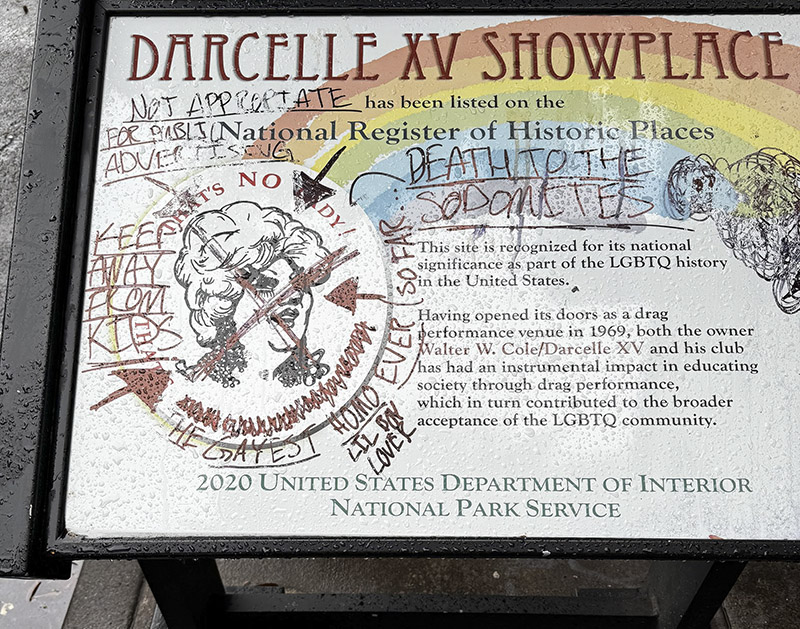
The owner of Portland's Darcelle XV Showplace says a historic plaque honoring the club's listing on the National Register of Historic Places was vandalized with anti-gay graffiti and what he described as "vile hate speech."
Jeremey Corvus-Peck said in a May 15 Facebook post that he discovered the vandalism while visiting the club earlier that day.
The graffiti invoked anti-LGBTQ tropes portraying gay and queer people as child "groomers" or pedophiles, mocked LGBTQ visibility, and called for violence against members of the community.
"I think we have an inherent human need to gather and form connections with people that are like us, particularly as a non-majority group," says Rachel Karp. "As long as queer people are not the majority, I think there will be a desire and a need for in-person queer spaces."
Karp, co-producer of the podcast Cruising, is the author of the forthcoming The Lesbian Bar Chronicles, which profiles many of the approximately thirty or so remaining lesbian bars in the United States. The 30-year-old recalls how the podcast and book were both inspired by news reports during the COVID pandemic about the closure of bars and restaurants that were unable to keep operating due to government-mandated lockdowns.
The District of Columbia Mayor's Office of LGBTQ Affairs is promoting four city-sponsored events in June to commemorate LGBTQ Pride Month.
"These moments are designed to honor our history, elevate our community, and celebrate the partnerships that continue to move us forward," D.C. Mayor Muriel Bowser said in a statement.
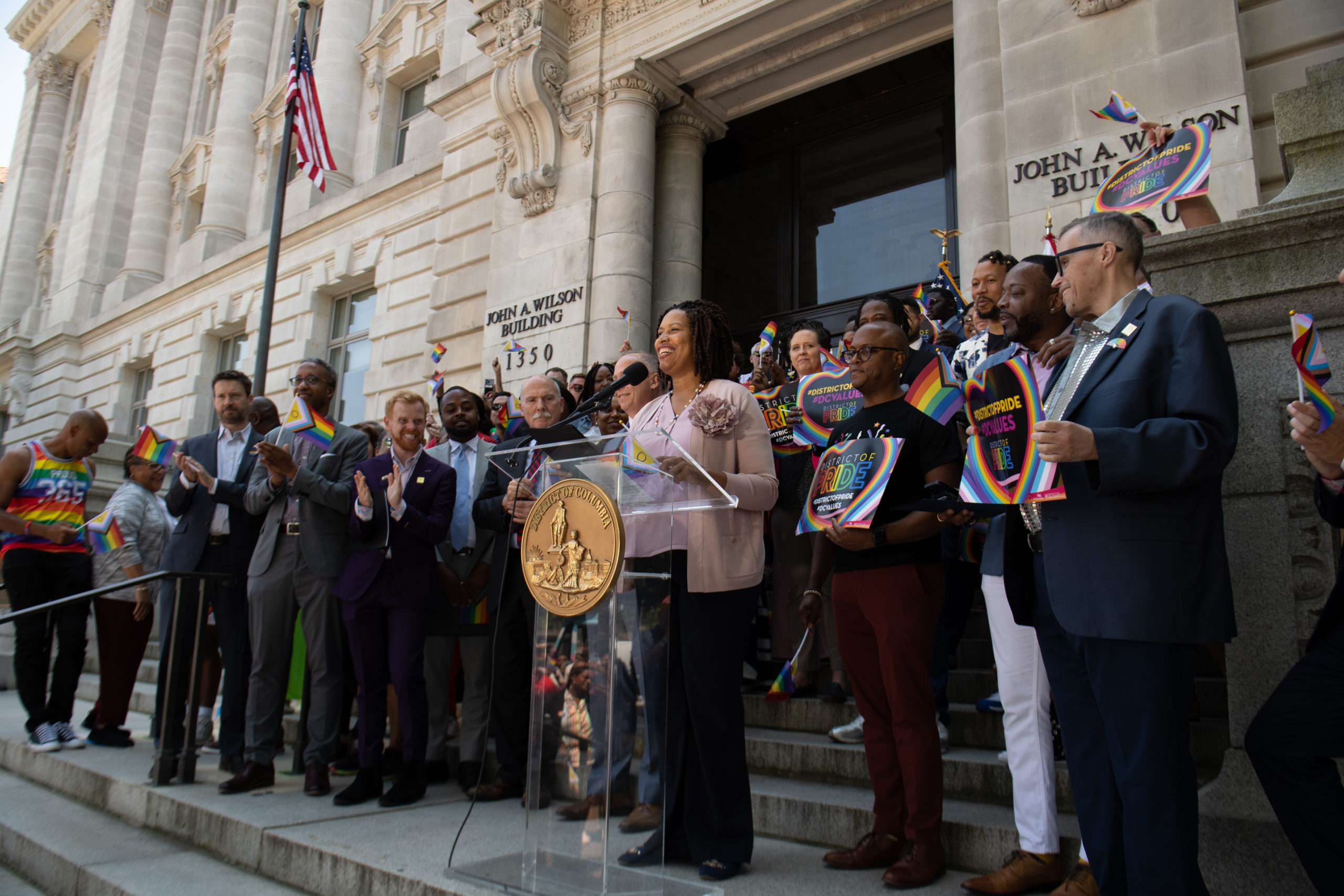
Beginning Monday, June 1, at 4 p.m., the Mayor's Office of LGBTQ Affairs will host its annual Pride flag-raising ceremony at the John A. Wilson Building. The event, considered the symbolic start of Pride Month, will feature remarks from the mayor and several community leaders on the building's steps before attendees gather for a group photograph.
These are challenging times for news organizations. And yet it’s crucial we stay active and provide vital resources and information to both our local readers and the world. So won’t you please take a moment and consider supporting Metro Weekly with a membership? For as little as $5 a month, you can help ensure Metro Weekly magazine and MetroWeekly.com remain free, viable resources as we provide the best, most diverse, culturally-resonant LGBTQ coverage in both the D.C. region and around the world. Memberships come with exclusive perks and discounts, your own personal digital delivery of each week’s magazine (and an archive), access to our Member's Lounge when it launches this fall, and exclusive members-only items like Metro Weekly Membership Mugs and Tote Bags! Check out all our membership levels here and please join us today!






You must be logged in to post a comment.