The U.S. Supreme Court has ruled that state bans prohibiting transgender athletes from competing on girls’ and women’s sports teams in high school and college are constitutional and do not violate transgender athletes’ right to equal protection under the law.
The 6-3 decision does not apply to intramural mixed-gender sports teams, such as voluntary adult leagues that do not receive federal funding.
The nation’s highest court found that Title IX — the federal law prohibiting sex-based discrimination in educational settings — allows schools to maintain separate women’s and men’s sports teams based on biological sex due to the inherent physical differences between biological men and biological women.
The court also ruled that the term “sex” in U.S. law “cannot plausibly be interpreted to refer to anything other than biological sex.”
“To provide equal opportunity for female athletes, schools do not merely maintain, for example, one soccer team, one basketball team, one ice hockey team, and one lacrosse team that are equally open to female and male athletes. That approach would deny equal opportunity to female athletes because, as all agree, females and males have inherent physical differences relevant to athletic performance,” Justice Brett Kavanaugh wrote for the court’s conservative majority. “Those ‘[p]hysical differences between men and women’ are ‘enduring.’ … To ensure equal opportunity for female athletes, schools therefore typically maintain separate women’s and men’s sports teams.”
Noting that 27 states — as well as the International Olympic Committee, the United States Olympic and Paralympic Committee, and the NCAA — have adopted laws or policies restricting transgender female athletes from competing in female-designated sports, Kavanaugh found that neither Title IX nor the Equal Protection Clause of the Fourteenth Amendment prohibits schools from restricting transgender athletes from certain teams based on their sex assigned at birth.
One of the plaintiffs, Becky Pepper-Jackson, a transgender female who challenged West Virginia’s 2021 ban on transgender athletes, argued that schools should make exceptions for transgender individuals who identify as female and have taken puberty blockers to prevent the onset of male puberty, when males typically acquire the physical and physiological traits that advantage them over females.
But the court found that Title IX, as written, does not support that argument, finding that sex-segregated sports teams are “reasonable” given the inherent differences between the sexes — even if a transgender individual receiving gender-affirming care may not possess those exact physical advantages. Requiring schools to make individualized assessments, the court said, would force states and school districts to compare the physical and athletic abilities of transgender athletes on a case-by-case basis.
The court also found that, absent restrictions based on biological sex, it would be nearly impossible for judges to determine how puberty blockers or hormone therapy affect individual transgender athletes when deciding whether they are eligible to compete.
The court also found that even if some transgender athletes taking hormones or puberty blockers no longer retain physical advantages over cisgender females — a contention that remains the subject of ongoing medical and scientific debate — allowing schools to distinguish based on students’ biological sex does not violate transgender students’ equal protection rights.
Addressing Pepper-Jackson’s legal arguments, Kavanaugh wrote: “[I]t is an unhappy occasion whenever a student who wants to play school sports cannot do so. We appreciate the desire of every student, including B. P. J., who wants to play school sports. And we recognize that student-athletes are understandably disappointed and upset when they do not make a team or otherwise cannot participate. But the Title IX regulations guarantee ‘equal athletic opportunity.’ The regulations cannot and do not guarantee every student a spot on a team’s roster.”
Kavanaugh also rejected arguments that the Supreme Court’s ruling in Bostock v. Clayton County — which held that Title VII of the Civil Rights Act of 1964 prohibits employment discrimination based on sexual orientation or gender identity — applied to Title IX sports cases.
“Stated simply, Title VII and Bostock are not relevant in this very different statutory and factual context. In sum, Title IX allows schools to provide separate women’s and men’s sports teams defined by biological sex,” Kavanaugh wrote.
In a dissenting opinion, Justice Sonia Sotomayor — joined by Justices Elena Kagan and Ketanji Brown Jackson — agreed in part with the majority, finding that the transgender athletes’ Title IX claim fails, “although on a narrower basis than that on which the majority relies,” but disagreed with the majority’s conclusion regarding the equal protection claims.
“Applying a form of heightened scrutiny divorced from this Court’s cases, the majority holds that transgender girls like B. P. J. who wish to play girls’ sports are not protected by the Constitution, even if B. P. J. is correct that neither of the State’s interests is furthered by their exclusion,” Sotomayor wrote. “Yet the Equal Protection Clause demands much more when a State deploys a sex classification to achieve legislative aims. Perhaps West Virginia could meet those demands. Perhaps not.
“In either event, because unresolved factual questions prevent the Court from assessing the merits of B. P. J.’s equal protection claim at this time, the Court should allow the District Court to address those factual questions in the first instance. Yet in an opinion unencumbered by fact or law, the majority today cuts off that process prematurely, deciding instead that B. P. J.’s case must end now.
“This litigation implicates deeply sensitive, contentious, and evolving issues. These circumstances demand exercising judicial restraint, not rushing to answer conclusively difficult questions without sufficient evidentiary development,” Sotomayor continued.
“In opting otherwise, the majority extends great sympathy to those it favors: the young cisgender girls and women who play sports. I share that sympathy. Playing sports can lead to benefits that are immeasurable, and many are understandably invested in ensuring that competition stays fair and safe.
“Because the majority, however, inflicts a hardship on those it disfavors without giving them the fair and full opportunity the Constitution requires to litigate their contentions, I respectfully dissent,” she concluded.
“This is a heartbreaking ruling for our clients and transgender girls like them who’ve asked for nothing more than the same opportunities afforded to their peers,” Joshua Block, senior counsel for the ACLU’s LGBTQ & HIV Rights Project, said in a statement. “The reality is that the equality of transgender women and girls takes nothing away from, and in fact promotes, the equality of all women and girls.”
“This ruling is deeply harmful for transgender women and girls who only asked for the ability to participate in sports with their peers,” Sasha Buchert, senior attorney and director of Lambda Legal’s Non-Binary and Transgender Rights Project, said in a statement. “Now, one population, transgender youth and collegians, are targeted for specific and baseless discrimination.”
Lawyers for the plaintiffs argued that transgender athletes — and in some cases, cisgender athletes falsely accused of being transgender — are likely to face harassment or be wrongly barred from sports participation. They pointed to several recent examples, including a Utah basketball player who faced threats after a state lawmaker falsely claimed she had been born male and an Arizona student barred from sports because a clerical error listed him as female on his original birth certificate.
Kelley Robinson, president of the Human Rights Campaign, condemned the decision and urged LGBTQ advocates to remain politically engaged to prevent additional states and localities from adopting similar bans.
“No kid — not my kid, not your kid, not any kid — deserves to be discriminated against. Yet this ruling is heartbreaking for transgender student athletes who are being forced to sit on the sidelines simply for who they are,” Robinson said.
“When politicians convince the public that any girl could be ‘the wrong kind of girl,’ they invite harassment, intimidation, invasive questioning, or even an inspection of their body by a total stranger. It’s sadly just the latest decision by the conservative justices on the Supreme Court to roll back protections for marginalized communities and create a second-class citizenship for millions of people.”
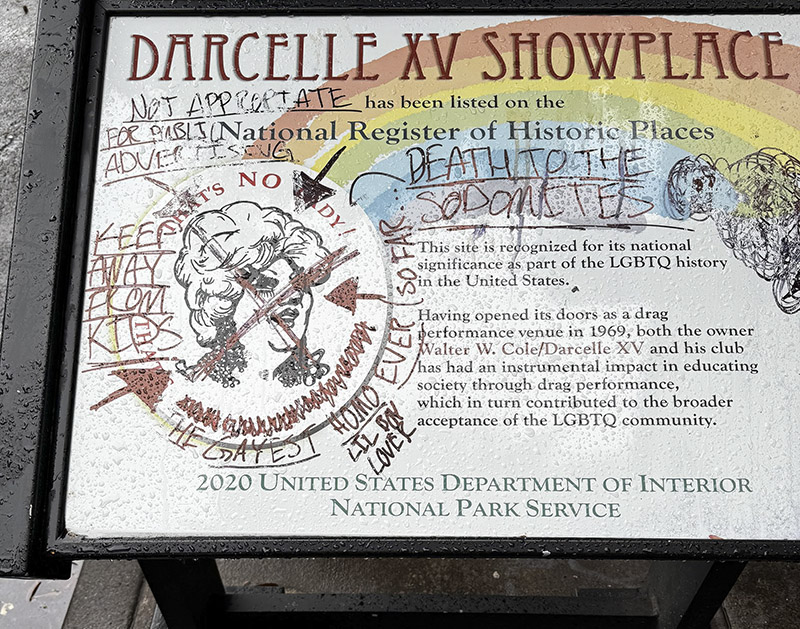
The owner of Portland's Darcelle XV Showplace says a historic plaque honoring the club's listing on the National Register of Historic Places was vandalized with anti-gay graffiti and what he described as "vile hate speech."
Jeremey Corvus-Peck said in a May 15 Facebook post that he discovered the vandalism while visiting the club earlier that day.
The graffiti invoked anti-LGBTQ tropes portraying gay and queer people as child "groomers" or pedophiles, mocked LGBTQ visibility, and called for violence against members of the community.
The organizers of the Rome Pride Parade, scheduled for June 20, have barred at least two Jewish LGBTQ groups from participating with a float, saying the organizations failed to sufficiently distance themselves from what organizers call the "genocide in Gaza."
"Anyone who shares the founding values of our movement and our community can join us in the streets," Roma Pride, the organization behind the parade, wrote in a May 26 Facebook post. "The guiding principle of a political demonstration is its manifesto, and in ours, the position of Rome Pride on the ongoing genocide in Gaza carried out by the State of Israel is clear.
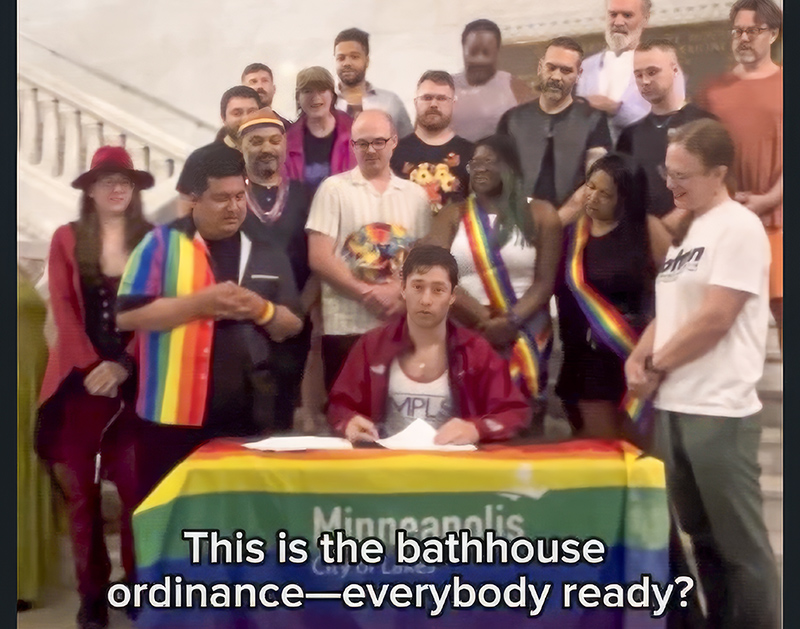
Minneapolis has repealed its nearly four-decade ban on gay bathhouses after the City Council voted 9-2 to approve two technical amendments to the city code effectively repealing the prohibition on bathhouses and adult sex venues.
The original ban was imposed in 1988 as part of an effort to curb the spread of HIV and reduce the number of AIDS cases, which had surged among men who have sex with men.
But in recent years, advocates have urged city leaders to repeal the 1988 ordinance, arguing that advances in HIV prevention have made it easier to protect people from contracting the virus.
These are challenging times for news organizations. And yet it’s crucial we stay active and provide vital resources and information to both our local readers and the world. So won’t you please take a moment and consider supporting Metro Weekly with a membership? For as little as $5 a month, you can help ensure Metro Weekly magazine and MetroWeekly.com remain free, viable resources as we provide the best, most diverse, culturally-resonant LGBTQ coverage in both the D.C. region and around the world. Memberships come with exclusive perks and discounts, your own personal digital delivery of each week’s magazine (and an archive), access to our Member's Lounge when it launches this fall, and exclusive members-only items like Metro Weekly Membership Mugs and Tote Bags! Check out all our membership levels here and please join us today!








You must be logged in to post a comment.