Capital Stonewall Democrats at the Capital Pride Parade – Photo: queeringancs.org
“We really see ourselves as a pipeline-building organization,” says Stevie McCarty, president of the Capital Stonewall Democrats, D.C.’s leading LGBTQ political organization. The group’s latest initiative seeks to recruit LGBTQ residents to run for local office — specifically, as Advisory Neighborhood Commissioners.
In D.C. politics, Advisory Neighborhood Commissioners — part-time, unpaid, nonpartisan representatives — are the elected officials closest to residents.
Every two years, 345 ANC seats — each representing approximately 2,000 residents in a particular geographic area — appear on the ballot.
Once elected, commissioners serve on Advisory Neighborhood Commissions (ANCs) across the city’s eight wards. They represent their neighborhoods and advise city agencies on issues including zoning, construction and economic development, liquor and business licensing, traffic-calming measures, sanitation and pest abatement, and public safety.
The Capital Stonewall Democrats sees those 345 seats as an opening. Although the District’s LGBTQ population is proportionally almost twice as large as that of any state, political observers have criticized the pool of ANC candidates for failing to reflect the diversity of the communities they serve — including neighborhoods with large LGBTQ populations.
To increase LGBTQ representation on ANCs, the Capital Stonewall Democrats has launched “Queering the ANCs,” a first-of-its-kind digital program designed to recruit, train, and support LGBTQ candidates running for ANC seats.
“In a perfect world, we would love to fill every ANC seat. Last cycle, there were approximately 55 ANC seats that had no candidates at all,” says McCarty, who represents ANC 2G04. Such vacancies can remain unfilled for months or even years if no one steps forward.
Another common criticism of ANCs is that many races attract only one candidate, making the outcome a fait accompli rather than a contest between competing platforms or ideas.
The proportion of out LGBTQ commissioners has hovered around 10% to 11% — lower than the LGBTQ share of D.C.’s overall population.
“We are working on this program seeking to close that gap,” McCarty says. “Queering the ANCs” is part of the organization’s longer-term strategy to build a bench of viable LGBTQ candidates for office.
“Think about the council races that will be on the ballot in 2028,” he continues. “By building a pipeline of ANC commissioners, we can give LGBTQ people the confidence, know-how, and resumé that come from serving in local government.” That experience can give them greater credibility if they later run for the D.C. Council, mayor, the State Board of Education, or another elected office.
How It Works
At the heart of the initiative is a web-based tool that gauges a person’s interest, availability, and readiness to run for an ANC seat. Users take an online quiz, enter their address, and learn who currently represents their neighborhood.
Once would-be candidates receive their quiz results, they are invited to create a “Campaign Copilot” account, which shares their name with the Capital Stonewall Democrats and gives them access to a candidate portal.
After registering as official candidates, they can obtain voter files from the D.C. Board of Elections and upload them to the portal. The files allow them to verify petition signatures and develop lists of doors to canvass. The portal also provides a “to-do” list that guides candidates through each stage of their campaigns.
To appear on the ballot, ANC candidates must submit 25 signatures from registered D.C. voters by 5 p.m. on Wednesday, August 5. The portal explains where and how to submit petitions and includes a tracker to help candidates monitor the signatures they have collected.
“We built this tool because too many people who would make excellent commissioners in their neighborhoods are simply never asked to run, and they don’t know where to start or never receive the practical support they need to get on the ballot,” McCarty says. “So we wanted to build this in a simple, useful, and accessible way that commissioners can use or candidates can use on their own time as they work towards becoming a commissioner.”
The portal includes training modules and courses, along with tools that allow candidates to set voter-contact and petition-signature goals. McCarty says the features are intended to make campaigning feel more manageable and approachable.
“It can be really scary for people to think about the extra time commitment when you’re serving, let alone when you’re campaigning,” McCarty says. “It’s almost like a campaign wellness app, if you think of Apple Fitness. You can set goals, like, ‘I want to get 10 petition signatures this week,’ or ‘I want to talk to five neighbors this week.’”
A check-in board provides weekly prompts encouraging candidates to meet those goals.
The candidate portal also includes a safety toolkit addressing online data privacy and offering practical guidance for candidates canvassing neighborhoods or gathering petition signatures.
The resources reflect the heightened risk of harassment and victimization faced by queer and transgender candidates. “Campaigning can be scary, and it’s very difficult for queer and trans members of the community to step into full public life,” he says. “So the lessons are designed with some of that framing to help keep people safe.”
For residents who are unable or unwilling to run themselves, “Queering the ANCs” offers a tool for nominating neighbors as potential candidates. The tool sends nominees an email encouraging them to run and directing them to the campaign resources.
“Maybe you don’t want to run for ANC yourself. But this type of power-building has to be a shared community effort,” McCarty says. “Maybe your nudge, or the 60-second quiz, is what gets somebody motivated.
“So we’re encouraging our ward captains, and anyone who feels like they know their neighbors well enough, to nominate people. You can even create or host an event and bring neighbors together to talk about finding candidates to run. So it walks you through how to develop that community and how to coach neighbors through the process.”
To learn more, launch a campaign, or nominate someone to run for an ANC seat, visit queeringancs.org.
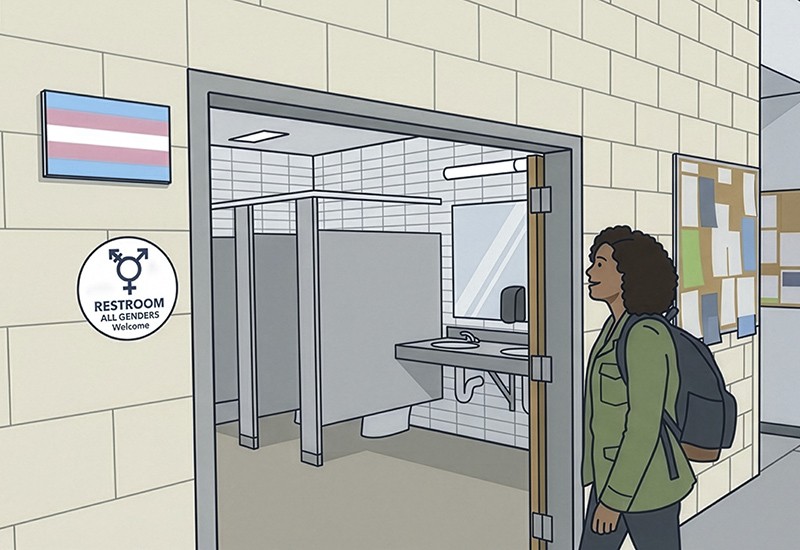
A transgender advocacy group has created a crowdsourced map of trans-friendly bathrooms in Idaho to help residents find facilities they can use safely.
State lawmakers recently passed a law prohibiting people from entering bathrooms that don't align with their assigned sex at birth. The law, which took effect earlier this month, applies to government-owned buildings and private businesses open to the public, including gas stations, restaurants, entertainment venues, and hospitals.
A first violation of the law -- which opponents have dubbed a "bathroom ban" -- is punishable by up to one year in prison. A second or third violation could carry up to five years, or potentially life in prison if prosecutors invoke the state's "persistent violator" statute.
Idaho officials suggested that DNA testing could be used to enforce the state's transgender bathroom ban, one of the strictest in the nation. The law applies not only to government-owned buildings but to any place of public accommodation, including privately owned businesses.
The law, which has been challenged in federal court by six transgender Idahoans, is set to take effect on July 1. Under its provisions, anyone who enters a bathroom or changing room that does not align with their assigned sex at birth in a place of public accommodation can be charged with a misdemeanor and face up to a year in jail.
A gay couple is recovering after what they believe was a bias-motivated assault in Caldwell, Idaho.
Eric Reed and Juan Olvera said they were leaving a restaurant near Indian Creek Plaza, a downtown shopping and dining district, on the evening of June 13 when several men allegedly yelled homophobic slurs at them.
The couple said they were chased through a parking lot and assaulted by one of the men near the railroad tracks at 9th Avenue.
"I literally thought I was going to die, and I don't even know how to explain the fear I have right now. We haven't left the house for the past few days," Olvera told Boise NBC affiliate KTVB. "What's going to happen to the next person? Are they going to kill them? I literally felt they were going to kill us for being gay. It's a scary thing to live through, and I never would wish this on anyone."
These are challenging times for news organizations. And yet it’s crucial we stay active and provide vital resources and information to both our local readers and the world. So won’t you please take a moment and consider supporting Metro Weekly with a membership? For as little as $5 a month, you can help ensure Metro Weekly magazine and MetroWeekly.com remain free, viable resources as we provide the best, most diverse, culturally-resonant LGBTQ coverage in both the D.C. region and around the world. Memberships come with exclusive perks and discounts, your own personal digital delivery of each week’s magazine (and an archive), access to our Member's Lounge when it launches this fall, and exclusive members-only items like Metro Weekly Membership Mugs and Tote Bags! Check out all our membership levels here and please join us today!







You must be logged in to post a comment.