Supreme Court Justice Samuel Alito – CBS News Screenshot
U.S. Supreme Court Justice Samuel Alito, a Catholic who is one of the high court’s most doctrinaire conservatives, says in a new book that the court’s decision extending marriage rights to same-sex couples was “perhaps the decisive point in our nation’s turn against religious liberty.”
Alito, who dissented in the 2015 Obergefell v. Hodges case, made the claim in a speech at Catholic University of America (CUA) three years after the decision. The remarks were published in So Ordered, a collection of the justice’s speeches that he says reflect his judicial philosophy and views of the United States.
Seven of the 19 speeches published in the book were delivered to Catholic groups, reports ABC News.
“In dissent from that ruling, I expressed my worry that equating the expression of certain views with bigotry — or, if you like, with dignitary harm — would drive believers out of public life,” Alito said in the 2018 CUA speech.
Throughout So Ordered, Alito claims in several speeches that “support for religious liberty has cratered.” As evidence, he cites a string of court cases involving conflicts between supporters of marriage equality and people, particularly business owners, who claim to have “sincerely held religious beliefs” opposing same-sex nuptials.
“What we see in these and other cases,” Alito said in a 2022 speech, “is a refusal to live in peace with those who violate the new moral code.” He added that conflicts over those differing views will “virtually guarantee that the Supreme Court will continue to see a steady stream of religious-liberty cases.”
But as ABC noted, in nearly every case cited by Alito, the high court — with Alito in the majority — sided with those asserting religious objections, ruling in favor of business owners who refuse wedding-related services to same-sex couples; permitting employers to deny insurance coverage to employees for treatments, medications, or procedures to which they morally object; and empowering parents to opt their children out of classroom lessons containing content that might conflict with their religious beliefs.
The high court has also ruled that states must allow religiously affiliated private schools to participate in state-funded private tuition programs and tax credit initiatives; blocked Philadelphia from excluding Catholic Social Services from its foster care program over its refusal to place children with same-sex couples; and struck down Colorado’s conversion therapy ban for minors, ruling that it infringed on therapists’ free speech rights.
In 2025, Alito said publicly that while he opposes the court’s ruling in Obergefell, he is not suggesting that the decision should be overruled — even though his fellow conservative, Justice Clarence Thomas, has called for such action.
But throughout his speeches, Alito suggests that the advent of marriage equality has effectively silenced Americans with sincere religious beliefs opposing homosexuality and same-sex marriage, likening them to societal outcasts.
“What I predicted in my dissent is coming to pass,” Alito said, painting the expansion of same-sex marriage and societal support for LGBTQ rights as potential threats to religious liberty.
Kelley Robinson, the president of the Human Rights Campaign, blasted Alito’s comments in a statement.
“After all these years, Justice Alito is still getting it wrong,” she said. “Marriage equality made our nation more free. It’s the law of the land, and it’s going to stay that way.”
Robinson cited data from the 2026 Annual LGBTQ+ Community Survey, recently released by the HRC Foundation, showing that 85% of LGBTQ voters fear that the U.S. Supreme Court could overturn the precedent set by Obergefell and put same-sex marriage rights at risk once more — as more than half of U.S. states still have unenforceable bans on same-sex nuptials in their laws or constitutions.
She also likened the ongoing resistance to marriage equality to other fights over LGBTQ rights and predicted that LGBTQ people would show up and vote for pro-equality candidates to counter the Supreme Court’s rightward drift.
“Today, the same forces that stood against marriage equality are attacking the safety of LGBTQ+ kids, the livelihoods of LGBTQ+ workers, and the wellbeing of our families,” Robinson said. “Our movement is equal to the moment. This November, we’ll make sure that who we love is never again up for debate.”
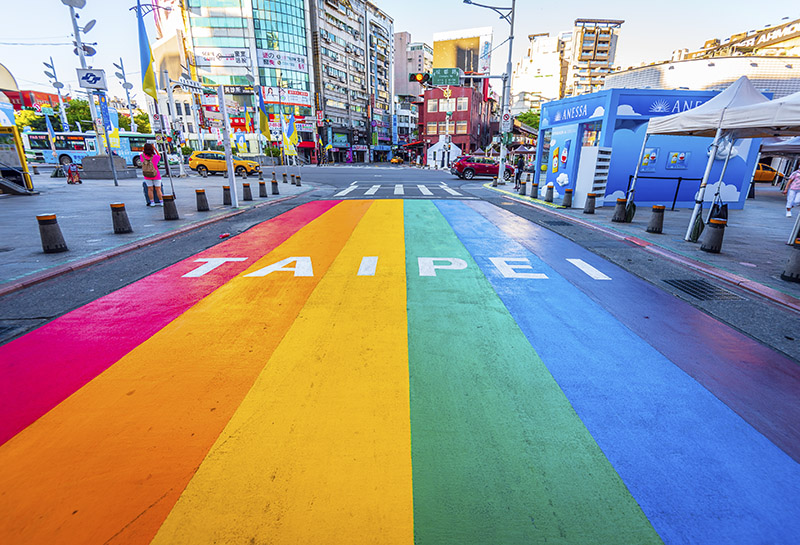
About 100 members of Taipei's LGBTQ community protested outside a local police station on October 4 after officers raided a gay bar, taking 51 people in for questioning and arresting its owner.
The raid on Commander D, a gay bar in Taipei's Wanhua district, took place on the afternoon of October 3, reports Reuters.
Police precinct spokesman Chen Yu-cheng said officers executed a search warrant for suspected "offenses against public morality." He said the people taken in for questioning were suspected of violating a law prohibiting "wantonly exposing one's naked body or presenting a lascivious posture in a public place or publicly accessible place."
New Jersey detective Russell Kingsland claims he suffered years of anti-gay harassment while working for the Office of the Attorney General's Division of Criminal Justice, including sexual assault, retaliation, and being "outed" to co-workers -- treatment he says destroyed his law enforcement career.
Kingsland plans to sue the office for $1.5 million, alleging that the treatment caused post-traumatic stress disorder that has hampered his ability to work.
Moscow's Tagansky District Court has fined the international hotel reservation service Booking.com a total of 6 million rubles, or approximately $71,365, for allegedly promoting "LGBT propaganda" and failing to remove banned content.
The charges stemmed from a newsletter sent to foreign partner hotels that referenced "accommodating LGBT guests during Pride Month" and included a photo that Russian censors deemed objectionable, according to Ostorozhno, Novosti, an independent Russian news outlet on Telegram.






You must be logged in to post a comment.