
Imani Woody Isn’t Done Fighting for LGBTQ Elders
As she steps back from Mary's House, Dr. Imani Woody reflects on a life spent making room for LGBTQ elders.

“Mary’s House is near and dear to my heart,” says Dr. Imani Woody, the founder and former president and CEO of Mary’s House for Older Adults, an LGBTQ-affirming residence in D.C.
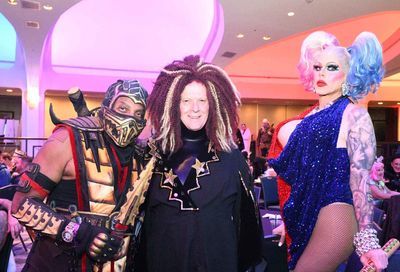
Woody, 74, founded Mary’s House in 2010. Its residence, which opened last year, is a renovated building that was once her childhood home. She was honored at a November 7 event at the Eaton Hotel celebrating her legacy, her commitment to LGBTQ equity, and her longstanding dedication to aging communities.
The idea for Mary’s House was prompted, in part, by Woody’s experience watching her own father decline after being placed in a nursing home where, as she recounts it, he was treated more like a number or an anonymous patient than a person.
As a same-gender-loving woman, Woody also thought deeply about those who were not as lucky as her father to have a supportive family. Sadly, her suspicions were confirmed when she first began flirting with the idea of opening a home for LGBTQ elders and looking for models to emulate.
“I would go into nursing homes to ask the administrators if I could talk to someone who was gay in their facilities, and they would say, ‘Oh, I don’t think we have any gay people here,'” Woody says, underscoring the lack of LGBTQ-affirming options. “That told me that it wasn’t safe for LGBTQ people, because how are you going to have a whole facility full of people and not one person gay?”
Woody has spent much of her career advising organizations on nondiscrimination and their obligations under the law, as well as developing culturally competent training sessions. She is well-versed in working with communities of elders, LGBTQ people, and people with disabilities. Those experiences provided a foundation for the work she undertook for 16 years, leading up to her retirement in June.
Woody, who remains on the Mary’s House board, took some time to speak with Metro Weekly and reflect on her longtime advocacy for underrepresented communities.
“As a leader of an organization — and being a black leader of an organization — you have to jump twice as high. You have to be twice as smart, or at least perceived that way. Barack Obama’s a constitutional fucking scholar, and people still don’t think he was good enough,” she says.
She has sought to make Mary’s House a welcoming, communal environment for LGBTQ elders who may struggle with isolation, homelessness, and finding a safe space where they can be themselves.
“One of my mantras is that we have biological families, but we have logical families, right?” she says. “The people who are with us and care for us logically. They should have been our family. We just were dropped in the wrong house. They are our family.”

METRO WEEKLY: Let’s start with your childhood, family life, and what your growing up experience was like.
IMANI WOODY: I’m a Washingtonian. I grew up in Northeast D.C., moved to Southeast D.C. when we were 10 years old, into the property space where Mary’s House DC now lives. I was the oldest of five kids. My mother was a homemaker, and my dad was a truck driver and a minister, so I’m a preacher’s kid.
I always loved D.C. In the summer, we would go to Hains Point and go to the beach and have picnics with my uncles and aunts who lived in the city. We’d drive up the East Coast to see folks who lived in Ohio, New York, and Philadelphia, and drive south to see folks who lived in North and South Carolina and Florida. I had the happiest of childhoods until my mom died when I was ten. I became an advocate for my siblings with my dad, which really prepared me for advocacy throughout life.
I graduated high school, got married — married a Marine — moved to Hawaii, lived there for a minute, had a kid –- I have a son — and decided that I needed to come back to the city. I went back to school, ended up going to Georgetown, became a paralegal, went to Lincoln University in Pennsylvania to get my master’s in human services, and then further education down the road to get a Ph.D. in human services as well.
MW: What was your coming out process like and who was the first person you told?
WOODY: The first person I came out to was my brother, who was gay. He said, “How are you going to be a lesbian? You got a kid.” That was so crazy. Because I was in a heterosexual marriage. I told my husband at the time, and he was not happy. But then my most eventful coming-out story is when I came out to my son, who was 16, and I said, “Phil, I think your mom might be a homosexual, and I hope you still love me.” And he said, “Mom, I think I might be heterosexual. I hope you still love me.”
And from that point on, once my son knew, and my husband knew, I told my sister, who was a Jehovah’s Witness at the time, and she didn’t speak to me for a year. But she later came around and was one of my staunchest allies.
My sister told my dad something [years later], and my dad came to the house [to visit]. And he and my stepmother had just left the house, and Dre, my wife, had left our house, and he asked me, “Are you a lesbian? Are you…? What is…?” He couldn’t even get the words out. And I thought he was kidding. I mean, he comes by our house every Sunday, we eat dinner, he knows Dre. I’m thinking, “He knows,” right? What kind of relationship do you think this really is? We have a one-bedroom, and we have a study. I don’t know, right? And he was serious, and he asked that, and I held my ring up. I said, “Yes.” I did The Color Purple thing. There’s a scene in that movie where Shug says, “I’s married now,” so I did the same thing. He didn’t think that was funny, but that was that.
It took him maybe a month to get over it, and then Dre became his best buddy. “Hey, you’re looking like new money,” or, “Can you go fix… can you look at my so-and-so? The faucet doesn’t do this or that,” that kind of stuff. So, yeah, those are my family coming-out stories, and, for me, once family knew and accepted or knew and didn’t accept, I was a big dyke after that. I was out.
And, you know, we [as LGBTQ people] come out every day, but let me just put this pin in. I am a big dyke, but I have to think about where I am. Safety is really a big issue. And I have to figure out, “Okay, if I’m feeling some kind of way, is it because I’m old? Is it because I’m black? Is it because I’m female? Is it because I’m lesbian?” All that “ish,” and trying to figure out how safe I am in going to and being out, doing stuff like holding Dre’s hand or just being normal, right? So it’s like going backwards, where I didn’t have any real fear of safety, whereas now I do have a little trepidation.
MW: Let’s talk about Mary’s House and how you came to start it.
WOODY: My dad had to go into a nursing facility. He had a stroke, and so we were looking for a nursing facility. He was a middle-class guy, had great insurance, and so we could pick a “good one.” I’m putting quotes around good one. And so we picked one, up on Wisconsin Avenue, and he had me as an advocate, my wife, grandkids, his preacher people, his church folk. But we still ended up pulling him out. He went into the facility continent, and came out incontinent, and it wasn’t because the people didn’t like him or they were not competent — it was because of the nature of nursing homes and facilities and how they treat old people and people with disabilities. That led us to pull him out. He died at home.
And that made me sad. They didn’t care that he was a preacher, they didn’t care that he was an upstanding citizen in D.C. He hired young men to work with him on his food trucks and stuff like that. He fed the people, he went to prisons to minister to inmates, he did all that kind of stuff. But that didn’t mean anything for them. He was just the resident in Room 222, and that was sad. He was an old Black man with means, with adequate insurance, but none of that mattered.
He was just in that bed, and I wondered: What would’ve happened had he been an out gay man? What would’ve happened had he been an out lesbian? And what would’ve happened had he been an out trans person? So that kind of weighed on me.
He died and he left me a house that I grew up in. And my wife and a group of women I call my “Kitchen Cabinet” were trying to figure out what to do with it.
And then someone died in, I want to say Bethesda, [but] it could have been Chevy Chase. But it was an upscale Jewish guy in our community who died, and they found him five days later in his upscale place. Because that’s what happens. We isolate. You stop playing canasta or stop going to the movies, and if somebody doesn’t call you, they just say, “Oh, I haven’t talked to John in three, four days, and somebody needs to go over there.” You just stop doing stuff. When you get older, you just kind of slow down and stop, and it’s easy just to stay in. I mean, look at what COVID did to us, right? So imagine that, being older.
And he died, and it really made an impact on me. I had a friend who was big up in a nonprofit organization, and was telling her about it. She said, “Imani, that’s me.” She said, “Monday through Friday, I have emails that are due, and blah, blah, blah…But over the weekend, something could happen, and if I don’t have an email that’s due or something’s due, nobody would really check on me until… it could be five days.” That fucking blew me away, excuse my language.
I said, “Wow, us as gay folks…” And many of us don’t have kids, in older generations, so who takes care of you when you’re old? I’m taking care of my dad — adult children take care of their people — but if you don’t have any people, who takes care of you? Our logical family that’s aging with us. So that led to the idea of making the house into a four-bedroom group home. But I found out from the Office of Zoning that you can’t do that.
But we could make it into a 15-room, single-room occupancy. So we petitioned and ended up getting the architects and building out 15 single-room occupancies to live communally. So this was going to be like living in a dorm for adults, like you don’t know each other, but you have to get along, build that kind of community. And it was targeting the relational needs of LGBTQ people. That’s the target. But in D.C., you can’t say, “Only gay people can come here.” You can’t do that. And so the overwhelming push ended up that we had more non-gay people than gay people, but we would think that would be okay, if everybody’s an ally.
But with the housing shortage in D.C., the rents start at $800, so everybody will say, “Oh yeah, I like gay people.” You’re going to say whatever you need to get in, it seems. I’m going into another chapter, so let me just stop right there, but that was the impetus behind making Mary’s House DC. It’s the first communal housing targeting the relational needs of LGBTQ+ folks with allies.
MW: Since you’ve alluded to it, there was some controversy with Mary’s House, where people who had lived there and left complained because there were more straight folks living there at the time than LGBTQ people, and they alleged that they were being discriminated against.
WOODY: Yeah, and that was so sad. But, again, you get what you get. LGBTQ folks were not biting at the bit to come in. Many people said, “Why do you build a house like that in Southeast D.C.? Why would you build it over there?” So there’s that class issue, where folks are not trying to move into Southeast.
And then there’s the issue of trying to train people to live in a communal housing situation who’ve never lived in a communal housing situation, including some of our gay brothers and sisters. So it’s not an apartment. You have a bedroom in a house and communal spaces; we have to care for those, and we have to be respectful of each other. And so there was some trying to put some training together to have folks understand that we’re different and we’re the same, but these are our rules, and that you have to be respectful on both sides. So training happened to try to get folks to understand that.
Again, it’s the first model of its type in the U.S. and it takes a minute. What we do have is zero tolerance for BS. The human rights laws in public spaces, we’re not going to be saying the N-word. If you’re a white person in our space, you can’t do that. You can’t be saying the F-word. If you’re a straight person in our space, you can’t do that.
You have to clean up after yourself. You can’t put up signs saying X, Y, Z. So those kinds of things we just continue to reiterate and really stress what is acceptable and what is not acceptable, and that’s training on all sides. It’s the training for the staff; it’s the training for the residents, no matter whether you’re short, tall, Muslim, Christian, gay, straight, whatever your affiliation is.
And I think sometimes the bad apples have left. This is my hope, because when that piece came out on NBC, many of the folks that lived there were just really brokenhearted, like, “What is this? I don’t know this.” And so we have on our website some folks who made a video talking about what actually happens, what it’s like to live there. It’s unfortunate that we got that kind of press. But the house is still standing. The kitchen is state-of-the-art. Everybody has their own little kitchenette with a full-size refrigerator, microwave, bedroom, bath, nice size bathroom. I mean, it’s really cute single-room occupancy, like a studio back in the day, is what I would call it. It’s really nice living. It’s got a rooftop that you can see the Washington Monument from on a clear day. It’s just really exciting living.
MW: How do you find people who might be a good fit for living at Mary’s House, and how do you make sure that that match is good?
WOODY: You can hope that a match is good — you can’t make sure that a match is good. And there are certain criteria to live in this house that you have to meet. You have to be over 60. You have to be in a certain income bracket. You have to have some other documents — I’m not the property manager, so I can’t tell you exactly what they are. But you have to have all of that first. And then, during the conversation between you and the property management, they talk about what’s in the house. There’s a picture of me in an article. They point to the article, “This is the founder. She founded this LGBTQ room,” so they go through the whole house. So it’s in the interview process whether you’re an ally or not, and you can show up as an ally and not be an ally, but you can’t live in the house and not be an ally and try to live that out loud. We are very proactive on that.
MW: What have you done at Mary’s House to foster community between residents? What sort of initiatives or programs do you have there?
WOODY: At Mary’s House, they have a brunch every month. They have a resident circle council that meets monthly. On Sundays, there’s a football thing going on in the great room. They just had a Halloween party. They dressed up in costumes and they sat on the porch and the neighborhood children came. They have Thanksgiving dinner. They do things like families do things.
MW: You retired this June as CEO and president of Mary’s House DC, but still remain on the board. Who has taken over for you?
WOODY: Charlene Leach is our executive director, and Andrea Macko and Rozanne Look are our co-presidents.
MW: And how did you find them?
WOODY: Andrea and Rozanne are on our board. Charlene had worked with us for over 10 years. She actually was a developmental officer when we met and she wrote our first grant from Brother, Help Thyself.
MW: What would you advise the city to do in terms of making more places like Mary’s House available or just more housing generally available for elderly LGBTQ people?
WOODY: One thing that would be that, as a nonprofit, things are just drying up in this environment. But what would be helpful is having wraparound services, which we are creating. We work with an agency now that we have wraparound services for some people who are in a certain bracket or certain class. For instance, do they need transportation to get to A, B, and C, or their doctor’s appointments? Do they need additional food?
We’ve taken on food insecurity, so that you can’t be hungry in Mary’s House. We have a food program that we’re making and expanding and having partners. We’re also fighting against social isolation. So we’re collaborating with Iona and with Seabury [Resources for Aging], and with some children’s groups and schools, and the police department, which has a formal partnership with us.
So we are collaborating and creating partners, but wouldn’t it be nice if the city took those abandoned schools or buildings and turned them into housing? We’re always looking for alternative housing, so the abandoned schools, the abandoned places that the city owns, even houses, could be used for that.
If you have a four-bedroom house, you could make it a four bedroom Mary’s House, a group house. And that wouldn’t take a lot of money. Just finding alternative, out-of-the-box spaces would be great, and having those spaces have wraparound services, and that staff are trained and educated on diversity and on the human rights laws that exist in our city and how we’re protected. The city should look at alternative housing with wraparound services, not only in Wards 7 and 8, but also in Wards 1 and 2. That would be awesome because we are everywhere. We have unhoused people across our city. So if I could wave a magic wand, that’s what I would do.
MW: When you look at the larger LGBTQ community, do you think there are things we could do to be more welcoming of our elders, and what would those things be?
WOODY: So we live in an ageist society, right? Nobody wants to get old. So there’s that part. But I think there’s intergenerational work, among old and young, to be done. How many young people wouldn’t mind having a grandparent or a parent, or how many middle-aged people wouldn’t mind having a parent because their biological parent is gone? We need to look at welcoming folk without paternalizing them. What events can we create that support intergenerational cooperation?
We used to do an event called “Party with a Purpose” every summer during Pride, in between Black Pride and Capital Pride, where we would invite elders to a space at a hotel, and the place was packed with elders and young people, and the music and food was such that folks on the outside were trying to get in.
So how do we make things like that happen on a regular basis? We’re segregated based on our ages, but we could work on that. We could build some programs that bridge those divides. We’re also still segregated in terms of race. I grew up in segregated Washington, D.C., and I promise you that we’re still segregated. I intentionally include people of other races and faiths in my space. But we don’t do that as an LGBTQ+ collective, in my opinion.
MW: Does it require some younger people to take a leadership role to bridge those gaps?
WOODY: Yes. But not just lead, but collaborate. You can’t bring the answer to the table if you’re a leader. You come to the table with ideas, and then you get ideas from others, and then you become a leader of the vision. You present your vision and get folks to buy into it.
MW: You are well-versed in diversity and anti-bias training. And while we primarily hear this message from the White House, much of corporate America has scuttled its diversity, equity, and inclusion initiatives, inclusionary language training, and other culturally competent programming. How does that make you feel when you see that rejection by some of these companies that once claimed to be allies?
WOODY: I’m brokenhearted. My heart is broken. It’s like one can feel a sense of betrayal in terms of, “Wow, you’re like this now?” It’s like when folks pulled out and boycotted Target. I was part of that Walmart boycott. I boycott Chick-fil-A. I am intentional with where my money goes.
Sometimes it feels like four steps forward and five steps back. And sometimes it feels like four steps forward and minus two steps back. When I think about our trans kids — I just pulled out a book called My Princess Boy. I’m getting ready to give it to my grandkids, who are 8 and 10. But that book is probably banned now, and it was an integral part of what I would teach [about gender-nonconformity] from that point of view and in that language. I believe in “Show me how to do something like I’m a five-year-old,” and I think it can be more impactful.
I feel like I’m all over the place here, but I often think about the civil rights law, and now there are poll taxes, voting taxes in places, and there was an instance where they removed a voting center from a historically black university, and stuff like that. I think about women getting poor maternity care, dying from a miscarriage, and the doctors being scared to touch the patient because of the laws against abortion or the laws on reproductive rights going backwards. And so the fights I was fighting as a young person, it feels like I have to fight them again and again and again. It’s exhausting. It’s almost defeating, right?
What makes me better is young people still doing this kind of work, showing that we’re not going to let it die, that we’re still fighting, and we’ll continue to fight the good fight. There’s always hope. That’s part of my mantra, too. As long as there’s hope, things can change. As long as there’s action, things can change. And I’ll always be standing beside young people to make those changes. I might not be on the street marching — I am 74 — but I will continue to fight the good fight.
For more information about Mary’s House for Older Adults, visit maryshousedc.org.
More from Metro Weekly:






You must be logged in to post a comment.