
Texas Launches “Tip Line” to Target Trans Restroom Use
Texas AG Ken Paxton’s tip line encourages people to report and photograph transgender people accused of using the "wrong" restroom.

Texas Republican Attorney General Ken Paxton has launched a “tip line” urging residents to report to state authorities people they believe are transgender for using restrooms that do not align with their sex assigned at birth — a violation of Texas’ bathroom ban.
In a statement announcing the tip line on his office’s website, Paxton said the bathroom ban — known as the “Texas Women’s Privacy Act” — is intended to protect women and girls from “mentally ill men wanting to violate their basic right to privacy” in restrooms, locker rooms, and other changing facilities.
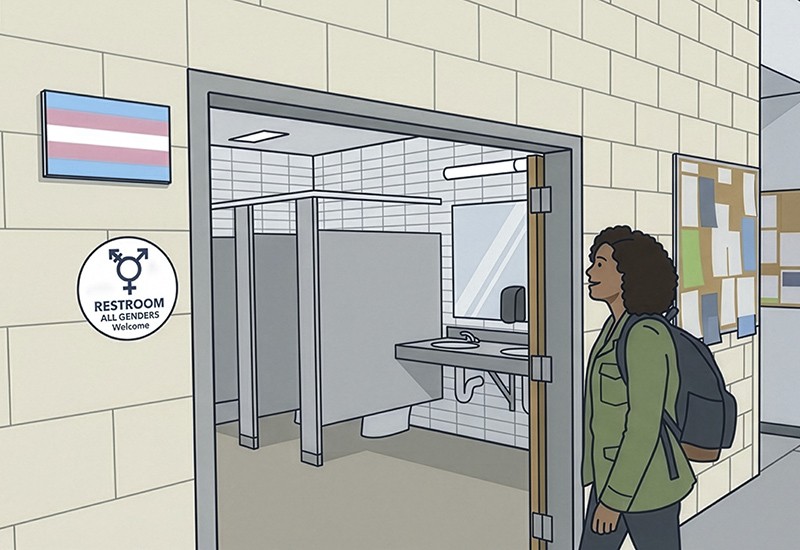
Under the law, all political subdivisions and state agencies — including public schools, charter schools, colleges, and universities — must designate any multi-occupancy restroom, locker room, or changing facility for either males or females.
Each subdivision or agency is required to ensure that no person enters a private space that does not align with their sex assigned at birth and may be fined or sued for each violation. Penalties include $25,000 for a first offense and an additional $125,000 per day for subsequent violations.
“It’s absolute insanity that action like this is even needed, but unfortunately in the day and age of radical leftism, it is,” Paxton said in a statement defending the law.
The law requires the attorney general’s office to investigate alleged violations, but complaints must first be filed with the accused agency. Paxton encouraged residents to submit an online complaint form that asks when the alleged violation occurred and invites complainants to upload documents or up to five photos to support their claims.
“Together, we will uproot and bring justice to any state agency or political subdivision that opens the door for men to violate women’s privacy, dignity, and safety,” Paxton said.
Ironically, Paxton’s tip line may itself violate Texas law, which prohibits photographing or recording another person without consent in a restroom or changing area. Critics have warned that enforcing the ban will lead to over-policing of both transgender people and cisgender individuals who do not conform to traditional gender norms or notions of beauty.
Brian Klosterboer, a senior staff attorney for the American Civil Liberties Union of Texas, said the tip line “wrongly encourages Texans to violate each other’s privacy in bathrooms.”
The law has already been applied beyond restroom use. According to San Antonio ABC affiliate KSAT, some students at University of Texas at San Antonio have been forced to relocate from mixed-gender dorms if they share a restroom with someone of the opposite sex — even if they are part of an opposite-sex couple.
More recently, a group called the 6W Project staged a demonstration at the Texas Capitol to highlight flaws in enforcement. As reported by the Texas Tribune, transgender demonstrators initially easily entered the restrooms of their choice without interference from security. They gave speeches in the Capitol Rotunda, and were later stopped by officers who demanded to see their IDs when they returned to those same restrooms.
Officers later claimed the ID requests were voluntary, though demonstrators who refused were denied access to the restrooms. Police allowed two transgender women with female gender markers on their IDs to enter the women’s restroom — a decision that appeared to violate the spirit, if not the letter, of the law. Officers were also stationed outside the women’s restroom, but not the men’s, underscoring the fact that the law is likely to be enforced unevenly based on a complainant’s personal biases.
“I think that the Texas government just established that they have no consistent enforceable standards for this law,” protester Matilda Miller told the Tribune.

When the bathroom ban passed in August, Ash Hall, a policy and advocacy strategist for LGBTQ rights at the American Civil Liberties Union of Texas, criticized the measure as unconstitutional, discriminatory, and overbroad.
“S.B. 8 will encourage ‘gender policing’ by bad actors who seek to harass or harm transgender people — or anyone who may not conform to stereotypical gender roles in public spaces,” Hall said. “This law puts anyone at risk who doesn’t seem masculine or feminine enough to a random stranger, including the cisgender girls and women this bill purports to protect.
“This bill is bad for trans and intersex people, bad for cisgender people, bad for business, bad for public health and safety, and bad for Texas.”

Support Metro Weekly’s Journalism
These are challenging times for news organizations. And yet it’s crucial we stay active and provide vital resources and information to both our local readers and the world. So won’t you please take a moment and consider supporting Metro Weekly with a membership? For as little as $5 a month, you can help ensure Metro Weekly magazine and MetroWeekly.com remain free, viable resources as we provide the best, most diverse, culturally-resonant LGBTQ coverage in both the D.C. region and around the world. Memberships come with exclusive perks and discounts, your own personal digital delivery of each week’s magazine (and an archive), access to our Member's Lounge when it launches this fall, and exclusive members-only items like Metro Weekly Membership Mugs and Tote Bags! Check out all our membership levels here and please join us today!


You must be logged in to post a comment.