The Montana Supreme Court upheld a lower court order blocking the state from enforcing policies that prevent transgender people from obtaining identity documents that reflect their gender identity.
In 2021, Montana lawmakers passed a law restricting transgender people from obtaining birth certificates that reflect their gender identity unless they provide a court order showing they have undergone gender confirmation surgery. Two transgender people challenged the law, and a district judge issued a preliminary injunction blocking its enforcement.
But state officials ignored the court’s order. The Montana Department of Public Health and Human Services issued an emergency rule — later made permanent — replacing the designation for “gender” with “sex” and prohibiting any changes to the sex designation on a certificate except in cases of error, even when a person has undergone gender confirmation surgery. A district judge in 2023 issued a permanent injunction blocking the state from enforcing that rule.
Separately, the Montana Motor Vehicle Division adopted a policy prohibiting residents from changing the sex designations on their driver’s licenses.
In December 2024, a state district judge blocked enforcement of the health department rule, the driver’s license policy, and parts of a 2023 law defining “male” and “female” based on reproductive anatomy, which had already been ruled unconstitutional by another judge.
On April 14, 2026, the Montana Supreme Court upheld that lower court’s injunction blocking the state from enforcing policies that prevent transgender people from obtaining state-issued documents that reflect their gender identity. The state’s highest court agreed that the policies violate transgender people’s “fundamental right to be free from discrimination on the basis of sex under the Montana Constitution.”
The high court found that Montana’s policies restricting gender marker changes treat transgender people unequally compared to cisgender individuals. Because transgender people are considered a suspect class, the state must prove its laws are “narrowly tailored” to serve a compelling interest and implemented in the least restrictive way to avoid infringing on people’s rights.
“Government issued identification documents are necessary to access public life. When they do not accurately reflect a person’s sexual identity, the transgender Montanan is prevented, based on their sex, from obtaining the same attributes of public life that a cisgender Montanan may obtain,” Justice Laurie McKinnon wrote on behalf of the court.
“Hence, the inability of transgender Montanans to receive government-issued identification documents accurately reflecting their gender identity is fundamentally about the nature of sex and suspect class discrimination under Article II, Section 4 — a clause that enshrines individual dignity, equal protection, and nondiscrimination,” McKinnon continued. “Transgender discrimination is, by its very nature, sex discrimination.”
Following the high court’s ruling, the case now returns to district court, where a judge will issue a final decision on the merits. Until then, transgender Montanans can continue to obtain birth certificates and driver’s licenses that accurately reflect their identities.
“I am deeply grateful and encouraged by the Montana Supreme Court’s decision to uphold the injunction,” Jessica Kalarchik, one of two plaintiffs challenging the health department and motor vehicle policies, said in a statement. “This victory represents not only a personal milestone, but also a meaningful affirmation of fairness, justice and the rule of law.”
“This is a good day not just for transgender individuals but for all Montanans,” Akilah Deernose, executive director of the ACLU of Montana, said in a statement. “Our Constitution exists to protect all of us from government overreach, and we are pleased that the Montana Supreme Court faithfully interpreted our Equal Protection Clause to protect against unlawful discrimination.”
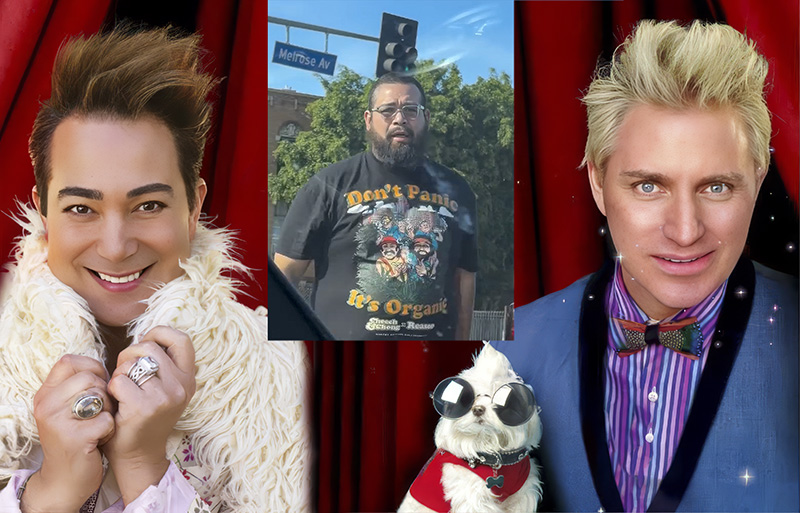
A gay couple who star in a fashion-focused reality TV series have shared video of an unknown man attacking their car in an apparent fit of extreme road rage.
Patrik Simpson and Pol' Atteu, who co-host the Amazon Prime series Gown and Out in Beverly Hills and the Undressed podcast, say they were driving on Sunday, March 29, between 9:20 and 9:30 a.m. when, while stopped at the intersection of Melrose Avenue and Vine Street in Hollywood, the driver of a gray Toyota 4Runner with a roof rack blocked their vehicle.
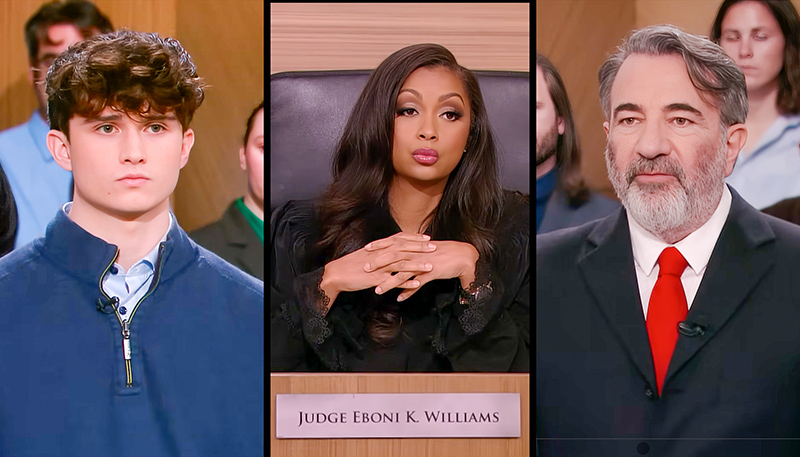
A Christian father who appeared on a court TV show sued his 18-year-old son for $6,000, claiming he was owed reimbursement after the teen failed to complete a summer conversion therapy program his parents had enrolled him in.
The dispute played out on a recently recirculated episode of Equal Justice with Judge Eboni K. Williams, which debuted in 2023. It’s unclear when the episode originally aired, but it was uploaded to YouTube on March 26, 2026.
As noted by LGBTQ Nation, courtroom television shows are not actual courts and don’t have to follow the same rules. Equal Justice bills itself as a "small claims court arbitration" show, meaning a neutral third party -- in this case, Williams -- hears both sides of a dispute and issues a decision that may be binding if the parties agree in advance to accept it. Arbitration is not the same as civil litigation.
LGBTQ advocates in Georgia are celebrating a milestone after 15 bills targeting the LGBTQ community introduced during the 2026 legislative session failed to pass before the session ended on April 2.
"This session, we stopped every bill targeting LGBTQ Georgians, even in spite of underhanded political maneuvers," Jeff Graham, executive director of Georgia Equality, said in a statement. "Thousands of Georgians from over 60 counties came together to successfully defeat every last one."
The organization said it mobilized 2,500 Georgia residents to contact their legislators, with 400 traveling to the Georgia State Capitol in Atlanta in recent weeks to lobby lawmakers, testify against the measures, and, in some cases, protest efforts to advance policies targeting LGBTQ rights or visibility.
These are challenging times for news organizations. And yet it’s crucial we stay active and provide vital resources and information to both our local readers and the world. So won’t you please take a moment and consider supporting Metro Weekly with a membership? For as little as $5 a month, you can help ensure Metro Weekly magazine and MetroWeekly.com remain free, viable resources as we provide the best, most diverse, culturally-resonant LGBTQ coverage in both the D.C. region and around the world. Memberships come with exclusive perks and discounts, your own personal digital delivery of each week’s magazine (and an archive), access to our Member's Lounge when it launches this fall, and exclusive members-only items like Metro Weekly Membership Mugs and Tote Bags! Check out all our membership levels here and please join us today!





You must be logged in to post a comment.