The new Netflix series Russian Doll (★★★★) is undeniably a lot to take, so come prepared for a dizzying trip. The eight-episode dramedy from co-creators Leslye Headland (Bachelorette), Natasha Lyonne, and Amy Poehler does offer its share of zinging dialogue and breezily droll humor. And the show’s lead, Lyonne — a galvanizing force as software engineer Nadia Vulvukov — is surrounded by a pitch-perfect cast, including effervescent stage and screen legend Elizabeth Ashley as Nadia’s loving guardian, Ruth.
But the show is heavily preoccupied with the mortality of young, seemingly vital Nadia, who dies again and again, once, twice, or multiple times per half-hour episode.
Nadia’s deaths often come with a blunt punch of karmic comedy, but even the biggest laughs serve mostly to light the path she follows into the dimensional abyss. Stuck in her own resetting time-loop, she’s forced to examine the choices that have led her brief but troubled life to its end. It sounds bleak, and it can feel that way, and yet Russian Doll is well worth taking the plunge with Nadia down that cosmic whirlpool.
Of course, Nadia’s a lot to take, too, but she seems to have made peace with that, describing herself as a “very tough lady who looks like if Andrew Dice Clay and the little girl from Brave made a baby.” She’s emerged from a rough childhood into a stable enough life to have friends like Maxine (Greta Lee) and Lizzie (Rebecca Henderson), who will throw her a blowout 36th birthday party in Maxine’s fabulous East Village apartment. And Nadia’s got enough game to leave the party with an eager hookup, Mike (Jeremy Bobb), even though the encounter leaves her feeling empty afterward.
Oh, and she keeps dying, returning to the exact moment we first met her, in the bathroom at her birthday party. Every time, a moment after lights out, she’s back in the bathroom of Maxine’s apartment, possessed of whatever knowledge she gained in her previous turn on her own Groundhog Day merry-go-round.
But she has no clue what’s happening to her. Is it mystical? Has she found herself in the afterlife, or living out an alternate reality? No one but her seems to be conscious that anything’s amiss. The fantastic second episode, written by Lyonne and Poehler, swerves towards Nadia’s distressed attempts to figure out whether she might be experiencing a mental breakdown. Or, maybe she’s caught in a downward spiral akin to an addict’s multiple recurring deaths along the way to rock bottom?
Nadia attacks the mystery with the tenacity of a metaphysical Columbo, gathering clues on each trip. Throughout, the writing stays as sharp as Lyonne’s delivery, highlighted by amusing turns of phrase, particularly from Nadia, Maxine, and Lizzie, who, in whichever reality, always hooks up with one or more women at the party.
Russian Doll — Photo via Netflix
The respective episode directors, including Headland, Jamie Babbitt (But I’m a Cheerleader, Gilmore Girls), and Lyonne, who helmed the series finale, keep the scene-by-scene pacing relatively brisk, although, as is the case with lots of series in the binge-worthy TV era, the show’s narrative evolves at a deliberate pace. That doesn’t mean things don’t at times change suddenly. Episode three concludes with a jaw-dropping revelation that completely alters the urgency of Nadia’s plight and the mood of the series going forward. And, to the creative team’s credit, that recalibration isn’t the show’s last jaw-dropping surprise.
But don’t be surprised when Russian Doll waxes philosophical. Nadia, and the audience, too, can marvel at how the behavior of some of her friends and loved ones always repeats itself, regardless of anything she might do. Then, others’ actions fluctuate wildly, unpredictably, depending on what Nadia might do. Her time-loop repeats and repeats itself, but, especially after she bumps into a stranger (Charlie Barnett) who possibly can help her understand her story, no loop is ever the same.
Some of Nadia’s random deaths are the same, though, which amounts to a wicked punchline in the joke of her existence. She tries to maintain her good humor as she suffers through death after death, and she even starts to learn from her mistakes. Like so many stranded souls, she just keeps on doggedly pursuing the answers that might finally let her in on the joke.
Russian Doll is now available for streaming on Netflix. Visit www.netflix.com.
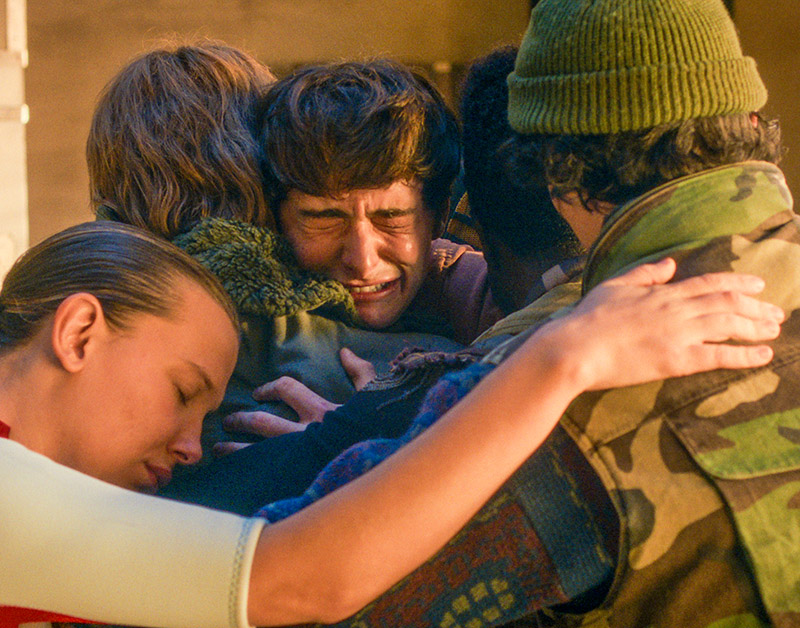
Matt and Ross Duffer, the co-creators of Netflix’s hit series Stranger Things, are responding to cultural backlash over a much-criticized storyline in which teenage character Will Byers comes out as gay.
The penultimate episode, "The Bridge," earned the lowest IMDb score and the harshest audience reaction of any episode across the series’ five seasons. Many fans criticized the episode -- particularly Will’s coming-out storyline -- for sloppy writing, uneven performances, cheesy sentimentality, and its timing within the episode.
Netflix's Stranger Things is facing backlash from viewers after writers devoted the show's penultimate episode to a storyline in which Will Byers, played by Noah Schnapp, comes out as gay.
In part because of the negative reaction to the coming-out storyline -- which appears in the third of three episodes released on Christmas -- Season 5 is now the show's lowest-rated season, earning a 56% audience score on Rotten Tomatoes.
The episode itself, "The Bridge," is the lowest-rated of the entire series on IMDb, with a 5.4 score. All other episodes in Season 5 are rated 8.0 or higher.
These are challenging times for news organizations. And yet it’s crucial we stay active and provide vital resources and information to both our local readers and the world. So won’t you please take a moment and consider supporting Metro Weekly with a membership? For as little as $5 a month, you can help ensure Metro Weekly magazine and MetroWeekly.com remain free, viable resources as we provide the best, most diverse, culturally-resonant LGBTQ coverage in both the D.C. region and around the world. Memberships come with exclusive perks and discounts, your own personal digital delivery of each week’s magazine (and an archive), access to our Member's Lounge when it launches this fall, and exclusive members-only items like Metro Weekly Membership Mugs and Tote Bags! Check out all our membership levels here and please join us today!






You must be logged in to post a comment.