
Harry Lighton Talks Kink, Romance, and Leather in Pillion
The British director explains why his BDSM romance is ultimately a story about queer identity and connection.

Looking disarmingly like a leaner Paul Mescal, Harry Lighton sits perched across from me on a hotel sofa, wearing a pair of distressed jeans. Notably, he is not wearing the handsome black leather kilt draped on a cushion beside him.
“A24 actually bought that for me for the New York premiere at the New York Film Festival,” he tells me, “because I turned up without anything remotely interesting to wear. I’ve now become kind of over-attached to it.”
In D.C. to promote his debut feature Pillion, a gay BDSM leather biker love story starring Alexander Skarsgård and Harry Melling, the award-winning writer-director has been taking his message directly to the people.
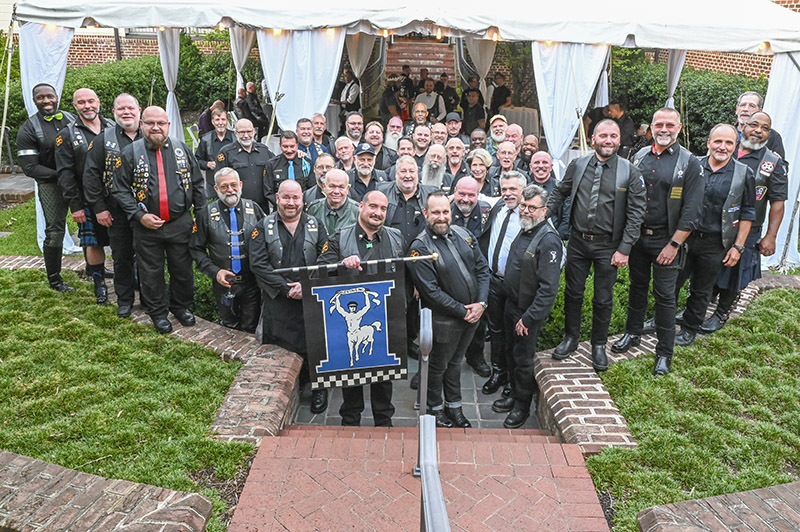
In addition to press interviews and promo screenings, the well-bred Englishman has been mingling with the throngs of LGBTQ leather, kink, and cosplay lovers from around the globe at one of that community’s premier international events: Mid-Atlantic Leather Weekend, hosted by the Centaur Motorcycle Club in D.C.

Lighton’s well-timed visit has brought him up close and personal with the film’s core audience, not often represented with such care and dimension onscreen as in his film, which is based on the 2020 novel Box Hill: A Story of Low Self-Esteem by Adams Mars-Jones.
As Lighton, 33, reveals in our discussion, he’s been exploring leather and kink since before he even thought of making Pillion. And he registers an almost giddy enthusiasm for it all — for the leather biker community, for his trip to MAL, even for that leather kilt he wore to the weekend’s kink-meets-chic Leather Cocktails.
“I’ve got a photo shoot later,” he explains of the garment. “But it’s quite cold, so I thought I wouldn’t wear it [now]. It’s also quite dangerous to wear when you’re sat down on a sofa. So for your sake, I thought I’d change into it.”
Despite the film’s provocative sex and premise, and bold depiction of a gay dom/sub relationship fraught with conflict between Skarsgård’s hard-edged top Ray and Melling’s shy newbie bottom Colin, Lighton appears not to be aiming to shock or disturb the faint of heart. The film reps a sincere expression of many of his feelings about transgressive sex and relationships, he says. But he was not sure how those feelings might connect with the moviegoing public.
So far, in the U.K., where Pillion has already been released, and is currently in the running for three BAFTA Awards, including Outstanding British Film of the Year, “it was a big surprise success…in terms of how many people went and sought it out in a cinema,” he notes. “Because on paper, a sort of explicit, BDSM rom-com doesn’t necessarily sound like it has much popular appeal. So I’m hoping that a similar thing will happen in America, that more people will go and see it than at first you might think.”

METRO WEEKLY: I heard that you were at Leather Cocktails last night. Was that your first experience of MAL and of a leather cocktail kind of event?
HARRY LIGHTON: Not my first experience at a leather cocktail event. It was definitely my first experience with MAL. I mean, I’ve never been to Washington before and barely been to America before. So it’s all pretty new to me. But I’d gone to a few leather drinks events, meetups back in the U.K., even before the idea of Pillion arrived. And then once it arrived, I spent a lot of time with the leather community in London specifically, and then more broadly in the U.K. And I went with, I guess, the U.K. equivalent of the Centaur Motorcycle Club, the GBMCC [Gay Bikers Motorcycle Club]. I spent a weekend with them up in Birmingham, and there were lots of socials, and they weren’t cocktail events. There were about 200 people there, and last night it looked like there were about 7,000 people there. And the commitment — everyone was really dressed to impress last night. I was very bowled away. The one I went to in England was a bit more low-key. But yeah, I love those events.
MW: When you rode with the club, did you have your own bike or were you–
LIGHTON: I was pillion.
MW: Pillion. All right. So I did not know that pillion was the passenger position on a motorcycle until this. Now I know. How did you arrive at that as the title for an adaptation of a book called Box Hill?
LIGHTON: Well, Box Hill is a place in Surrey in the U.K., which is famous for motorbikers, but I knew we weren’t going to set the film adaptation there. So we needed a new title. And while Pillion isn’t the title of the book, it gets a lot of airtime in the book that Colin is a pillion. And I thought it was a great equivalent word to “submissive,” one that felt very specific to the bike world in the film. I love how throughout queer history words take on meanings to describe someone’s sexual role or their role in a relationship, and there’s always a kind of naughtiness there. So the fact that pillion to your average straight biker will mean one quite mundane thing, just the passenger seat on a motorbike, and then in a gay context, it can carry this submissive charge. That really appealed to me.

MW: And it’s not explained in the film. That’s obviously a choice too. So why that choice?
LIGHTON: Just because I think that over-explanation, particularly when it’s a title, always will make me roll my eyes in a film. There’s always that moment in a film where someone says the title, and I guess metaphorically then turns to camera and goes like, “This is what it means.” I thought it was enough that Ray says, “I want you to be my pillion,” and you know that Colin sits behind him on the motorbike. It doesn’t feel integral to the experience of watching the film that you have a clear definition of what that word is, but hopefully it’s a fun little nugget of information for those in the know.
MW: I think the whole movie is going to be educational for people.
LIGHTON: Yeah, probably not for people at MAL.
MW: For a BDSM rom-com, it is surprisingly tender. And I’ve actually read other articles about this. I think it’s a common feeling that people are surprised by how romantic it is. Were you surprised at how that turned out?
LIGHTON: No, actually it was always the intention from day one to tackle the subject with what I felt to be honesty. My experience of BDSM and people within the community is that they’re incredibly various, obviously, like any subculture, but there are plenty of contradictions within the space. There’s room for harshness and sensitivity, and warmth as well as cold. And often in media, I think you only tend to get the harshness and the cold. So the whole challenge to me was bringing those temperatures which people are less familiar with when it comes to BDSM, and making people sit back and be like, “Oh, I see genuine intimacy can exist within these seemingly quite sort of anti-intimate relationships.”
MW: It’s to your credit then, that in addition to the romantic tenderness, it still feels hardcore, sexy, kinky. It doesn’t feel like there were any steps taken back on that. Did you set any limits for yourself on how hardcore you wanted the sexuality to be on screen?
LIGHTON: None. [Laughs.] I knew that I didn’t want it to feel like it was watered down, but also — it wasn’t like a limit in terms of being like, oh, well, we can’t show this because it’s too much — but I didn’t want the audience to just be poked at with explicit material. I didn’t want it to feel like empty provocation. So I was very wary when I was editing the sex scenes of how to tread a line between something which didn’t feel remotely prudish, but also which wasn’t just out to get laughs in the way that sometimes explicit sex is just a punchline. And because it’s the whole subject matter of the film, really, I knew that it couldn’t hold up to being a punchline for 90 minutes.
MW: I mean, the sex in the movie has its own arc. There are people who complain about any sex in a movie at all, but it’s life, and in this movie, it has a life of its own. With your actors, did you approach this as an abusive relationship, or as sort of regular dom/sub behavior?
LIGHTON: I think neither. I think there isn’t such a thing as regular dom/sub behavior, but there’s certainly by-the-book dom/sub behavior, like ethical BDSM, and I knew that the way which Ray practices domination isn’t the blueprint of how it should be done. It’s not wholly ethical, but then it’s also definitely not wholly abusive, because Colin can leave at any moment.
The whole sexual relationship is kicked off by Ray saying, “What am I going to do with you?” And Colin saying, “Whatever you want.” So I wanted it to sit in a gray area where the audience has to work out for themselves whether they think that Ray is kind of a force for good for Colin or a force for bad, or maybe a force for good but not a particularly ethical force for good.
I think there’s definitely safer parameters in which to practice BDSM, and in which to learn about it. But often your first experience of any kind of relationship, BDSM or otherwise, is a bit of a kind of jump off a cliff. And through that experience, you learn more about setting boundaries. So that’s really what the story, for me, was about. It’s about someone who enters into this world with no knowledge of the space, and through a relationship that, in some ways, immensely satisfies him, but in some ways has big shortcomings. He learns to put more definition into how he can take control of his desires.

MW: For me, it felt like it was about Colin learning that he can be a total sub/bottom and still love himself. I was struck because I didn’t know the book’s subtitle was “A Story of Self-Esteem.”
LIGHTON: Low Self-Esteem.
MW: Low Self-Esteem. So how does that apply to the story that you told?
LIGHTON: I think that the novel Colin’s self-esteem stays pretty [gestures indicating a flat line] from beginning to end. He still gets something from Ray, but his self-esteem is sort of a flat line. Whereas the story I told — I think that’s really the change — is that he begins with very low self-esteem, and then when his self-esteem starts to grow through his experience with Ray, that’s ultimately what also creates tension with Ray, because through self-confidence comes a desire to put more of your demands into the relationship.
MW: What attracted you to this world in the first place?
LIGHTON: The story? I’ve just always been interested in, I guess you could call it transgressive sex, or sex which sits outside of the normal definition. My very first short film, Sunday Morning Coming Down, which I made when I was 19, was about a pair of twins who go down to the British seaside to a glory hole, and one of them waits outside while the other one goes in.
I think there’s lots of rich narrative potential in people putting themselves in situations which have a combination of fear and desire — desire is often wrapped up in fear. And there’s also surprise for an audience who is unfamiliar. Everyone knows those initial sexual experiences where it’s like a house party and you have a fumble in the toilet. But when that fumble is in a public toilet through a hole in the wall, there’s much more originality in that. So it appeals to me, and it appeals to my personal feeling that I haven’t always fitted into the definitions of healthy relationships and healthy sex which have been passed down to me by society.
MW: Aren’t you a twin?
LIGHTON: Yeah, I am.
MW: What did your twin think of that short?
LIGHTON: He… I mean, the short was all right. The short wasn’t great, but he’s incredibly supportive. He actually is in Pillion. You see him in the football scene at the very end playing football. And he loved Pillion. So yeah, I think I actually need to go and make a film now which is a testament to how great of a twin he is, because Colin is a twin in this, and his twin is a bit useless. And then in that first film, the twin was a bit useless. So I haven’t really paid testament to how much I admire and love my twin.
MW: About the transgression, I wanted your opinion on something. At MAL yesterday, one thing that was sort of cute: when I was leaving, a crew of bikers came in, and they were all dressed exactly like the guys in Pillion. Something else I thought was cute, but also could be confusing to people, I saw a couple, which was a leather man who had his sub on a leash and collar, and a lot of people would look at that and have all kinds of judgments. Having made this film and had this experience, and specifically spent time with the community that you’re depicting, how would you look at a man being led around on a chain by his lover?
LIGHTON: I mean, I think for me, it’s always about whether that person is doing so by choice or not. The shocking thing about that imagery — someone being led around on a leash — is that there’s a version of that which isn’t a choice. And in that instance, it has a history of horrible abuse, and it kind of maps onto slavery. So there’s lots of really, really dark aspects of that imagery. But if it’s done in a safe, consensual environment and it’s something which both parties are getting pleasure from, then I think live and let live.

MW: How did you approach consent in Pillion? I mean, it’s constant negotiation between Colin and Ray, constant and almost never easy. So what were your thoughts on consent?
LIGHTON: It was sort of what I said about keeping it in the gray area earlier — there’s verbal consent in their first interaction, but then there’s question marks around whether Colin’s knowledgeable about what he’s going into once the relationship kind of steps up a gear. He moves into Ray’s house and Ray tells him to do stuff, and he always has the possibility of leaving, but it’s not like he’s given a written contract on his first day, which says, “Here is exactly what’s going to happen and are you okay with it?” So there’s a grayness to it.
And I always wanted to keep it in that grayness. I think by doing so, you then make the audience ask questions about the consent rather than just giving them the answer. I think the film would be much more boring if it was obviously, loudly non-consensual. Boring might be the wrong word. I think it’d be a much harder watch.
MW: It’d be a different movie, but not necessarily boring. Now that reminded me, between Ray and Colin, Ray is described, I mean, it’s textual, that he’s “impossibly handsome” and Colin is politely informed that that’s not how he’s seen. So there’s a power dynamic that’s also built into their appearance, or their physical attractiveness, at least as gay men see it. How do you specifically cast that, looking for actors and you’re like, “This guy’s got to be impossibly handsome and this guy’s got to not be that?”
LIGHTON: I mean, Alex is impossibly handsome, so I guess that’s the short answer. By conventional definitions of attractiveness, a 6’4″, beautiful, Swedish man is kind of impossible. I remember speaking to the novelist of the book, Adam Mars-Jones, and him being like, “I just don’t think I know who you can cast as Ray because he needs to look a certain way.” Then when I said I cast Skarsgård, he was like, “Oh, well, that makes sense.” But the great thing about Harry [Melling] is that I think Harry’s face just can do all sorts of different things. I’ve seen him in roles where he plays the conventional handsome leading man, and then he can also play someone who’s more quiet, and I guess beater, and he can manipulate his face in a way where he’s not as conventionally attractive.
What was important for me about Colin, it wasn’t about casting someone who wasn’t hot, it was about casting someone who had the physicality of someone who felt like they’d lost in life. And one of the things they’d lost in life was the dating race. So that gave them a lack of self-confidence in their appearance. And then once Colin shaves his head and gets his leathers on, suddenly he feels hot. Colin’s body language changes. So he hopefully is suddenly appealing to the audience, and yeah, that was kind of how I thought about it.

MW: The looks for the characters are important specifically in this world because the look is so integral to the self-expression. Based on my experiences, the gear, the leather, the clothes, everything in the film had an authenticity that isn’t accidental. So tell me about not only choosing what it is, but making sure that it felt really authentic to how these people would be. For example, I was watching the movie with my husband, and during the sex scene, he’s like, “Oh, it totally makes sense that he’d have a Prince Albert.” So that kind of stuff — you guys knew that that totally made sense.
LIGHTON: Yeah. When it comes to building a look, I think it’s all about details. And the great thing was that we had Alex and Harry and Jake Shears, who aren’t from the community, so we had to put lots of thought into, how can we take someone like Skarsgård, who has played Tarzan and he’s played quite varnished versions of beautiful, and how can we give him a grit and a sort of edge that makes him feel part of this biker world. So things like a Prince Albert [piercing] and certain tattoos and facial hair were our ways of doing that. Then, with the leathers actually, the focus was really on… There were two kinds of leathers in the film. There were the biking leathers and then the more fetish wear leathers, which you see Skarsgård wearing at that first date in the alley. And our costume designer, Grace Snell — who’s amazing — worked with specific fetish-wear designers to create a lot of those looks, like the aprons and that kind of thing.
MW: The wrestling singlets.
LIGHTON: Yeah, nice. The assless wrestling singlets. One of my favorite costumes. But the biker leathers themselves, my main thing was, I want these bikers to feel like contemporary bikers rather than the ’70s, ’60s bikers who have become such a part of gay culture through Tom of Finland. And the question was always, okay, how can we modernize that and put something new onscreen?
So, with Alex’s leathers, for instance, his road leathers, it was let’s do it in cream rather than black, and let’s use some neon accents and let’s add racing details like kneecaps and an aerodynamic ridge on the back to present something new to an audience and hopefully something which then can get fetishized itself. I think that’s how things often evolve, is that a costume will start somewhere and then it’ll get fetishized and then it’ll get developed. And that was a really exciting opportunity for me, I thought, to try and put something new into the queer bike space.
MW: That’s funny because your movie could then influence how these guys are dressing. I was going to bring up William Friedkin’s movie Cruising, because obviously it’s controversial. Some people think of it as problematic, some people think it’s sort of a nice time capsule. I think of it that way. I arrived in New York City at a time when leather bars still looked like Cruising, but I also feel like maybe they looked like Cruising because of Cruising. So you’ve actually seen this movie now with leather people. In terms of future influence, how are people responding to the movie?
LIGHTON: I mean, touch wood, so far, so good. There’s been leather folks at every screening we’ve gone to so far, because a lot of them have been preview screenings, and they always have been the people who come up afterwards. And I’m sure there’s people who are coming and then fucking off, “Oh, I hated that.” But the people coming up to me have been really, really enthusiastic, and some have been very moved about having felt like they’ve seen a version of their culture and their way of loving presented on the screen.
It’s much too early to say if Pillion will have any impact going forward. I don’t know. But hopefully someone will be inspired to try and wear Ray’s kind of leathers in the future. And I’d love that, if I go into a gay bar in ten years and there’s someone who’s got Ray’s leathers on, I think that would make my day.
MW: The jacket is really striking. I didn’t think of it as, “I’m seeing something I haven’t seen before,” it was just a cool look. So that’s the leather community. Colin is a member of a barbershop quartet, and you’re not as kind to them. Any response from the barbershop quartet community?
LIGHTON: [Laughs.] Do you think I’m not kind to them?
MW: I think that the movie paints barbershop quartet as being —
LIGHTON: Being a bit lame.
MW: The polar opposite of coolness. Yeah.
LIGHTON: Because it’s painted as quite a sexless community, maybe, in contrast with the bikers. But it’s also hopefully painted as something which requires enormous skill and which has its own version of community. In our film, it’s like a family affair. There’s three members of the same family plus a cousin in this quartet. And it’s also where the film ends up, Colin is back with that barbershop community, but also now has one foot in a different version of BDSM culture. And I wanted to show actually that while those two things initially seemed totally dissonant, by the end, he’s found a way to reconcile both those worlds. So it certainly wasn’t meant to be… I’m sure there’s people from the barbershop community who are amazing in bed.

MW: I’m sure. So I want to read you a quote. This was something I found on Goodreads from someone who read the book Box Hill, but I think it applies in general. “I just don’t like how so many novels about gay men are about gay men in unhealthy, abusive relationships in which the abuse remains unaddressed.” So what would you say to someone who might be interested in this story, but is reticent that this is another unhealthy relationship?
LIGHTON: I think that it’s a complicated relationship. It sort of depends what you go to the movies for, really. Some people go to the movies to find stuff, which is, I guess, more single-notedly optimistic, and that’s totally fine. If you want to go watch a film because it gives you a certain kind of feeling, then go search out that film. This isn’t that film. This film is designed to make people hopefully both laugh and cry, and fear for someone, but also be excited for someone. I wanted it to have feelings that sit quite uncomfortably together, and if that’s not what you’re looking for from a film, then maybe don’t go see this.
But if you do go see it, I think you won’t just get an unhealthy relationship from it — you’ll get a moving story of someone trying to get past a personal obstacle where they’re scared of life and they’re scared of any form of relationship. And they do that with someone who’s a flawed character, Ray. But by jumping off that cliff, they then kickstart a new chapter in their life and catalyze something which pushes them forward. And I find that very inspirational. I find Colin and Colin’s journey in the movie, personally, inspirational.
MW: I find it inspirational. But I also understand people who want some gay fiction that isn’t — I don’t want to put words into the mouths of other people — they’re looking for rosier plotlines.
LIGHTON: But, to me, it seems like now there is a good mix. We have shows like Heartstopper and Heated Rivalry. I haven’t seen the end of Heated Rivalry, but there’s shows now which are quite mainstream and do give you quite a rose-tinted view of the gay experience. So maybe twenty years ago, there were a lot of doom and gloom tragic stories, but I think that people have definitely begun to address that. And it feels reductive to me to put pressure on yourself as a filmmaker to just provide something positive because a portion of your community tells you that’s what they want. You have to do what feels true to you as a filmmaker.
MW: What are you thinking to do next?
LIGHTON: I don’t know. I said that immediately, next, I wanted to do something which wasn’t about gay sex, because I feel like I’ve spent the last five years doing that. But then being here at MAL, I’ve been fairly inspired by the possibilities of a Pillion 2. So who knows? It takes a long time to make a film, as everybody says. Once this is out, I really want to have a little break and kind of think about what I want to spend five years dedicating myself to.
Pillion is rated R and now playing in theaters nationwide. Visit fandango.com.
More from Metro Weekly:



Support Metro Weekly’s Journalism
These are challenging times for news organizations. And yet it’s crucial we stay active and provide vital resources and information to both our local readers and the world. So won’t you please take a moment and consider supporting Metro Weekly with a membership? For as little as $5 a month, you can help ensure Metro Weekly magazine and MetroWeekly.com remain free, viable resources as we provide the best, most diverse, culturally-resonant LGBTQ coverage in both the D.C. region and around the world. Memberships come with exclusive perks and discounts, your own personal digital delivery of each week’s magazine (and an archive), access to our Member's Lounge when it launches this fall, and exclusive members-only items like Metro Weekly Membership Mugs and Tote Bags! Check out all our membership levels here and please join us today!


You must be logged in to post a comment.