
Sally & Tom Turns a Fraught History into Compelling Theater
Round House's rousing Sally & Tom uses witty backstage comedy and a game ensemble to probe the contradictions of America's past.

As notorious and mystifying a pair as America’s 250 years have produced, Sally Hemings and Thomas Jefferson might have had a love that breached taboos.
Or, as suggested, among other possibilities, by Suzan-Lori Parks’ perceptive comedy Sally & Tom, the concept of a consensual relationship between Hemings and Jefferson just isn’t morally tenable.
Sally was born and lived almost her entire life enslaved, and Jefferson, a framer of American freedom and independence, was the man who held her as property. They were intimate for decades, but was theirs a true love story?

Pulitzer-winner Parks (Topdog/Underdog) addresses that one head-on. “This is not a love story,” says Sally — or is it Luce (Renea S. Brown), the playwright behind the play-within-this-play? Luce and her scrappy theater troupe, Good Company, are taking on the tangled web of Sally Hemings and Thomas Jefferson in Luce’s new play The Pursuit of Happiness.
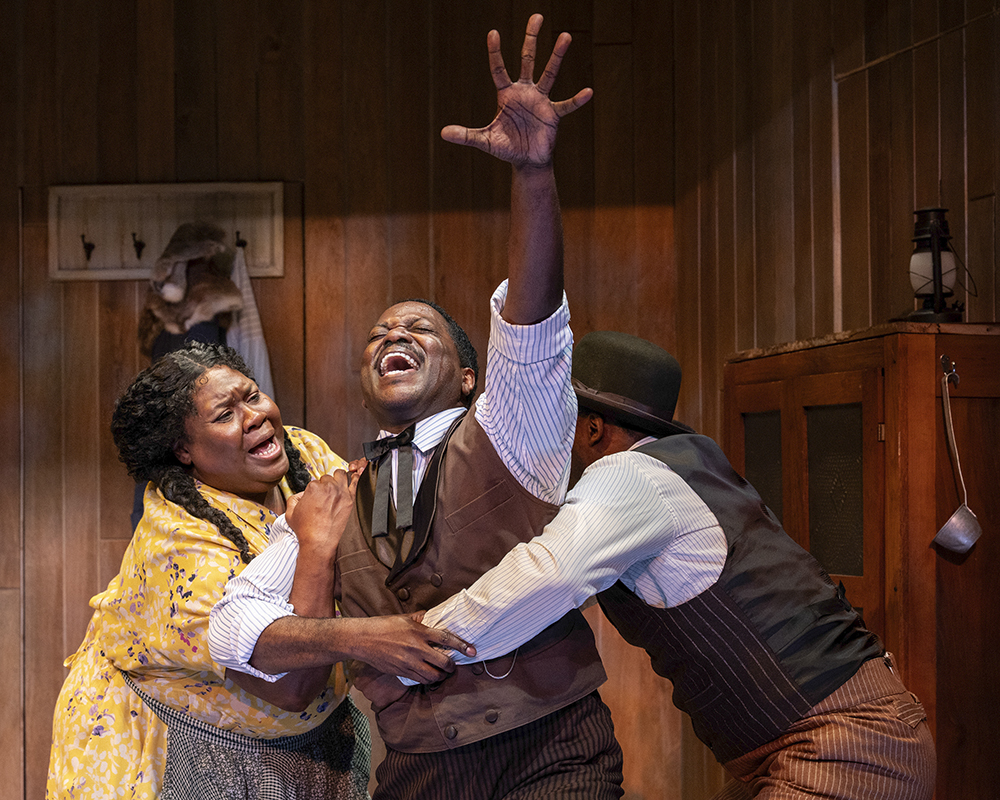
Luce is also starring in the play as Hemings, opposite her boyfriend Mike (Josiah Bania), who’s playing Jefferson and also directing. So, the members of Good Company are entangled in their own web of complicated relationships, including Luce’s ex, Kwame (Ro Boddie), a budding film and TV star, performing the role of Sally’s brother, James Hemings, trusted, enslaved valet to Thomas Jefferson.
The myriad contradictions and hypocrisies of life at Monticello are written on the wall in Round House’s incisively funny production directed by Timothy Douglas. Scenic designer Tony Cisek brings the point home, emblazoning Jefferson’s notes for the Declaration of Independence on a scenic backdrop and scrawled across the green-painted floorboards.
Cisek’s set fixtures and doorways on wheels keep the action rolling through Douglas’ well-orchestrated transitions, toggling between the historical drama brought to life by Good Company onstage, and the present-day drama generated by the Good Company members backstage.

The scenes backstage feel especially crisp. Douglas’ eight-person ensemble etches sharp distinctions between their characters offstage, and the 18th-century characters they’re playing in The Pursuit of Happiness.
Kimberly Gilbert, as agreeable company member Ginger, employs an enviable instinct for just how much comedy to add in comic relief. And Boddie’s nuanced Kwame, seeing something of himself in proud James Hemings, playfully blurs the line between the actor’s ambitions and the character’s.
Meanwhile, Parks’ script, allying historical detail with Luce’s artistic license, keenly probes the politics and practices of owning people in America. Sally and Tom’s interracial affair becomes both text “onstage,” and subtext, via Luce and Mike’s interracial partnership. The play draws parallels between the two couples without lashing their respective stories together.
Ultimately, there could be no comparison. Sally and Tom are the more compelling couple, and, per Brown and Bania’s genuine rapport, truly fascinating to consider in the context of their times. The question persists throughout the play. Does Sally love, or think she loves, Tom? What choice does she have? What choices does she have in anything?
The play, and Brown’s assured performance, emphasize Luce’s power as a Black woman to choose how Sally’s story gets told — even if the playwright is constantly beholden to the wishes and preferences of her company members, director and lover, and a demanding, unseen producer.

Yet, despite the barrage of opinions, and pushback on many of her ideas, Luce wields a weapon we don’t know that Sally ever picked up, one that Jefferson exercised masterfully: the pen. In her way, Luce will have the last word on her version of the past, as well as her own future, full of music and fire.
Sally & Tom (★★★★☆) runs through June 28 at the Round House Theatre, 4545 East-West Highway, Bethesda. Tickets are $50 to $94, with discount options available, including 2-For-1 Tuesday. Call 240-644-1100, or visit roundhousetheatre.org.
More from Metro Weekly:



Support Metro Weekly’s Journalism
These are challenging times for news organizations. And yet it’s crucial we stay active and provide vital resources and information to both our local readers and the world. So won’t you please take a moment and consider supporting Metro Weekly with a membership? For as little as $5 a month, you can help ensure Metro Weekly magazine and MetroWeekly.com remain free, viable resources as we provide the best, most diverse, culturally-resonant LGBTQ coverage in both the D.C. region and around the world. Memberships come with exclusive perks and discounts, your own personal digital delivery of each week’s magazine (and an archive), access to our Member's Lounge when it launches this fall, and exclusive members-only items like Metro Weekly Membership Mugs and Tote Bags! Check out all our membership levels here and please join us today!




You must be logged in to post a comment.