“Our role as journalists is to help communicate stories and be voices for people,” says Vaughn Hillyard, a former campaign reporter who is now senior White House correspondent for the cable news network MS NOW. “In journalism, we are part of ever-evolving stories and dialogues.”
For Hillyard, the desire to tell important stories and hold people in power to account dates back to his high school days in Phoenix, Arizona. He worked for the student newspaper, which won a First Amendment Press Freedom Award after its reporting on a standardized testing system being used by the Glendale Union High School District was censored and stalled for a year before being published — well after he had graduated and entered college.
“In so many ways, that experience made me committed to doing journalism, because it was so transparent that the superintendent didn’t want to answer any questions,” he says. “Teachers went on the record criticizing the standardized testing system. And I was gobsmacked at the willingness of somebody, who we are supposed to respect as the leader and authority figure of the school district, actively silencing not only the story, but the teachers that spoke out in it.
“That moment really shaped me in a lot of ways,” he adds. “We sometimes like to think good of people that are in high office or in positions of authority, but there is a responsibility that we have, regardless of what level and what positions we’re talking about. Whether it be Superintendent of schools, or whether it be the President of the United States, we have a prerogative to hold them to account.”
After high school, Hillyard attended Arizona State University’s Walter Cronkite School of Journalism, where one of his professors, Aaron Brown, a former CNN and ABC anchor, encouraged him to branch out beyond his home state, where Hillyard had felt content to settle.
“He said, ‘Go move overseas, to New York or to D.C. I don’t want to hear from you until you’re in one of those places,” he recalls. “We were in the parking lot, the last ones out from my graduation. And that was kind of the tough love that Aaron gave me. He said, ‘You’re 22 years old. You don’t know anything about the world. You’ve only lived in Phoenix. Go. Learn from people that are really good at what they do or go learn about the world.'”
Hillyard applied for a job as a Tim Russert Fellow at NBC and MSNBC, which led him to Washington. He later served as a researcher for NBC’s longtime foreign affairs correspondent Andrea Mitchell. In the summer of 2015, he became an embedded campaign reporter, moving to Iowa for six months to cover the 2016 Republican presidential campaigns, specifically the Ted Cruz campaign.
After Cruz dropped out, Hillyard was assigned to cover former Vice President Mike Pence day-to-day, while occasionally covering the Trump campaign. He soon established himself as a source on Republican politics and the MAGA movement.
In 2017, he embarked on the road once more, driving around the country and talking to regular Americans about their concerns and feelings about politics, reporting back to NBC about those conversations. After Trump lost the 2020 election, Hillyard was assigned to cover the then-former president’s political comeback.
“I was there on January 6th outside of the U.S. Capitol. And I covered his first big rally in January 2022. And covered most of his rallies in 2022, 2023, 2024,” Hillyard says. “I covered the indictments, I covered the trial up in New York, and I covered his next presidential campaign. After Trump won, my husband and I decided it was time to return to Washington, D.C., and we said we were going to cover the Trump story until the end, and that’s what we’re doing,” he says.
In 2025, Hillyard was named NBC White House correspondent, and later became a senior correspondent for MSNBC prior to its separation from Comcast and NBCUniversal News Group, and its rebrand as MS NOW. He and his husband, Devan Cayea, are now raising a 3-month-old son, Hudson.
“One could say that Devan and I have taken perhaps an ‘old-school’ view of what a traditional family would more or less look like, but that’s the life that we developed for ourselves,” he says. Despite being married to another man, Hillyard, who was raised Christian, embraces a more LGBTQ-affirming view of religion.
“I am of the faith and the belief that God loves everybody, and that we love thy neighbor, and that we are also open-minded about other faith communities,” he says. “The best man at my wedding was my best friend from growing up in Arizona, a Mormon guy. I think our different faith journeys can very much be intertwined with celebrating our individuality and our own uniqueness.”
Returning to his political reporting work, Hillyard is sharply critical of those in power who try to avoid engaging their constituents or taking responsibility for their actions in office.
“I am amazed generally by the unwillingness of modern-day politicians to make themselves vulnerable and put themselves in potentially uncomfortable positions to have basic dialogue,” he says. “Where is the modern-day town hall? We hardly have them anymore. In 2017, there were some, and people didn’t like that they got shouted down. That’s tough. Welcome to America.”
Hillyard notes that when he travels the country and talks to ordinary Americans about the economy, the government, and their expectations for their elected representatives, it doesn’t always align with the image that politicians — including President Trump — seek to cultivate.
“There is such a fear among folks of having to answer for uncomfortable policy positions,” he says. “There’s just an uncomfortability in our politics that drives people into their self-isolation.”
Hillyard attributes the recent success of insurgent left-wing candidates in Democratic primaries to politicians’ growing reluctance to engage with their own communities.
“It makes me disappointed that politicians are increasingly unwilling to answer tough questions, not just from journalists, but from their own constituents,” he says. “And it’s not because they aren’t good people. It’s not because they don’t care about their communities. But if you don’t continually engage in tough conversations and make yourself vulnerable, reality is going to be left behind with the last election you ran.”
Vaughn Hillyard – Screenshot: MS NOW
METRO WEEKLY: When did you come out, and what was that experience like?
VAUGHN HILLYARD: I came out in 2017. I was out on the road for years [as part of my career]. I never had a girlfriend. I had a great community of friends and family, and I was really passionate about my job. I spent so long listening to people tell their own stories and tried to help share those. And I’ll admit that, sometimes, I neglected my own story.
I know that everybody has their own path to coming out, and people have different lived experiences. I’m proud of my own story and how I got there, and I’m so glad that I did. And not to judge anybody else, but I think as part of my job, it is important that I be wholly transparent about who I am and who I love, and the fact that I am proud to have an awesome husband and now a kid. I think as a journalist, part of gaining that trust requires being open with others about our own lived experiences. And so for the last 11 years, I’ve been covering Republican politics. I am very proudly open about the life that I’ve grown.
I think it’s important to note that, because of how open I am, I have felt a great amount of love in return. I went to Hialeah, Florida, ten days after my wedding in 2023, and there were several pro-Trump media members who were the first to come up to me and give me a hug and congratulate me. They didn’t care that I was marrying a man. I like to think it’s because, over the previous years, they had gotten to know me as a human and understood that I shared love with everybody just the same. And that warmth in return, it felt great.
MW:Let’s get more specific. Who was the first person you came out to, and how was your coming out received?
HILLYARD: I was sitting outside of a Panera Bread in Slidell, Louisiana, and I called my friend Stephanie, who I’ve known since preschool, and who has two moms. I knew Stephanie would love me unconditionally. And I teared up on the phone with her, and I just felt free. I felt like I was taking control of my own story, and that I was going to explore a personal life that was full of unknowns and opportunity. And Stephanie [supported] me immediately.
MW:How long have you been married to your husband?
HILLYARD: We married in October of 2023, a little more than two-and-a-half years into our relationship. We met a month before the pandemic in 2020. He was working at the time for Amy Klobuchar’s presidential campaign. He’s out of politics now.
MW:You also have a son, whom you conceived with the help of a surrogate, correct?
HILLYARD: Yes. We had an awesome surrogate, Laura, in Arizona, who lives about 20 minutes from my folks’ home where I grew up. We worked with a surrogacy agency in Albany, New York. It was coincidental when they called up and said, “We have an awesome human that we’d love for you to meet.” And when we met Laura, we knew. She also said she knew that we wanted to go on this journey together. And so, it was a two-year process. And she is still very much a part of Hudson’s life, and she has two kids of her own, and they’re an awesome extended part of our family.
MW: There’s been a lot of resistance to same-sex couples having children via surrogacy across the world. We’ve seen it in Italy and other parts of Europe, where some forms of surrogacy are banned. There’s opposition from the political right, but also from left-wing feminist groups, to the very idea of surrogacy, and a framing that it is exploitative of women, that it is unnatural, and that raising children in same-sex households is harmful to children. When you hear those arguments, how do you remain objective, given they’re implicitly attacking your family?
HILLYARD: I must be truthful to who I am in my own lived experience. I think that is important to me being a journalist too. I can tell you and others to go talk to folks who have lived through their own surrogacy experiences. There’s a lot of beautiful stories that we’ve heard from a great many people, across the political spectrum, about growing beautiful families. I’m so lucky and thankful that we had the chance to do that because, not only did we get Hudson, we also got Laura and her own two kids, who are now close extended family. And Hudson will forever have Laura, who is more than a surrogate, but a part of our family.
Also, the two couples that I first talked to when we started looking into our surrogacy journey were heterosexual couples, who went through surrogacy for their own health reasons. And the families that have had the opportunity to flourish are amazing. I think that if folks knew of [people’s] personal experiences — which I hope to highlight by sharing my story — they would celebrate the beauty of what this relationship allowed us to have the opportunity to be. I think that every story is unique. I also do think it is absolutely important that families and surrogates have a mutual respect and love for one another. And I am so grateful that we found and were able to be with Laura on this journey.
Vaughn Hillyard – Screenshot: MS NOW
MW: What’s the difference between covering a campaign and being out on the road in America, and being in the White House press corps?
HILLYARD: Being out across the country allows you to, on a daily basis, hear directly from people, regardless of perceived political party, about what their expectations are for the government and from their president. I would use those voices to back up and also lead my questioning of the candidates, to ensure that it wasn’t Vaughn Hillyard, the question off the top of his head. They were questions, frustrations, concerns that came directly from people. The voices of people across the country, those are voices that politicians can’t refute. They can call us fake news. They can suggest that we, in the media, have an “agenda.” But when you give them the name of an actual farmer or an actual person who doesn’t have access to health insurance, you can’t name-call. You can’t spin and you can’t deride where that’s coming from.
So to push that forward to covering the White House beat, I use those contacts every week to check in with people that I’ve met over the last 11 years. They help keep my focus where it should be. These are folks, several of whom have become more than sources around the country. They’ve become friends who make a baby blanket for my newborn and son and send it. They’re watching the coverage and they appreciate being heard.
I’d like to think that when I ask the White House questions, it always is known that it’s coming from a place of experience and not perception. And I try to root my journalism in that. It’s easy to sit in a briefing room and ask questions. I think what I’m doing — and I think what my colleagues at MS NOW are doing — is ensuring that our line of questioning and our stories are reflective of the concerns of people whom we’ve met across the country over the last decade.
MW:What is the most difficult part about covering President Trump and his administration as a reporter?
HILLYARD: I think the most difficult part about covering the President is sometimes the feeling that there is limited space for nuance. There is so much happening all the time, and so much new material that I sometimes feel like we are limited in being able to report extensively enough. And the consumer of news is also limited in their own time, and of what they’re able to take in. And therefore, we sometimes move at a very quick pace and it makes the news that much more difficult to digest with the context it deserves.
MW:You were at the White House Correspondents’ Dinner this year, when a shooter disrupted the event. What was it like being there, and can you tell us, in your own words, what happened?
HILLYARD: That was the night that my son was officially three weeks old, and it was the first step for me back into the media world, the news world, and away from him. As soon as we realized [the noises] were shots, I instinctively tried to take cover over at a table nearby. I think the frustrating part is –- and it is the harsh reality of what we do now in our coverage — that event isn’t necessarily unique to our times. We all take into account what a weakening of societal humanity does to our communities and our families.
And on that night, I ran out of the Washington Hilton to begin going live, because the cell service was non-existent in the basement where the ballroom is. And I started going live on MS NOW for a few hours, trying to detail [what was going on] the best I could from [where I had been] inside of the ballroom.
MW:What was the reaction to that coverage?
HILLYARD: My reaction was, “You’re back in it.” And through the lens of having a son, there is a sense of wanting to share a world with him of hope and of peace. And yet there is a reality that he is growing up at this young age with chaos so often around him. And I want to make sure that I do justice to my job and do justice to him at the same time.
MW:We’re in a midterm election year. What are you hearing from people within the broader left and right coalitions? What are Republicans and Republican-leaning independents thinking about, versus what Democrats and Democratic-leaning independents?
HILLYARD: Before I even answer that, I think what I will say is that it’s more imperative than ever that we, as journalists, as well as the folks in political office, give grace and space to Americans when it comes to their own political identities. Because I have watched people who want to consider themselves one political party go through crises in terms of who they think represents their values. I think that is, and has been, changing every month.
In terms of the folks that helped elect Donald Trump and that Republicans are relying on to help them in November, I think that there is, from conversations, great surprise. There is great surprise among a great many folks, who voted for Republicans to be in Washington D.C., at the approach of this White House, from moving aggressively in its military strikes against Iran, to the resistance to concerns of so many about what the consequences of these steep tariffs will be to the economy, to the focus on these different projects at the White House that are not at the forefront of folks’ minds across the country.
I think that there is a crossroads right now, among the electorate, as to what they perceived would be fought for versus what actuality is right now. And that’s tough to politically spin for Republicans who find themselves in office, for instance, when the president calls the bipartisan housing bill a yawn. Legislation, it’s tough. Congress is tough, but it’s not a yawn. And I think that really runs afoul of what most people want to see coming out of Washington, D.C.
In terms of the Democratic side, I get to jump around and cover Democrats here and there. And I think it’s important, because a year ago, I was covering Zohran Mamdani on his primary day for the mayoral race against Andrew Cuomo. And a lot of the energy and the fervor and the sentiments were against corporate America and the establishment. Those are throughlines that we hear from Americans of all political identities –- as we have seen with Donald Trump over the last 10 years –- that galvanize people off of an energy of anti-progress. And I think that we are suddenly watching part of the Democratic Party demand that their leaders within their party work more aggressively to make the changes that they have long articulated are at the top of their priority list.
MW:Do you think the members of the Democratic-leaning coalition are actually serious about gaining power and doing things, or have they, at this point, devolved into a factional turf war where they are fighting each other?
HILLYARD: Yes, I believe the Democratic Socialists are very serious about making substantive changes, legislatively and to our political system. And I say that after having lived in Arizona during the rise of the Tea Party and seeing a political movement that is unwilling to die until it has its chance at power. They got that in Donald Trump. But we see political movements back in 1964. Barry Goldwater ran as this newfound conservative, and he got destroyed in the 1964 presidential election. But Ronald Reagan, 16 years later, picked up that mantle and really introduced what was then modern-day conservatism to the Republican Party.
And political parties, they change, they shift. And for the Democratic Party, there were voters who nearly made Bernie Sanders their nominee for president in 2016, and nearly got that change within the Democratic Party.
In 2020, they got darn close again. And the idea that the demands that were being made by voters backing Bernie Sanders would just go away, I think, is a fool’s errand for anybody that is working in politics. And I say that as somebody who has talked to thousands of people across this country over the years. Because, as one example, I can challenge anybody to go off and try to be a journalist for a day, go and ask folks about health care. I was down in deep-red Pearlington, Mississippi, several years ago. And one person after the next, I asked what they thought about health care.
They thought that health care should be accessible and free to all because a tenet of a thriving community is its health. And those folks overwhelmingly voted for Donald Trump. Right? And that is where I don’t think it’s fair to box people in in what the identity of our politics today is. And I think that that is where Democratic Socialists, and some of whom consider themselves Independents by label, understand that there are a great many Trump voters that they can resonate with. And it may not be the modern-day coalition of the Democratic Party, but they understand that there is a future coalition that they’re actively building. And I have a hard time seeing this movement disappear until they have their opportunity at power in Washington, D.C.
MW:Where does the disconnect exist between those currently in power and the people on the ground?
HILLYARD: The founders created the Congress to make deliberation difficult and to make the creation of laws something that required concessions and agreement. As a consequence, 250 years later, most Americans don’t like that reality. And there is only so much space for excuses that people on the ground are willing to give those who are in those positions.
When you have longtime Democratic leaders, whether they be governors or senators –- Michael Bennett just lost his primary in Colorado –- make the case that they are adequately representing their constituents, for a great many, slow progress isn’t good enough. And that is a reality that those who are elected to these leadership positions have to grapple with.
And for those who have been the long standard-bearers for the Democratic Party, there’s that fervor among voters that they are going to have to wrestle with in the months and the years ahead.
MW: Is partisanship more acute now than it was when you first started on the beat in 2016, or is it about the same?
HILLYARD: I’m not sure if it’s partisanship. It is more distrust in journalists, elected officials, folks’ own family members, and neighbors. The number of people I have talked to who are not talking to close relatives is sad, and it is fueled by distrust. And it is imperative that the President of the United States, this White House, and other federal, state, and local leaders in both parties demand truth and accountability.
It is becoming increasingly difficult as a journalist to ask basic questions of people because they don’t want to engage. And when folks are not engaging with journalists or with their neighbors or their family members because they don’t trust each other, well, what does that conversation look like? It’s non-existent. And we’re just going to be driven to more difficult places until more voices demand respect and conversation.
MW: Are you finding fewer people willing to talk to you as a reporter?
HILLYARD: Yes, absolutely. And I used to more effectively be able to open my chest up, introduce myself and a conversation would begin. It’s not that easy now. And breaking down those barriers of distrust really makes the job difficult. And it’s not helpful when we’re trying to tell people’s story when we can’t.
MW:Why do you think there’s more distrust of the media now?
HILLYARD: This isn’t specific to us or another outlet. That includes FOX. Let me be very clear. I’m somebody that had a good relationship with Brian Glenn who was the White House guy for Real America’s Voice. He’s also known as Marjorie Taylor Green’s fiancé. The level of conversations we had, they were deep. And we traveled the country, on a lot of the same flights together, and at events together, for five years. The conversations that I had with Brian, I wish that I could have with even more people. Brian, to his credit, would tell people, “Vaughn’s a good guy.”
And Brian did one very specific thing. He played his own role in covering Donald Trump and the White House, which I covered as a journalist, and yet I think there was at least a mutual understanding of the type of conversation that we could have between each other. And I wish that the country knew that, because they would not necessarily suspect that the senior White House correspondent for MS NOW and Brian would have such civil dinners. But those are conversations that are imperative [that] we all have.
It is imperative that the president stop eroding trust in fellow Americans and instead lift up the idea that we each love our neighbors and our brothers and our sisters. We absolutely have to have that, or else our communities will continue to fracture. And the president, too often, is telling people not to trust the media and is telling them not to trust those that have a different party label in front of their name.
MW: Just to follow up, is the fear of people talking to you, based on the assumption that you’ll take their words out of context, or is there another sort of fear?
HILLYARD: They distrust that we, in the media, care about the future of this country. And that’s a shame, because we must believe that our neighbors love the country just as much as we do. And there are individuals today that are telling people not to believe that. And that is resonating, unfortunately.
But asking questions and doing accountability journalism, that is love for one’s country. That is the role that we play. And being skeptical of elected officials only helps better the expectation-setting of what we demand from our elected officials.
MW: There’s been a historic criticism from the right about what they believe is unfair or biased media coverage. We’re also heard, more recently, criticisms from the alternative media space that the mainstream media fixates on certain narratives or shapes stories to align with pro-establishment views, couched as so-called “common knowledge” or talking points. How are you making sure you flush out stories further and get more diverse perspectives?
HILLYARD: It’s a good question. And truly this is not a dodge. This is my actual answer to you here. Last year my guiding light, my professor, Richard de Uriarte, he was my ethics professor in college, a longtime newspaper man out in Arizona. And everybody in politics in Arizona loved this man, because he listened. He was the guy that if you were indicted, he’d call you and say, ‘Things can get better.’ He was insistent on just listening and telling the story. And I think sometimes the media can overcomplicate the story. So we should say what we know, listen, and do justice by those that are living it.
I don’t think that the moral compass of journalism should be that complicated. For me, it seems pretty black and white. Not that stories are black and white, but the ethics of how we cover them are. And I think our responsibility is to ask questions and say what we know, and acknowledge what we don’t know. And damn, so often there is a lot we don’t know, and it’s important that we acknowledge that as well.
MW:Because you are an out gay journalist, do you sometimes feel a responsibility to the community in terms of your reporting when covering LGBTQ issues?
HILLYARD: Absolutely. When we’re talking about gender-affirming care, we are talking about the health and well-being of Americans, our neighbors, our loved ones, and their stories and their truths. And the facts matter. We as journalists have a responsibility to articulate those facts in the stories of those in our community accurately and responsibly, and in no way, because of any political pressures, should we shirk from that.
I also believe that we must make it clear, as journalists, that as long as love is at the heart of one’s own journey, then we should celebrate the pursuit of happiness of every single American in our communities. And if somebody is actively pursuing policies to prohibit or inhibit one’s path to that pursuit of their own happiness, then it is our responsibility to report that.
I don’t see where there is any conflict in that reality, because I think that that is what being a journalist is. It’s sharing the stories of our community. And sometimes our community can be the LGBTQ community. Sometimes our community can be my North Phoenix suburb. Sometimes our community can be my community in Dupont Circle. Sometimes my community can be that of the MS NOW journalism community. A story is a story, and we have a responsibility to share it ethically, responsibly, and clearly.
MW: Have you ever felt pressure, or received criticism from LGBTQ people, for “not doing enough” for the community as a reporter?
HILLYARD: No, I have not. I’ve covered efforts by Republican lawmakers around the country to ban gender-affirming care for minors. I think I brought humanity to that piece, interviewing young people who were seeking transition care. And I think that their voices, again, were really important to the actual conversation around gender-affirming care. I’ve brought up that issue when I’ve interviewed Republican presidential candidates like Asa Hutchinson, who actually vetoed a ban on certain gender-affirming treatments when he was Governor of Arkansas. And I talked about that with him as part of his run, and why he thought that [the ban] was too far, and that ultimately it was the rights of parents and medical professionals to have that conversation about youth and their wellbeing. And I made that a part of my coverage.
I went out to Amarillo, Texas, once, and so often when we talk about faith and Christianity, especially as it’s tied to our politics, it’s usually concentrated on the Evangelical community and their pertinence to the Republican Party. And I think that our faith and Christianity is so much more complex and layered than that. I went to a church that was open and affirming, and interviewed their minister, and talked about how faith is an important part of the Democratic Party, too. And not just Christianity, but a Christianity that was open and affirming of the LGBTQ community. And when you’re talking about religion, there’s a [sizable] part of America that practices a Christianity that welcomes people from the LGBT community in their pews.
So I haven’t been critiqued or criticized. And I’d like to think that’s because people know that I’m working in good faith, and I try to be the most sincere that I can as a reporter.
MW:Have you ever been pressured by an editor or somebody higher up at MS NOW to either censor or to change a story?
HILLYARD: MS NOW has been terrific and I’m really proud — damn proud — to work for this organization because there is no corporate influence. There is a directive for us to report. And there has not been a single time at MS NOW that I’ve been called up before or after a hit on television saying, “What was that all about?”
MW:There is creeping concern over media consolidation and corporate monopolies, and how journalists can navigate a media environment where one company owns multiple outlets and can exert control over what airs and what doesn’t. How can we ensure that journalists can perform their jobs without falling victim to censorship or political agenda-pushing?
HILLYARD: Journalists must support the independence of other journalists. And we should celebrate the news organizations, and those who own them who give newsrooms the editorial independence to report. MS NOW and Versant Media do that. That’s why I’m here. And I think that’s why we are growing. Because when you look at the current media landscape at the national level, I think that there is a realization that MS NOW’s editorial independence gives us, as reporters, the breadth to do our work without the concern of corporate or political intervention. And that’s why I am proud and happy to be working at this place, specifically.
Vaughn Hillyard is a senior White House correspondent for MS NOW. You can follow him on X at @VaughnHillyard and on Threads and Instagram at @vaughn_hillyard.
If you've known a true sociopath, it's likely you'll recognize the type among the three hyper-ambitious grad students in Aurin Squire's wicked new comedy My Favorite Sociopath.
Making its world premiere at the venerable Contemporary American Theater Festival, in Shepherdstown, West Virginia -- in a solid production directed by Céline Rosenthal -- the play pits the three aspiring journalists against each other for a plum job at a newspaper. And the competition gets dirty.
The tactics used by one or more of them to steal an advantage might be described as amoral. Their behavior could certainly be seen as sociopathic.
Republicans in Congress have added six anti-LGBTQ riders to the annual State Department funding bill for fiscal year 2027.
Democrats have denounced the riders as "poison pills" that could jeopardize the bill's passage and unfairly target LGBTQ people.
"None of these riders make our world any safer," U.S. Rep. Mark Takano (D-Calif.), chair of the Congressional Equality Caucus, said in a statement. "It's beyond shameful that the Republican majority has again tainted this vitally important bill with these poison pill riders."
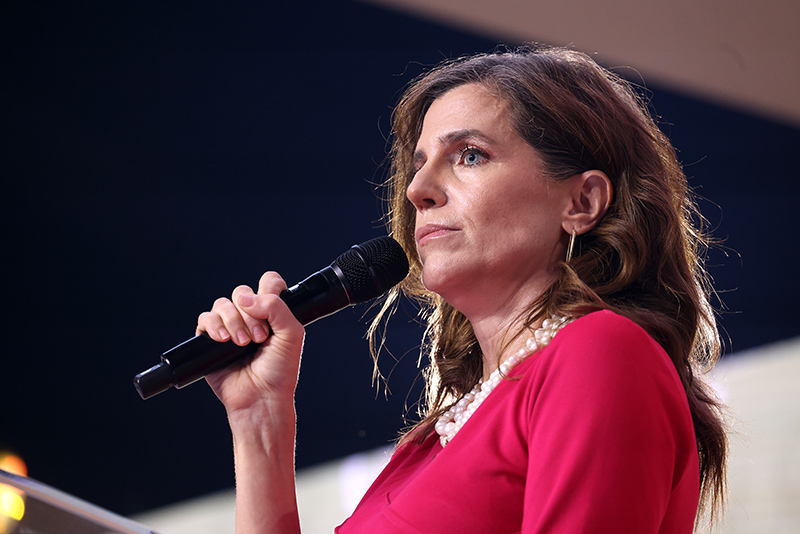
U.S. Rep. Nancy Mace (R-S.C.), one of the transgender community's fiercest opponents, is reportedly considering a bid for the U.S. Senate seat left vacant by the sudden death of Sen. Lindsey Graham on Saturday, July 11.
Graham, 71, spent 31 years in Congress, serving four terms in the U.S. House before winning four terms in the Senate. He developed a reputation as one of the Republican Party's most hawkish voices on foreign policy, consistently advocating for U.S. military intervention abroad and a strong military presence overseas.
According to a statement from his congressional office, Graham died from an aortic dissection caused by arteriosclerotic cardiovascular disease, a condition in which plaque buildup hardens and narrows the arteries, restricting blood flow and increasing the risk of heart attack or stroke.
These are challenging times for news organizations. And yet it’s crucial we stay active and provide vital resources and information to both our local readers and the world. So won’t you please take a moment and consider supporting Metro Weekly with a membership? For as little as $5 a month, you can help ensure Metro Weekly magazine and MetroWeekly.com remain free, viable resources as we provide the best, most diverse, culturally-resonant LGBTQ coverage in both the D.C. region and around the world. Memberships come with exclusive perks and discounts, your own personal digital delivery of each week’s magazine (and an archive), access to our Member's Lounge when it launches this fall, and exclusive members-only items like Metro Weekly Membership Mugs and Tote Bags! Check out all our membership levels here and please join us today!









You must be logged in to post a comment.