Two post-election surveys from national LGBTQ organizations suggest that political ads focusing on transgender issues did more to turn voters away from the candidates they were meant to help than to win them over.
A Morning Consult survey released by the LGBTQ media advocacy group GLAAD found that midterm voters were twice as likely to say ads focused on transgender issues made them less likely to support a candidate as they were to say the ads made them more likely to do so. The survey, conducted from November 4 to 6, included 2,026 registered voters, 1,725 of whom said they voted in the midterms.
Among midterm voters, 37% said they were less likely to support a candidate who ran ads about transgender issues, while 18% said they were more likely to support such a candidate.
The gap was wider among rural voters. Forty-seven percent said they were less likely to support a candidate who ran ads about transgender issues, while 13% said they were more likely to do so.
Among Southern voters, 40% said the ads made them less likely to support a candidate, while 17% said they were more likely to do so. Among voters without a college degree, 37% said they were less likely to support such a candidate, while 17% said they were more likely.
Asked what motivated them to vote, 59% of midterm voters cited the cost of living and 31% cited health care. Just 5% cited transgender issues, though 70% said they had encountered media coverage of those issues in the month before the election.
The survey found a similar pattern across nine states where conservative groups spent heavily on anti-transgender ads — Arizona, Colorado, Georgia, Missouri, Nebraska, Ohio, Texas, Washington, and Wisconsin. Spending on those ads totaled about $187 million across the nine states this election cycle, including $78 million in Texas and $26 million in Ohio.
In those nine battleground states, 58% of midterm voters cited the cost of living as a reason they voted, compared with 6% who cited transgender issues. Forty-six percent said they were less likely to support a candidate who ran ads about transgender issues, while 15% said they were more likely to do so. Among registered voters surveyed in those states, 77% said they had seen, read, or heard about transgender issues in the run-up to the midterms.
Asked why candidates talk about transgender issues, 20% of midterm voters said candidates wanted to divide voters along partisan lines. Another 16% cited media attention, 12% said candidates wanted to avoid discussing other pressing issues, and 8% said they wanted to rally their base.
Voters were also skeptical that candidates raised transgender issues out of genuine concern. Just 12% said candidates were responding to voters’ concerns. Eleven percent each said candidates wanted to address a social issue that matters, protect transgender people, or protect “traditional values.”
A separate post-election survey from the Human Rights Campaign found that 88% of what it calls “equality voters” backed Democrats in congressional and gubernatorial races. HRC defines “equality voters” as LGBTQ people and allies who prioritize LGBTQ equality when choosing candidates.
Democratic support among equality voters was slightly higher than among LGBTQ voters overall, 85% of whom backed Democrats.
HRC estimates that nearly $400 million was spent nationwide on anti-transgender ads this election cycle. Forty-seven percent of voters recalled seeing ads criticizing Democratic candidates for “allowing people who were born as men or transgender people to compete in women’s sports” or “allowing gender-changing surgery on children.” Ad recall was higher in congressional battlegrounds (55%), Texas (66%), and Ohio (72%).
Super PACs, including Elon Musk’s America PAC, targeted Texas and Ohio with anti-transgender attack ads.
Corruption, inflation, and threats to democracy ranked as voters’ top three issues in the GQR poll conducted for HRC. Nearly two-thirds of voters (65%) said they wanted to hear less about transgender athletes and surgeries, while 14% wanted to hear more.
In the same poll, 58% of voters agreed with the statement that “Republicans’ obsession with transgender people and children is strange and over the top.” That’s three percentage points higher than the 55% who backed Democrats this cycle.
Agreement was higher among Hispanic voters (64%), independents (62%), and younger men (61%).
“MAGA Republicans spent hundreds of millions in a desperate electoral strategy demonizing the transgender community and it backfired spectacularly,” HRC President Kelley Robinson said in a statement. “This poll makes it clear: attacking transgender Americans is a losing strategy.”
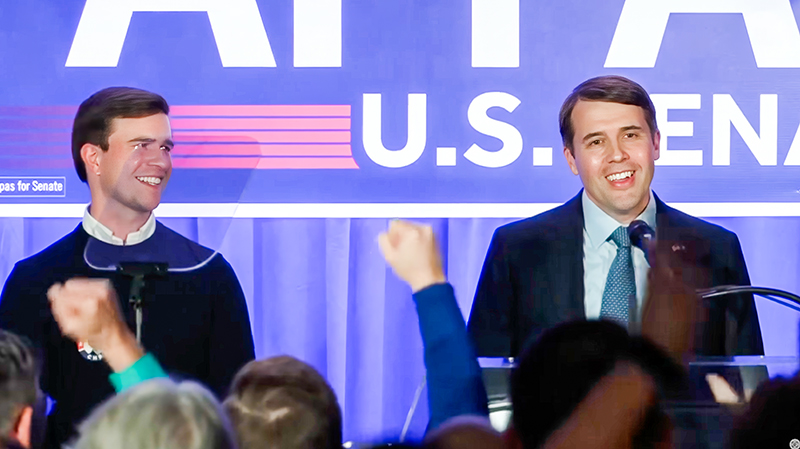
On Tuesday, America elected its first openly gay male U.S. senator, Chris Pappas, as voters from coast to coast sent Democrats to Congress in what some pundits have labeled a "blue tsunami."
Pappas, who currently represents New Hampshire's 1st Congressional District in the southeastern part of the state, beat back a strong challenge from former U.S. Sen. John Sununu (R-N.H.), who briefly surged into the lead in some polls this summer. Ultimately, however, the state reverted to its Democratic lean, with Pappas romping to a 14.3-percentage-point margin of victory over his Republican opponent, with over 90% of the vote counted.
A new AI-generated attack ad supporting Jennifer Balkcom, the Republican nominee for North Carolina's 11th Congressional District, accuses Democratic nominee Jamie Ager of hosting a barn dance with drag queens and children.
The ad, paid for by the National Republican Congressional Committee and approved by Balkcom, was posted to the North Carolina Republican Party's official X account on October 22.
The ad shows Ager speaking into a microphone, with a Progress Pride flag hanging on a barn wall behind him. "Wanna know what we need more of in Washington, D.C.? Barn dances!" he says, as ABBA's "Dancing Queen" starts playing.
Meta, the parent company of Facebook, Instagram, and Threads, has reportedly paid at least 29 accounts with histories of promoting anti-LGBTQ rhetoric for posts ahead of this year's midterm elections.
According to reporting from Uncloseted Media and The 19th, Meta pays these creators through Facebook Content Monetization, a program launched in 2024 that allows eligible creators to earn money based on the performance of their public Facebook posts, including text, Stories, Reels, longer videos, and photos.
Many creators celebrated the program's launch, with some reporting a major increase in their earnings. But critics say the program encourages inflammatory posts and so-called "rage bait" to increase engagement.







You must be logged in to post a comment.