2014 Eurovision Song Contest winner Conchita Wurst – Photo: Albin Olsson, via Wikimedia.
Hungary has pulled out of the 2020 Eurovision Song Contest due to the contest’s LGBTQ-friendly nature and encouragement of LGBTQ representation.
While no official reason was given for the withdrawal, sources within Hungary’s state-owned public broadcaster MTVA believe the decision is due to a rise in homophobic rhetoric stemming from the Hungarian government’s right-wing lurch and its emphasis on promoting traditional values.
In previous years, MTVA hosted its own song contest, with the winner going on to represent Hungary in the continent-wide contest. But last month, the broadcaster announced that the country’s in-house contest would instead focus on the hit of the year.
That announcement was considered a signal that Hungary was planning not to compete in the upcoming 2020 contest, something confirmed last week when the list of competing countries was released.
A source at MTVA told The Guardian that staff believe the decision to withdraw from the contest was due to Eurovision’s pro-LGBTQ attitudes, which conflict with MTVA’s policy of discouraging positive coverage or portrayals of LGBTQ individuals or LGBTQ rights.
That follows a report by Hungarian website index.hu last week that claimed Hungary had withdrawn because Eurovision was perceived as “too gay,” and that a pro-government commentator had even called Eurovision a “homosexual flotilla.”
Prime Minister Viktor Orbán has denied those claims, but has not offered any other explanation.
However, Hungary’s ruling Fidesz party has made its stance against homosexuality and embrace of “traditional values” well known. Orbán has even initiated a “family first” policy to incentivize marriage and childbearing in an effort to boost birth rates as the country’s population continues to decline.
Other government officials have not been shy in expressing their contempt for homosexuality. Earlier this year, László Kövér, the speaker of the Hungarian parliament, compared same-sex adoption to pedophilia.
Deputy Speaker István Boldog called for a boycott of Coca-Cola after the company launched an advertising campaign for a local music festival using photographs of a gay couple.
This is not the first time that Eurovision has been criticized for its LGBTQ-friendly nature.
In 2014, a Russian legislator attempted — and failed — to cancel the broadcast in Russia on the grounds that it “propagandizes homosexuality,” thus putting it into conflict with Russia’s controversial anti-gay propaganda law.
Russian politicians also went into an uproar after Conchita Wurst, an Austrian singer and drag queen, won Eurovision that same year, with some politicians calling for a boycott of the contest for promoting homosexuality or portraying it in a favorable light.
Despite that bluster, Hungary’s withdrawal is the first time a country has pulled out over social issues. Some have withdrawn over financial worries or geopolitical issues, only to return later.
Now in its 65th year, the 2020 contest will be hosted in Amsterdam and feature 41 countries, including Bulgaria and Ukraine, who are returning after a one-year hiatus.
The European Broadcasting Union, which runs the contest, told The Guardian that “it is not uncommon for EBU members to have breaks in participation in the Eurovision song contest.”
“We hope to welcome their broadcaster MTVA back to the Eurovision song contest family soon,” the EBU said in a statement.
Hungarian lawmakers have voted to remove anti-LGBTQ provisions from a 2021 "child protection" law adopted under former Prime Minister Viktor Orbán.
By a 139-51 margin, the Hungarian parliament passed a bill retaining protections against material that can "seriously impair the child's physical, intellectual, emotional, or moral development." But the amended law removes bans on the "portrayal" or "promotion" of sexual or gender diversity, according to Agence France-Presse. The term "promotion" was ill-defined and interpreted broadly under the Orbán regime.
The vote marks the first significant reversal of the Orbán regime's efforts to crack down on LGBTQ visibility. Prime Minister Péter Magyar won a landslide victory in April, ending 16 years of rule by Orbán's Fidesz party.
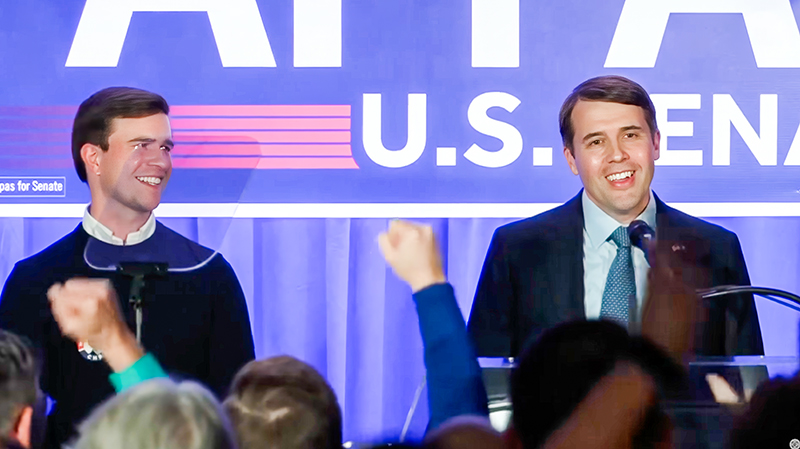
On Tuesday, America elected its first openly gay male U.S. senator, Chris Pappas, as voters from coast to coast sent Democrats to Congress in what some pundits have labeled a "blue tsunami."
Pappas, who currently represents New Hampshire's 1st Congressional District in the southeastern part of the state, beat back a strong challenge from former U.S. Sen. John Sununu (R-N.H.), who briefly surged into the lead in some polls this summer. Ultimately, however, the state reverted to its Democratic lean, with Pappas romping to a 14.3-percentage-point margin of victory over his Republican opponent, with over 90% of the vote counted.







You must be logged in to post a comment.