Scott Wiener – Photo: Courtesy Wiener, Marni von Wilpert – Photo: Facebook
Two LGBTQ congressional candidates in California advanced to the November general election after finishing among the top two vote-getters in their respective races in the state’s jungle primary on Tuesday, June 2.
According to results from the Secretary of State’s office, with 50% of ballots counted in California’s 11th Congressional District race, openly gay State Sen. Scott Wiener (D-San Francisco) led the 11-candidate field with 41% of the vote. San Francisco Supervisor Connie Chan (D) was second with 29%, while Democratic Socialist Saikat Chakrabarti finished third with approximately 15%.
Under California’s “all-comers” jungle primary system, all candidates compete on the same ballot, with the top two vote-getters advancing to the general election regardless of party affiliation. Because many Californians vote by mail, final results often take several weeks to tabulate — especially in crowded primary contests where margins can be relatively narrow.
With 57% of ballots counted in California’s 48th Congressional District race, which stretches from the San Diego suburbs to the LGBTQ-friendly city of Palm Springs, San Diego City Councilmember Marni von Wilpert, a Democrat, placed second in a 12-candidate field with about 20% of the vote. She finished well ahead of third-place candidate Ammar Campa-Najjar, also a Democrat, who received about 10%.
Von Wilpert, who is a lesbian, will face Republican San Diego County Supervisor Jim Desmond in the general election in a district that was redrawn from one that President Donald Trump carried by 17 points in 2024 to one that former Vice President Kamala Harris won by 3 points.
The 48th District is expected to be one of four semi-competitive congressional races in California this November, all in districts redrawn to slightly favor Democrats. The state’s other congressional seats largely favor one party, with Democrats holding a 44-4 advantage following a mid-decade redistricting push. As a result, political observers expect heavy spending by outside groups and super PACs as Democrats seek to regain control of Congress and Republicans fight to retain it.
Results for other LGBTQ candidates in California were mixed as of Wednesday morning, although several races remain too close to call as mail-in ballots continue to be counted.
Incumbent State Sens. Caroline Menjivar (D-Panorama City) and Steve Padilla (D-Chula Vista) each advanced to the general election after finishing first in their respective races, with 56.3% and 60.2% of the vote. But Juan Camacho, a former government affairs specialist running in State Senate District 26, fell short, finishing sixth with 7.9% of the vote.
Meanwhile, West Hollywood Councilmember John Erickson, who is running in State Senate District 24, was in third place with 16.4% of the vote, trailing the second-place finisher by fewer than 4,000 votes. It remains unclear whether the remaining mail-in ballots could alter the outcome of the race. Erickson was recently targeted by a political attack in which flyers featuring AI-generated images invoking homophobic tropes about gay men — paid for by a political action committee tied to developers and business interests — were mailed to voters.
In Assembly races, incumbents Christopher Ward (D-San Diego), Sade Elhawary (D-Los Angeles), Alex Lee (D-San Jose), José Luis Solache Jr. (D-Lynwood), Rick Chavez Zbur (D-Los Angeles), and Corey Jackson (D-Perris) all advanced to the general election. Assemblymember Mark González (D-Los Angeles) also advanced after running unopposed. Meanwhile, Scott Houston, a gay man seeking the Assembly District 66 seat in Los Angeles County’s South Bay region, earned 5.2% of the vote and did not advance.
Jeff Prang, the incumbent Los Angeles County Assessor, advanced to the general election with 56.77% of the vote in a five-candidate field. Meanwhile, Covina City Treasurer Neil Polzin secured a spot in the general election with more than 60% of the vote, while Tal Khan Valbuena advanced in the race for a Los Angeles Superior Court seat with 50.91%. Other LGBTQ candidates also ran for local offices, including mayor, city council, and school board seats.
In addition to California, five other states — New Jersey, South Dakota, Montana, Iowa, and New Mexico — also held primary elections on June 2. Of those contests, only a handful, mostly for state legislative and county supervisor positions, featured known LGBTQ candidates.
In South Dakota, Adam Bair, a gay man, advanced to the general election as one of two Democrats nominated for the two House seats representing District 10, which includes parts of Sioux Falls. In Montana, incumbent State Reps. Zooey Zephyr (D-Missoula), the state’s first transgender lawmaker, and SJ Howell (D-Missoula), the state’s first nonbinary lawmaker, both won their party’s nominations for reelection. Meanwhile, Brady Bremer, a gay man, secured the Democratic nomination for a House seat representing part of the Bozeman area.
In Iowa, two LGBTQ candidates appeared poised to win Democratic nominations for seats on the Johnson County Board of Supervisors based on unofficial results. Mandi Remington, the current District 5 supervisor, was leading her primary with 61% of the vote, while V Fixmer-Oraiz, who would become the state’s first nonbinary supervisor if elected, was leading the District 4 primary with 56%.
In Iowa House races, incumbent State Reps. Aime Wichtendahl (D-Hiawatha), who became the first transgender person elected to the state legislature in 2024, and Elinor Levin (D-Iowa City), an openly queer lawmaker, advanced to the general election and appear unlikely to face opposition from Republicans or independents. Drew Stensland, a gay man who won the Democratic primary for an open seat representing the Cedar Falls area, also appears to have no general election opponent. A fourth LGBTQ candidate, Cody Smith, lost the Democratic primary for a State House seat in the Des Moines area.
The U.S. House of Representatives passed a bill requiring federally funded public schools to "out" transgender students to their parents if school officials learn the students identify as a gender different from their assigned sex at birth.
H.R. 2616, the "Stopping Indoctrination and Protecting Kids Act" -- dubbed the "Don't Say Trans" bill by critics -- passed 217-198, with eight Democrats joining Republicans and one independent in support of the measure.
Sponsored by U.S. Reps. Tim Walberg (R-Mich.) and Burgess Owens (R-Utah), the bill requires public schools to obtain parental permission before using names or pronouns that do not align with a student's assigned sex at birth or recognizing a student's gender identity.
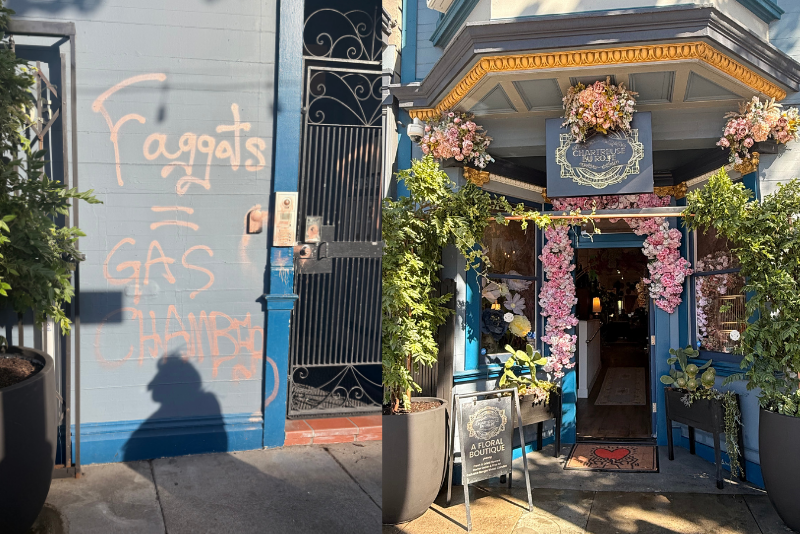
San Francisco police are investigating after a suspect vandalized a floral design shop with homophobic graffiti before fleeing in an SUV bearing a pro-Charlie Kirk message on the back windshield.
Jeff Dumlao, co-owner of the floral design studio Chartreuse by Roje in San Francisco's Castro neighborhood, said he and his partner, Roberto Cancel, had just closed for the day on May 16 when they were alerted to the graffiti.
"We were going to support one of our friends at an art show down the street, and on the way, we get a text from one of our clients saying, 'I know you just closed, but you might want to come back because there's some unpleasant graffiti on the wall outside your store and some sort of disturbance happening,'" Dumlao told SFist.
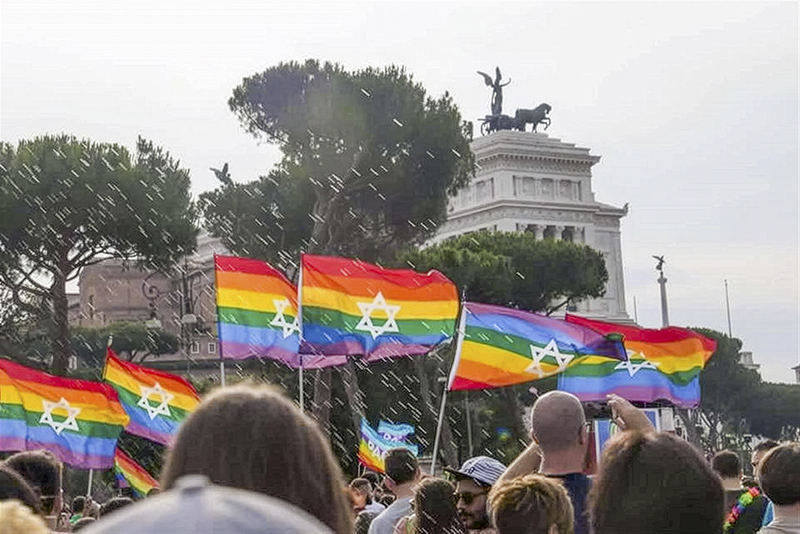
The organizers of the Rome Pride Parade, scheduled for June 20, have barred at least two Jewish LGBTQ groups from participating with a float, saying the organizations failed to sufficiently distance themselves from what organizers call the "genocide in Gaza."
"Anyone who shares the founding values of our movement and our community can join us in the streets," Roma Pride, the organization behind the parade, wrote in a May 26 Facebook post. "The guiding principle of a political demonstration is its manifesto, and in ours, the position of Rome Pride on the ongoing genocide in Gaza carried out by the State of Israel is clear.
These are challenging times for news organizations. And yet it’s crucial we stay active and provide vital resources and information to both our local readers and the world. So won’t you please take a moment and consider supporting Metro Weekly with a membership? For as little as $5 a month, you can help ensure Metro Weekly magazine and MetroWeekly.com remain free, viable resources as we provide the best, most diverse, culturally-resonant LGBTQ coverage in both the D.C. region and around the world. Memberships come with exclusive perks and discounts, your own personal digital delivery of each week’s magazine (and an archive), access to our Member's Lounge when it launches this fall, and exclusive members-only items like Metro Weekly Membership Mugs and Tote Bags! Check out all our membership levels here and please join us today!







You must be logged in to post a comment.