
Jake Loewenthal Is Having a Signature Moment
The D.C.-based actor talks "Merrily We Roll Along" at Signature Theatre, stage fright, stripping down onstage, and getting married.

The still-fresh D.C. theater season has already produced a few must-see shows, but one in particular seems to be on the lips of theater fans everywhere I go these days. “Have you seen Merrily We Roll Along?” was a recurring question on one recent non-theater-related occasion.
Yes, in fact, we’re featuring the show’s “Charley Kringas” on the cover. “That’s Jake Loewenthal? I’m seeing it next week. I can’t wait.” True story.
Word of mouth is undeniable, and, in this case, a strong testament to enthusiasm for Matthew Gardiner’s penetrating production of the Stephen Sondheim reverse-order musical. Naming the actor based on the role is also a noteworthy sign of how well Loewenthal has established himself among theatergoers and theater creators, in the District’s thriving scene.
Arriving in D.C. from New York with his partner during COVID, the Brown U./Trinity Rep-trained performer hit the ground running with roles in Signature’s Rent and Falsettos at Rep Stage. He has stayed plenty busy since.
Shifting easily between lead and ensemble, comedy, drama, and musicals, Loewenthal most made his onstage mark as a music man in shows from Little Shop of Horrors at Ford’s Theatre, to Into the Woods, his first Sondheim role at Signature, and a show very close to his theater kid heart.
He was ten or eleven when he first saw it. “So that’s a few years before the Broadway revival with Vanessa Williams,” he says. “Which I managed to see by — I’m sure I did not sneak onto this school bus, but I did finagle my way onto a friend from a different school’s field trip to go to New York City to see Into the Woods. That’s how committed I was.”
Into the Woods revealed a new world to him “because it’s all of these fairytale stories that we all know and love, but then it’s dark and it’s asking these very serious questions in a way that, at least for me as a kid, I’m like, ‘Well, it’s not talking down to you. You have to rise to meet the material.’ I think for me as a kid, I was always really hungry for art and for adults who didn’t talk down to you.”
While he remained “obsessed” with theater his whole childhood, Loewenthal wasn’t committed to it as a profession until that crucial crossroads of deciding where to go to college. “I wasn’t planning on going to college for acting until I saw Raúl Esparza in Company, the John Doyle revival,” he says.
“I was a senior in high school. And watching him sing ‘Being Alive,’ I said, ‘Oh my gosh, I have to try to do this. I have to give this a whack. I’m 18. Time’s running out. I have to do this now.’ I mean, it’s crazy,” he says, laughing at his teenage, end-all-be-all urgency.
“That changed the trajectory of my life because I was all set to go to one college and I decided to go to a different one at the last minute. I studied acting and I never looked back, for better or worse — but mostly for better.”
For better, he’s now once again playing Sondheim at Signature, alongside Jason Gotay (as Frank Shepard) and Melanie Field (as Mary Flynn), portraying three artists whose decades-long close friendship, told in reverse, goes from drunken disaster to bubbly joy.
Masterfully riding every bump along the road in between — including his show-stopping number “Franklin Shepard Inc.” — Loewenthal nightly lives out the dream of somebody committed to being alive onstage.

METRO WEEKLY: So I checked, I’ve seen you in at least ten shows in the last few seasons.
JAKE LOEWENTHAL: Ten?
MW: Ten. Yeah, that’s crazy. But we’re going to start with the current one, Merrily We Roll Along, which I just saw for a second time this weekend. It’s really fabulous. What do you most enjoy about playing Charley Kringas?
LOEWENTHAL: Oh, I love how himself he is. I love how uncompromising and prickly and combative he can be, and his strong sense of right and wrong. It’s really interesting playing a character who ages over 20 years and finding that journey, but who also has such a strong sense of self while being buffeted about by all of the changes of life. I think that’s been really fun to find, the ways that he does change, but also the ways that he doesn’t. Some people are just so themselves.
MW: The show portrays Charley as being uncomfortable with the success of his best friend, Frank, and who Frank becomes with that. But he’s not just jealous — although he’s got to be some part jealous. In your reckoning, how jealous is he, and how much is he right on the money about who Frank becomes?
LOEWENTHAL: I’m not sure if I experience him as being so jealous. I think he’s got a really good bullshit detector, and I think it’s going off almost immediately when he meets a lot of these people. I think of the scene in “The Blob” when we’re first spending a lot of time with Gussie, and I think he has a lot of people’s number. And, of course, there’s a means to an end when you’re climbing any ladder of success in any industry, but I think he is uncomfortable with the kissing ass required. It’s not something that comes naturally to him.
MW: Okay, so Charley’s right. All right, fine.
LOEWENTHAL: [Laughs.] But also that’s just the way I’m seeing the world these days through his eyes. So, yeah.

MW: I see lots of shows, but I rarely get to see something a second time. I was really struck by how natural everything looks on everybody a month in. The wardrobe looks really like yours, and the movements, everything. So what changes for you over the course of a run? Like what is the difference between doing “Franklin Shepherd Inc.” the first time versus doing it the 40th time?
LOEWENTHAL: There’s just such a joy in repetition. There’s only so many weeks we have to rehearse these things, just financially. You can’t spend six weeks in the studio. We have to get it up on its feet. We have to have an audience, and you learn so much from the audience, of course. But that means sometimes you jump into performances a little raw still.
And so to be a month in and to have gotten those reps in, it allows things to really feel second nature. And so there’s not a part of my brain these days that’s as afraid as I was maybe a month ago of like, “Oh God, do I know these words? Oh God, is the audience going to laugh at something different and I’m going to be taken out for a second?” Because “Franklin Shepherd Inc.” is a runaway train unless you really have it under your feet. So now it’s nice to feel that way and then to get to play within all of the things that we rehearsed six weeks ago.
MW: It’s like this show’s “Not Getting Married Today.” Have you done that one?
LOEWENTHAL: No. Gosh, no, I wish.
MW: Again, on the subject of artists and friends and show business — since this is a story about maintaining a friendship with somebody in the same business — what has your experience taught you about the joys and challenges of maintaining friendships in a business where some people move ahead faster or fly a little higher at different times, and it’s unpredictable that way?
LOEWENTHAL: I think so much of it for me is just about having a strong foundation of support outside of theater, friends that are not necessarily theater people, although I do love my theater friends. And also realizing that everyone’s journey is so different. That’s easier now to make peace with in my late 30s, but it was hard in your 20s to see people running ahead, falling behind. It’s interesting, the Frank Shepherd of it all.
I remember that well from being in my early 20s, these people who find success early. I had a friend I grew up with who is an agent at UTA who taught me this expression, “Oh yeah, they got big on you.” I had never heard this expression of someone who gets big on you, which is basically like, “Okay, I’m in the next echelon and goodbye.” And so yeah, what is the line? “Friendship’s like a garden. You have to water it and tend it and care about it.” That is just true. It’s just true and you have to not lose sight of the real ones.
MW: So especially with the way this story runs backwards, it’s really bittersweet. Somehow it manages to be a fun show. Talk about that weird sort of paradox with this show, which is, I mean, it’s sad, but also I left it feeling uplifted.
LOEWENTHAL: Oh, that’s good. I would hope so. And it’s such a trite answer, but how like life, right? It’s sad, it’s funny. In the sadness we have to find the humor, and I’m glad that so much of the humor of the piece is landing because it is so funny. The book is so witty and sharp, and when you’ve got Maria Rizzo [playing Gussie Carnegie] onstage, you’re always going to be laughing. So I think the two go hand in hand.
MW: I have a Maria Rizzo question.
LOEWENTHAL: Thank God.
MW: You just teed me up.
LOEWENTHAL: Yeah, we can talk about her for the rest of the interview.
MW: You also worked with Maria in She Loves Me and Into the Woods. Tell me one true thing about performing onstage with Maria Rizzo.
LOEWENTHAL: She is a master at riding the wave of energy from the audience. She’s a technician in how she works when it comes to humor. So she plots these things out meticulously in rehearsal, but then the way she adapts to an audience, she’s a genius. And watching someone ride that wave, there’s really nothing like it. And I’m not super sure that can be taught. It’s intuition and brilliance.
I think she can bring humor and humanity to any character. I know a lot of people have come to the show and been like, “Wow, I have never thought about Gussie as deeply as this production made me.” That’s a credit to her, it’s a credit to Matt. She’s never going to take the easy way out. She’s always going deeper, and I admire that so much about her.
MW: She Loves Me was one of my favorite things I’ve seen at Signature. I also think it’s a signature Signature musical because it’s such a musical for people who love musicals. What do you think is in the secret sauce at Signature for producing good musicals?
LOEWENTHAL: Well, this is so cheesy, but I just think it’s a love of the game. I think sometimes a theater produces a musical and they’re like, “Well, because we have to produce a musical. We have to make money. We have to give the people something different.” And Signature, you just know everyone in that building loves musicals. And no matter what the show is, there is someone in that building who is going to come in on day one, whether it’s Matt Gardiner, whether it’s someone in admin, and say, “This is my favorite musical of all time.”
And so there’s always that love of the piece in the room. And I think when you’re starting from a place of love and admiration and a joy in sharing that, the work is always going to be exceptional.

MW: A lot of people say they love Sondheim. Have you always loved Sondheim? Actually, I know one person who is really vocal about preferring Andrew Lloyd Webber, but have you always loved Sondheim?
LOEWENTHAL: Who’s that? Who’s that?
MW: Actually, it’s somebody really close to this conversation, but I’m not going to mention any names.
LOEWENTHAL: I’ve got nothing against Mr. Lloyd Webber–
MW: It sounds like you do have.
LOEWENTHAL: No, I don’t. I don’t. I will say, I grew up in Connecticut surrounded by lots of other little kids who loved musical theater as well. And there were definitely the people who were obsessed with the VHS of Cats, and then there were the kids who were obsessed with the VHS of the original cast of Into the Woods. I was the latter, which I found in my friend Kelly’s family room, and we put it on and it changed my life. I was obsessed and got the cast recording at Borders. Do you remember Borders?
MW: Yeah, of course.
LOEWENTHAL: And I wore that out to the point where when I then got to do it a few years ago at Signature, which was a small miracle, I mean, I was fully off-book day one. I was like, “I know all my lines and I know all the witch’s lines. Let’s go.”
MW: You came to bake.
LOEWENTHAL: Exactly.
MW: When did you start performing?
LOEWENTHAL: Gosh, I think–
MW: Out of the crib.
LOEWENTHAL: Elementary school. My elementary school had a good arts program, and I had a best friend at the time who was even more keen to be onstage than I was. So we were always pushing each other to be stars. I think by fifth grade, we had fully taken over the spring concert at our elementary school. We staged a very dynamic, I’m using that word sarcastically, Chitty Chitty Bang Bang.
MW: Oh, wow.
LOEWENTHAL: But I also had terrible stage fright as a child. So my parents would come to these things and there’s thirty kids onstage and they’d be like, “We couldn’t see you. Why were you in the back the whole time?” It would give me terrible anxiety to go onstage, to the point where my parents were like, “You know you don’t have to do this, right? You don’t have to be onstage.” I had to work through that.
MW: Well, how did you get over it?
LOEWENTHAL: Oh, I didn’t. It’s all still there. It’s all still there. But what I will say is the blessing, I mean, you said you’ve seen me in ten shows in five years, I mean, that’s incredible. That’s the magic of D.C. theater. There’s so much amazing theater here. I will say, from Rent, which was my first show in D.C., my first show at Signature, to now, going onstage every night, it’s not easy, but it’s so much easier in just the repetition of it all. Like we were saying before, the worst thing that could ever happen has happened and I didn’t die.
MW: What was that?
LOEWENTHAL: Oh God, I don’t know. You’re going to fuck up. Things are going to go wrong. And I remember I had this amazing teacher in grad school who, when someone was afraid, when someone was violently shaking or didn’t want to do something, he would say, “You’re going to die. And this is not what’s going to kill you.”
I think that there’s something about doing eight shows a week for so many weeks of the last five years that has really drummed that into me in a way where there’s a lot more ease to being onstage, and that is the greatest gift of all. Being comfortable onstage allows you to explore in a way that I think when you’re seeking perfection like I was five years ago, it neutralizes you in a way that you’re allowed to be riskier, and that’s where the actual good shit is.
MW: A show that you did that I didn’t see you in — but I saw the show — was Little Shop of Horrors at Ford’s.
LOEWENTHAL: Oh, yeah.
MW: I saw it before you were playing Seymour Krelborn. I bet you were a great Seymour. How did it happen that you took over that part, and how strange is it to come into a show where everybody’s been running and playing already and you’re the brand new guy?
LOEWENTHAL: My sweet friend Derrick Truby had to leave the show, which is the worst thing in the world. It’s happened to me, where you’re injured or you’re sick, and it’s really hard to leave something like that behind, especially a role like Seymour, which Derrick was so good in. And yeah, they called me and they said, “Can you start today?”
MW: Wow.
LOEWENTHAL: I think four days later I was in the show. When you’re confronted with an opportunity like that, a challenge like that, you rise to the occasion. It’s one of those impossible challenges that once you’re on the other side of it, you’re like, “Oh my gosh, I think maybe I can do anything.” And I had also just done that recently in an even shorter timeframe, and so I think I’ve been surprising myself with what I’m capable of in terms of just simply learning material.
But it was really fun and everyone was so welcoming, and I think it was liberating in a sense to jump into something because you don’t have to worry about the critics. You just have to make a choice. You can’t agonize over it, you just have to do something. When you don’t have to worry about thinking about it all the time, some of the great choices you make are just correct.
MW: Let’s talk about your Falsettos at Rep Stage. That was the only gay role I think I’ve seen you do.
LOEWENTHAL: Falsettos was one of the rare gay roles I’ve gotten to play. They don’t let me do that. Happy to do it again. [Laughs.]
I think, listen, we didn’t talk about it, but I think there are many ways to read Charley’s affection for Frank [in Merrily], specifically in that final scene on the rooftop with “Our Time.” But I do think that there is the type of admiration a male friend can have for a male friend where you’re like, “I don’t know what this feeling is. Do I want to be you, or am I in love? What is this feeling?” And I definitely think there’s also something about Jason and I, we’re both gay, we’re both sitting on a rooftop, pressing our thighs into each other and clutching to each other and thinking about the future. There’s something inevitably queer about that final scene just by nature of it being us.
Then on the flip side, you can often feel a little like Talented Mr. Ripley, like let me be you. There’s many readings, and I like to think, if you’re looking for it, it’s there. If you’re not, it isn’t. A little wink for the girls.
MW: The gworls.
LOEWENTHAL: Exactly.

MW: I mean, I’m still buying Charley and Evelyn, and Frank and et cetera, et cetera, et cetera. So it’s all good. I mean, it’s the arts.
LOEWENTHAL: Exactly. And it just makes the heartbreak that much more complicated when your feelings are so enormous that you don’t even necessarily understand them.
MW: Yeah. Mary’s got a complicated love thing happening too, but it seems so much more straightforward, and also everybody acknowledges it.
LOEWENTHAL: Yeah. Yeah. Poor Mary.
MW: Poor Mary, but a good Mary. Again, congrats on that.
LOEWENTHAL: She’s the best. Yeah.
MW: Did you see, either on stage or on film, the Groff/Radcliffe Merrily on Broadway?
LOEWENTHAL: Yeah. I saw it on film. I missed it in New York. So the Maria Friedman production started in London, and then they did a version of it in Boston at the Huntington with the two guys from London, and I believe Eden Espinosa, and that’s the one I saw. So I saw the show, but without the three stars that made it the hit that it is on Broadway. But I really enjoyed it. It was informative.
MW: In what sense? Not necessarily towards your performance, but informative about the show, perhaps.
LOEWENTHAL: I think, about how much heart it can have. I’ve seen a few productions of Merrily in my life, and I will admit it has not always worked on me. It can be cold. It can be a cold show. The music’s incredible and the story is amazing, but if you don’t believe in the chemistry of these three leads, it doesn’t work on you. And I think that’s what was so incredible about that Maria Friedman production, and also just the heart that Jonathan Groff, I mean, all three of them, but Jonathan Groff specifically brought to that role. I said, “Oh, this is what it can be.”
MW: Yeah, it was a revelatory Frank for me too. It wasn’t the first one I saw, but it was the first time I really saw Frank.
LOEWENTHAL: Yeah. And then on the other side, Matt has talked a lot about this production they did at the Kennedy Center with Raúl Esparza, and I think Michael Hayden and Miriam Shor.
MW: Yeah, I didn’t see that.
LOEWENTHAL: Twenty years ago. That, for him, is kind of the blueprint. And guess what? There’s a bootleg. I’m the sort of actor that wants to see everything — I want to have as much information, if not more, than the audience might have coming in, which with the Signature audiences who are these Sondheim aficionados, that can be a challenge. But watching that one, I was like, “Oh, and there’s the humor of it.” So I was really eager with this production we have to marry those two things, the humor and the heart. I think Matt felt the same way, so it was a great place to start.
MW: Are there other Sondheim parts that you’re dying to do? Are you going to be in Signature’s Follies, for example?
LOEWENTHAL: [Coyly.] No.
MW: As far as you know?
LOEWENTHAL: Well, no, no, I’m not. But there’s a part of me that’s like, “Am I allowed to say that? I don’t know what I’m allowed to say.” No, no plans. Simultaneously too old and too young. Not every show’s for you. But I will be there with bells on because there is nothing I love more than a bunch of women of a certain age singing about heartbreak and resentment and disappointment. That is my bread and butter, so I can’t wait.
MW: I’m looking forward to it and to seeing who’s going to be in it.
LOEWENTHAL: Yes. I think whoever it is, I just know it’s going to be amazing, and we’re all going to be gagged, for lack of a better word. Gosh, I have found wanting things not particularly useful in my career. So what I will say to the universe is I want to do them all. I don’t care in what capacity. Even just being in the room is a gift with Sondheim material. But I would really like someone to really crack Anyone Can Whistle. That’s the one I’m keen for someone to take back to the drawing board just a little bit because that score is divine.
MW: I don’t know it at all.
LOEWENTHAL: We’ve got to fix that.
MW: I’ll look into it right away. Is there a production I should look for? Not to watch it, but to hear the score — whose cast recording?
LOEWENTHAL: Jump into the original. But some of these songs, “Anyone Can Whistle,” “With So Little to Be Sure Of,” “Everybody Says Don’t,” I mean, any Sondheim concert, you can imagine these songs are getting performed because they’re some of the best. They’re just in this show that people don’t really know.
MW: Okay. Well, I’m going to get to know it. And you did put that in the universe. Is your partner in theater or anything like that?
LOEWENTHAL: No, he escaped.
MW: And is that a good or a bad thing?
LOEWENTHAL: Oh, it’s great. It’s great. Because he gets it, but he’s outside of it. He was a stage manager and COVID came and he said, “Enough.” So he applied to law school and got in, and we moved here to D.C. for him to go to law school, and now he’s a full-blown lawyer. So he’s busy and I’m busy and they are different kinds of busy because he’s busy during the day and I’m busy at night, and we’re making it work. But it’s a lot to balance two schedules like this.
MW: These are two leading professions in D.C., theater and law.
LOEWENTHAL: Exactly. It’s my job to bring them together. I meet a lot of lawyers who are like, “There’s theater in this town?” And I’m like, “Okay. You live next door to Arena Stage. You know that huge building? That’s a theater.”
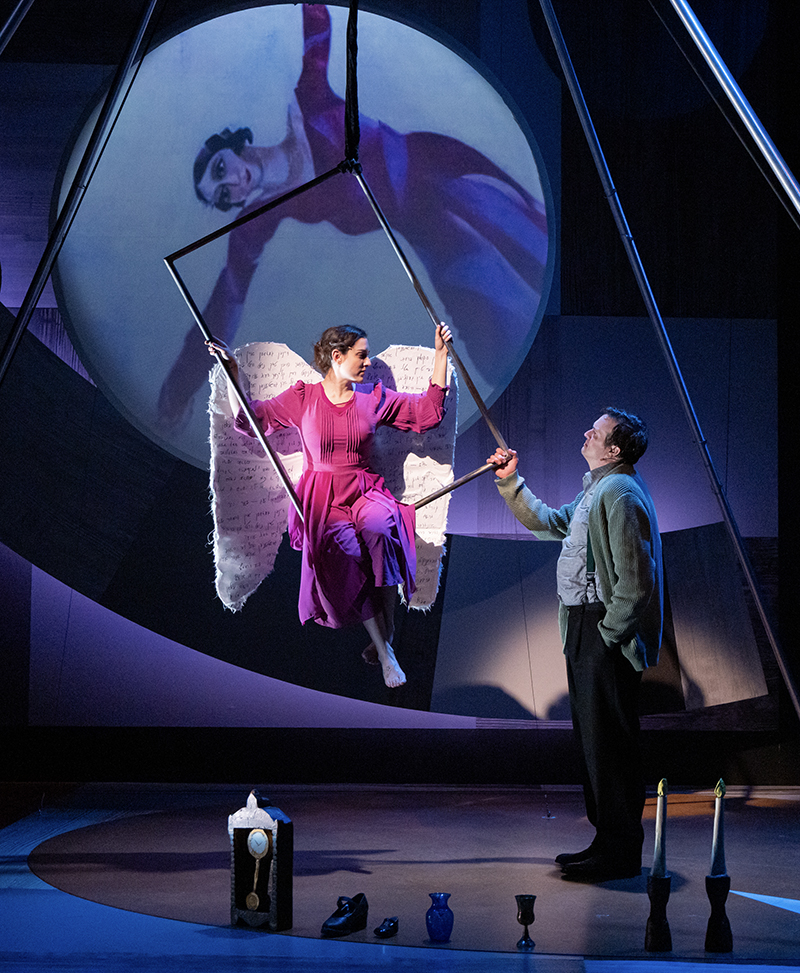
MW: I also saw you in Dodi & Diana at Mosaic. Which was you as part of a married couple in the Paris Ritz hotel room that Dodi and Diana stayed in. It was a really sexy, intimate performance. There was some nudity in the show. What is your approach to being genuine and unselfconsciously intimate onstage in a show like that?
LOEWENTHAL: Well, coming from an unabashedly vain place, my approach was, I read the play and this guy, I mean, they’re like, “He’s a fitness obsessive and he’s doing pull-ups in the hotel room and his abs are glistening with sweat.” And I was like, “What is this stage direction?” Well, fuck. So I spent the summer before doing Dodi & Diana basically getting into the best shape of my life because I was like, “If I’m going to play this guy, I want to really play it. And if I’m going to be naked onstage, fucking my wife in a hotel room in Paris, I don’t want to be thinking about my body. I want that to be the last thing on my mind.” Because so much of being in a hotel is this permission to be unselfconscious. It’s this really private place where we exist in a really authentic way. I think that was one of the coolest parts of the premise of the play. And so I wanted to make sure that I wasn’t going to feel self-conscious. And that required a lot of effort on my part. Also, once I was there, the homework, getting really comfortable with your scene partner, and just having an amazing intimacy coordinator who makes you feel comfortable and also makes sure the story is getting told.
MW: I think you have been around probably for the era before intimacy coordinators being standard. So you feel it’s an improvement or a great addition to what you’re doing?
LOEWENTHAL: I think it depends on the show, but I’ve never worked with an intimacy coordinator and been like, “Oh, we didn’t need that.” Because so much of it, it isn’t just like, “And now you kiss and now you place your hand here.” It’s sort of about all of the micro movements, the way we touch each other, not just like, “And then put your hand on her face.” It’s like, “What is the quality of the caress? What story are you physically telling? And what is the audience learning about your relationship through your physical proximity?” And it’s a lot of the small work that maybe a director, especially of a big show with a cast of thirty, doesn’t have the time to get into that nitty-gritty. An intimacy coordinator can help you really craft the physical relationship between characters in a way that makes the relationship more legible to the audience. There’s always more. It can always be richer. And I think that’s what’s great about that work.
MW: Okay. Two more questions. This is on Dodi & Diana, and this is totally out of your purview, but you must have looked into it. Do you think the royal family had Diana killed?
LOEWENTHAL: Oh, God.
MW: In your opinion.
LOEWENTHAL: In my opinion, no. But that show is the closest I have come to giving a shit about the royals. I think not of them. I wish them well. But God, no, poor thing. No, I hope not. I hope not.
MW: I hope not, too. But that’s another rabbit hole people can go down if they want to. So all right, what’s next for you after Merrily closes?
LOEWENTHAL: Okay. So before Merrily closes, I’m getting married.
MW: Oh, wow, congratulations!
LOEWENTHAL: Thank you so much. That’s the big next thing. So I’m not going to be there for a few shows because I have to get married. It was very nice of Matt to let me do that. And then we’ll close in November and I am flying off to St. Louis to do a little Christmas musical, something different.
MW: Wait, an unnamed Christmas musical?
LOEWENTHAL: White Christmas.
MW: Oh, okay. That’s one. Are you Bing Crosby or Danny Kaye?
LOEWENTHAL: I’m Bing Crosby.
MW: Way to go.
LOEWENTHAL: Thanks. Then I’ll be back in D.C. in the new year.
Merrily We Roll Along runs through Nov. 1 at Signature Theatre, 4200 Campbell Ave., Arlington, Va. Tickets are $47 to $141. Call 703-820-9771, or visit sigtheatre.org.
More from Metro Weekly:







You must be logged in to post a comment.