“What happens to a dream deferred?” Langston Hughes asked in his famous poem, “Harlem.” Playwright Jez Butterworth shows us in his heartbreaking, epic play The Hills of California. Only here, dreams aren’t simply deferred. For the Webb sisters, they are stifled and stomped upon before they are even given wing.
In 1976 Blackpool London, three of the four sisters have gathered to discuss the impending death of their mother, Veronica (Laura Donnelly), days away from losing her battle with life. “Mother’s cancer, her primary cancer, is stomach cancer. A tumor. This particular tumor can be caused by years and years of stress and worry, stress brought on by any number of things,” Gloria (Leanne Best) explains to her siblings.
The intimation is clear: the number one reason is guilt. In their younger days, Veronica pushed the foursome towards performance stardom with an act akin to The Andrews Sisters.
Through a friendship forged by Veronica’s friend, Jack Larkin (Bryan Dick), the family is introduced to Luther St. John (David Wilson Barnes), an American talent scout whose clients include Perry Como and Nat King Cole.
Butterworth transports us back to 1955, and the three-act drama toggles back and forth between time periods. Yet by 1955, Big band and swing music was on its way out, making way for the hipper, cooler genre of rock and roll. Luther explains the problem but believes that only one of the sisters, Joan (Lara McDonnell) has the star quality he’s seeking.
As a grown adult, Joan (played in a dual role by Donnelly), now living in San Francisco, has to face the cruel reality that life did not unfold for her as she had hoped, and deal with the resentment towards an overbearing stage mother who forced her daughter into a traumatic situation that cannot be undone.
This explains why Joan hasn’t returned home to visit until now and has left Jill (Helena Wilson) shouldering the responsibilities of caregiving and maintaining the now defunct Seaview Hotel, where the action in the 1970s takes place.
Rob Howell has given this cast a massive set that comprises a mountain of steps, a once-festive tiki bar, complementing the hotel’s theme (although, ironically, guests have no view of the sea from the property), and a broken jukebox that mirrors the Webb family’s broken lives. Now grown, Gloria and Ruby (Ophelia Lovibond) have settled down with husbands and kids, but they still trudge through a consistent life of unfulfillment.
Family dynamics are catnip for playwrights, but too frequently, the writing is simply bad, with storylines predictable and overly melodramatic. Seasoned theatergoers should feel assured, however, that in Butterworth’s hands, this is family drama at its very best. Much like he did in 2017’s The Ferryman, Butterworth creates fully developed and dimensional characters who are continually compelling to watch.
Much credit can be given to director Sam Mendes, who brings a profound sense of realism. Not a false note exists in The Hills of California, making it all that more of an emotional ride. No doubt that the play, which transferred from London’s West End after a successful run earlier this year, will attract the attention and praise of Tony voters.
While the whole cast is pitch perfect, it is Donnelly who has the good fortune to portray both Veronica in the fifties flashback scenes and adult daughter Joan in the seventies. It’s truly impressive to watch her effortlessly glide between a Northern England accent and California American.
Butterworth reminds us of the frail nature of siblinghood. As children, we learn to innocently and genuinely connect and care for one another, but in adulthood, life can throw curves, resentments can fester, and devastating secrets can be revealed. We’re also reminded that all of our choices, for better or worse, become the sum of our parts.
The Hills of California is a rare treat. Running nearly three hours, it takes time to pick up steam, but once it does, it keeps audiences leaning in, eager to eavesdrop on this flawed but fascinating family.
The Hills of California (★★★★☆) plays through Dec. 22 at the Broadhurst Theatre, 235 West 44th St., on Broadway. Tickets are $58 to $351. Visit www.thehillsofcalifornia.com.
Let me start with a nitpick: Marty Supreme is not, as commonly reported, Josh Safdie's solo directorial debut. That would be The Pleasure of Being Robbed, a modest, mumblecore-era gem released in 2008, long before Josh and brother Benny became known for directing white-knuckle crime thrillers like Good Time (2017) and Uncut Gems (2019). Made on a shoestring budget with a cast of unknowns, Pleasure followed the misadventures of a young kleptomaniac (Eleonore Hendricks) in Bloomberg-era New York. Few saw it in 2008, but those who did sensed a budding talent.
Constellation conducts some wickedly funny business with Dracula: A Comedy of Terrors, Gordon Greenberg and Steve Rosen's screwball spoof of Bram Stoker's gothic horror tale. Zingy and zany, Nick Martin's production is maybe not as sidesplittingly hilarious as the company's friends in the house on opening night might have you believe, but it's still damn funny.
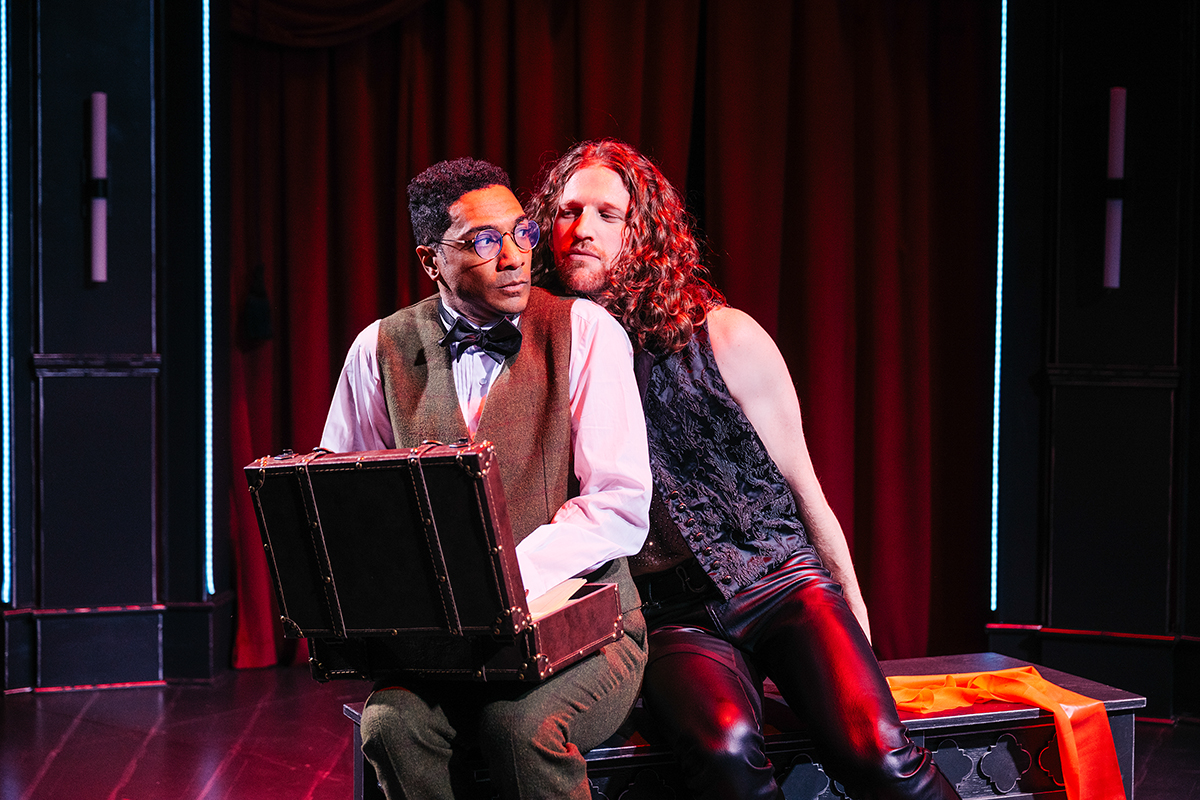
True to the chilling atmosphere of the novel, the play begins with a warning to intrepid hero Jonathan Harker (Sentell Harper) that nothing "but death, destruction, and evil" awaits inside the castle of Count Dracula. Of course, in this comic spin, what actually awaits are Mel Brooksian parody, sexed-up silliness, and blood-sucking shenanigans presided over by a louche, leather-clad Count looking for love.
Lovell Holder's debut novel, The Book of Luke, arrives at a precipitous moment for queer literary fiction. The heated tale of a handsome gay ex-athlete romancing a rival (or two) on a hit reality TV competition, the book seems custom-built to reach the ravenous audience that's turned the Heated Rivalry books and TV series into a phenomenon.
Of course, Holder, who's also a filmmaker, started writing The Book of Luke several years ago, with a different intention than riding the wave of a gay hockey hit.
Holder started the book, which chronicles the life and reality TV adventures of Luke Griffin, the soon-to-be ex-husband of a gay Republican U.S. Senator, in 2019. "I was really interested, at that time, in the idea of complicity and how underrepresented communities can sometimes oppress members of other underrepresented communities," he says.
These are challenging times for news organizations. And yet it’s crucial we stay active and provide vital resources and information to both our local readers and the world. So won’t you please take a moment and consider supporting Metro Weekly with a membership? For as little as $5 a month, you can help ensure Metro Weekly magazine and MetroWeekly.com remain free, viable resources as we provide the best, most diverse, culturally-resonant LGBTQ coverage in both the D.C. region and around the world. Memberships come with exclusive perks and discounts, your own personal digital delivery of each week’s magazine (and an archive), access to our Member's Lounge when it launches this fall, and exclusive members-only items like Metro Weekly Membership Mugs and Tote Bags! Check out all our membership levels here and please join us today!









You must be logged in to post a comment.