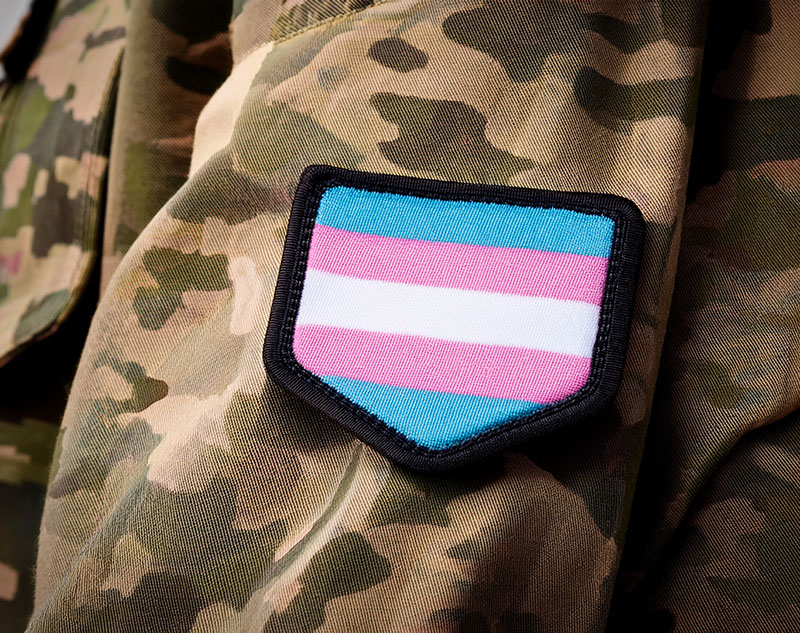
The U.S. Supreme Court on Tuesday signaled it may uphold state bans barring transgender girls and women from competing on female-designated sports teams during oral arguments in two closely watched cases.
Lower courts previously ruled in favor of the two transgender athletes, who challenged bans in Idaho and West Virginia — two of the 27 states that have enacted laws banning people assigned male at birth from competing on female sports teams.
Proponents of restricting transgender participation argue that people who are assigned male at birth and undergo male puberty prior to transitioning retain physiological advantages that give them an unfair edge over cisgender female competitors.
In Idaho, 25-year-old Lindsay Hecox, a Boise State University student, sued the state in 2020 over its ban on transgender athletes competing in collegiate sports. Hecox, who has received testosterone suppression and estrogen as part of her transition, unsuccessfully tried out for track and cross-country teams and has since participated in running and club soccer.
Hecox’s lawyers have asked the high court to dismiss her case, arguing that it is now moot because she is no longer seeking to compete on women’s teams. She previously sought to withdraw the lawsuit, citing “negative public scrutiny” over her challenge to the ban and a desire to focus on “academic and personal goals,” including graduating in May. A federal judge denied that request, however, ruling that the case raised broader questions about Idaho’s ban and similar transgender athlete restrictions in other states.
In West Virginia, 15-year-old Becky Pepper-Jackson sued over the state’s ban on transgender athletes in grades K-12, which defines gender as “based solely on [an] individual’s reproductive biology and genetics at birth.” Her lawsuit argues that the ban violates her right to equal protection under the law and her rights under Title IX of the Education Amendments Act of 1972, which prohibits discrimination based on sex.
Pepper-Jackson’s lawyers have asked the Supreme Court to issue a narrower ruling that would exempt her from the ban, noting that their client — who has identified as a girl since age eight and holds a West Virginia birth certificate recognizing her as female — is on puberty blockers and hormone therapy and has never undergone male puberty.
As a result, her lawyers argue, Pepper-Jackson does not retain the physiological advantages that would give her an unfair edge over cisgender competitors and should therefore be allowed to compete on her school’s female cross-country and track and field teams.
During three hours of oral arguments on January 13, five of the six conservative justices on the nine-member court appeared to signal support for upholding the bans, arguing that they do not violate Title IX or the Fourteenth Amendment’s guarantee of equal protection.
Several conservative justices pointed to a provision of Title IX enacted two years after its passage — known as the Javits Amendment — which allows for sex-based classifications in sports based on biological sex, a provision often credited with expanding athletic opportunities for girls and women.
“Javits changed Title IX,” Justice Neil Gorsuch said. “It said, you know, sports are different.”
Justice Amy Coney Barrett questioned whether a ruling in favor of the transgender plaintiffs would open the door to situations in which “boys who just couldn’t make the team because they are just not good enough” at a particular sport would attempt to play on girls’ teams, even if they do not identify as girls.
The conservative justices also appeared to favor a narrow ruling limited to sports, rather than a broader decision that would extend into other disputes over transgender rights, such as access to gender-affirming restrooms.
Through his questions and statements, Justice Brett Kavanaugh appeared to lean toward a “states’ rights” approach that would uphold transgender athlete bans in the 27 states that have enacted them, without forcing the remaining 23 states — including Virginia and Alaska, which have adopted policies barring transgender athletes from female teams — to enact similar laws.
Praising Title IX and the growth of women’s sports as “one of the great successes…in the last 50 years,” Kavanaugh expressed concern that striking down restrictions on transgender participation could undermine that progress by denying opportunities for cisgender girls.
“For the individual girl who does not make the team or doesn’t get on the stand for the medal or doesn’t make all-league, there’s a harm there, and I think we can’t sweep that aside,” he said.
Most of the justices agreed that the scientific consensus on whether transgender athletes enjoy a competitive advantage over cisgender competitors remains unclear. As a result, the court’s three liberal justices appeared open to an equal protection claim but focused much of their questioning on crafting a narrow ruling that would allow some transgender athletes to compete based on their individual circumstances, as Pepper-Jackson has requested.
“I would think the state would just have to make exceptions where people can demonstrate that the justification that makes the state’s conduct constitutional doesn’t apply to them,” Justice Ketanji Brown Jackson said.
Such a narrow ruling with exceptions could affect at least one other pending challenge to a transgender athlete ban. In Arizona, two teenage transgender girls — both of whom are on puberty blockers — have argued that the state’s ban is discriminatory and that they should be exempt because they have not undergone male puberty and therefore hold no “unfair advantage” over their cisgender counterparts. A federal judge has blocked the ban from being enforced.
Notably, Gorsuch — who authored the majority opinion in a sweeping 2020 decision holding that Title VII of the Civil Rights Act of 1964 protects gay and transgender people from employment discrimination — did not appear receptive to arguments from lawyers representing the transgender athletes. He did, however, press lawyers for both sides on whether laws targeting transgender people should be subject to heightened scrutiny because of a history of anti-transgender discrimination, as reported by NBC News.
In recent decisions, the high court has been broadly dismissive of LGBTQ discrimination claims. Last year, the court’s conservative majority upheld the constitutionality of state laws banning gender-affirming care for minors and has allowed the Trump administration to bar transgender people from serving in the military and restrict access to gender-neutral passport markers.
The court has ruled in favor of allowing businesses to deny services to LGBTQ people and same-sex couples, sided with parents seeking advance notice and opt-outs from lessons involving LGBTQ-themed material, and signaled support for laws that opponents argue could enable efforts to forcibly change LGBTQ individuals’ identities.
Federal lawmakers have passed the annual National Defense Authorization Act, a sweeping defense policy bill that includes a new federal ban on transgender women competing on female-designated sports teams at U.S. military service academies.
The ban on transgender athletes was folded into the 3,086-page bill, which authorizes approximately $900 billion in military and national security spending for 2026, according to Mother Jones. The House of Representatives passed the measure by a 312-112 vote, with 94 Democrats and 18 Republicans opposed. The Senate followed with a 75-22 vote, and the bill now heads to President Donald Trump for his signature.
A California school district will pay $700,000 to a lesbian administrator -- plus an additional $500,000 in attorneys' fees -- to settle her claims that she was demoted and pushed out because of her sexual orientation.
Rose Tagnesi, the district's former special education director, sued Grossmont Union High School District last month, alleging she was harassed and retaliated against for opposing what she called the board's "anti-LGBTQ agenda" -- including efforts in 2023 to ban LGBTQ books and cancel contracts with an LGBTQ-affirming mental health provider.
The Dallas Landmark Commission unanimously approved rainbow-colored steps outside Oak Lawn United Methodist Church as a temporary art installation, allowing the display to remain for up to three years despite objections that they violate historic preservation codes.
As a designated historic site, Oak Lawn United Methodist Church is required to seek city approval before making major exterior changes, including paint colors, according to Dallas-area PBS/NPR affiliate KERA.
The LGBTQ-welcoming church did not submit an application to the landmark commission before repainting its exterior steps in the colors of the "Progress Pride" flag, incorporating the traditional rainbow along with black and brown stripes and the blue, pink, and white of the transgender Pride flag.
These are challenging times for news organizations. And yet it’s crucial we stay active and provide vital resources and information to both our local readers and the world. So won’t you please take a moment and consider supporting Metro Weekly with a membership? For as little as $5 a month, you can help ensure Metro Weekly magazine and MetroWeekly.com remain free, viable resources as we provide the best, most diverse, culturally-resonant LGBTQ coverage in both the D.C. region and around the world. Memberships come with exclusive perks and discounts, your own personal digital delivery of each week’s magazine (and an archive), access to our Member's Lounge when it launches this fall, and exclusive members-only items like Metro Weekly Membership Mugs and Tote Bags! Check out all our membership levels here and please join us today!









You must be logged in to post a comment.