
‘The Flying Lovers of Vitebsk’ Review: More Artistry Than Chemistry
Theater J pairs striking aerial work with a portrait of Marc Chagall and Bella Rosenfeld's romance that lacks the passion of his paintings.

On his path to greatness as one of the preeminent painters of the 20th century, Marc Chagall found an enthralling muse in Bella Rosenfeld, who would become his (first) wife.
The Flying Lovers of Vitebsk, written by Daniel Jamieson, with music by Ian Ross and Sarah O’Halloran, recounts the couple’s romance, making a credible case that Chagall’s ultimate renown as “the quintessential Jewish artist of the 20th century” might only have been achieved with Bella’s love and support. There are many such cases.
As told to the audience by Chagall and Bella themselves in the play, she would devote herself to ensuring he could enjoy and express his gifts to the fullest while largely neglecting her own. The play relates that story with a sound sense of completeness that’s conveyed in Theater J’s production directed by Hayley Finn.
However, despite the satisfaction of a poignant finish, the journey along the way can be shaky. Chagall (Jamie Smithson) and Bella (Dani Stoller) each offer first-person accounts of their lives, with periodic vignettes enacting their recollections, along with songs performed mostly by talented, gregarious singer-musicians Katrina Michaels and Jeremy Allen Crawford, with Smithson and Stoller also duetting from time to time.
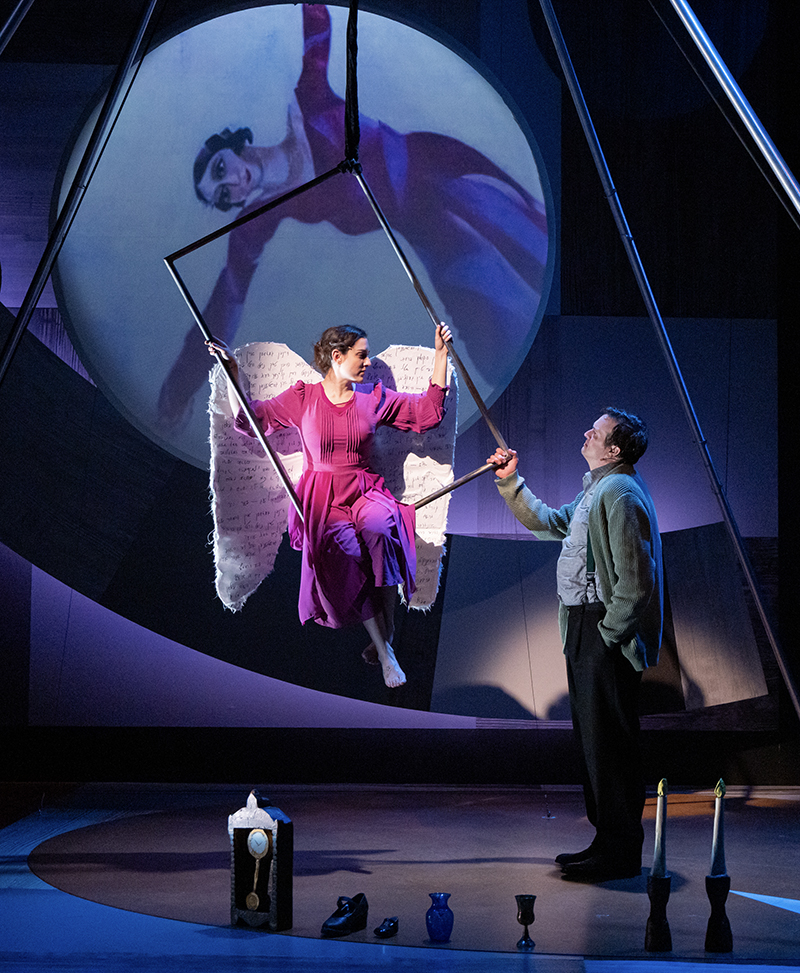
Also periodically, the songs, stories, and/or Chagall’s paintings are interpreted through movement by Rachael Small and Thomas Martin, two entrancing aerialists. (The painter was fascinated by circus folk, especially acrobats.) Chagall or Bella might be downstage describing an event in their lives, while the two lovers float in the air behind them on a trapeze suspended from a towering metal frame.
Misha Kachman’s spare scenic design is almost overwhelmed by the structure, but Colin K. Bills’ expressive lighting does a lot to enhance the atmosphere, in concert with Camilla Tassi’s projection design.
At its best, The Flying Lovers of Vitebsk combines sensual and cerebral pleasure in triptych images of three pairs of lovers: the Chagall’s embracing, the aerialists flying, the musicians playing, all while fragments of Chagall masterpieces appear projected onto frames and canvases hung around the stage.
Such moments come too few and far between stretches of drab oral storytelling and labored romance. Smithson might not yet have found his muse for embodying Chagall with more gravitas and libido, especially if he wants to sell the play’s occasionally poetic language of amour, such as the painter’s line that his whole being “is pervaded with the colors of loving you.”
His and Stoller’s rapport doesn’t suggest the palpable passion of an all-time love, although not for lack of onstage kissing and hugging. And unfortunately, the struggle extends to the pair’s uneasy duets. Stoller solos beautifully on the Yiddish-language songs, but as a duo, their quieter moments land more convincingly, as in the scene of Chagall meeting their baby Ida for the first time.
In its wistful look back at family and, particularly, at Chagall and Bella’s hometown of Vitebsk, the play effectively revives a forgotten place. One moment, Chagall is holding up a black-and-white postcard of Vitebsk, a town of three cathedrals and sixty synagogues, he notes proudly. The next, he’s recalling how the Nazis wiped out the town and practically everyone who lived there.
Yet, in him and Bella and other survivors, Vitebsk and its culture could live on, if barely. In speeches here, he summons the town’s colors and smells, the food, the land, the people, while in paintings we see the real Chagall captured every shade and facet of their lives with joy and affection, preserving them for posterity along with his beloved Bella.

The Flying Lovers of Vitebsk runs through Nov. 1, at Theater J, 1529 16th St. NW. Tickets are $79 to $89. Call 202-777-3210 or visit theaterj.org.
More from Metro Weekly:





You must be logged in to post a comment.