Douglas Sills for Metro Weekly – Photo: Christopher Mueller
Douglas Sills loves to laugh. It’s a big laugh, hearty and life-affirming. And it — along with a warm, impossibly broad smile — blankets a conversation with him in warmth and comfort. The laugh bursts forth at unexpected moments, such as when the actor, known for stints on Broadway and as French chef (revealed to be a Kansas cook) Monsieur Baudin on HBO’s The Gilded Age, is asked if he has ever been part of a play that’s gone terribly wrong.
“I don’t have a disaster in my head offhand,” he grins. “Do I? I don’t. Maybe it’s because you go to work every day for months and you’re pouring your heart and soul into it, you’re there for hours and hours and hours and hours and hours, and you’re giving up everything to do it, and it’s not a high-paying thing. And so you drink the Kool-Aid — you have to. And so maybe that’s why it doesn’t feel like a disaster to me.” He pauses. “But I’ve seen some disasters.”
Like?
He laughs, this time knowingly. “I mean, I really shouldn’t say….”
And then, he does say, but off-the-record. No need to burn any Broadway bridges, after all.
Recently, Sills has been playing to packed houses at Signature Theatre, in their remarkable — and remarkably grounded — production of Fiddler on the Roof. He plays Tevye, the leading role made legendary on Broadway in 1964 by Zero Mostel and later immortalized by Topol in Norman Jewison’s 1971 film adaptation.
This, however, is a different Tevye, less larger-than-life than life itself. Sills, who has a magnificent singing voice and a stage presence that gives the term “magnetic” new meaning, vanishes into the role of a work-weary milkman who is watching his life change before him in real time, witnessing his traditions — the traditions of the Jewish culture he holds so dear — erode one-by-one.
“I’ve just never seen anyone better do it because of the wide range of what he is able to play,” says Fiddler‘s director Joe Calarco, who conceived of the production’s in-the-round setting with an array of tables that reconfigure, like a puzzle, to create various settings. “I always say the goal of creating any character in collaboration with an actor is like, ‘What is the frame of the character?’ And then, the actor can run around in it knowing where the edges of the frame are. But the frame of Tevye is so huge, I just encouraged Doug to not be afraid of what he had found.
[advert2]
“I feel the role has become more and more — what’s the right word? — impish over the years,” Calarco continues. “And I just felt like I wanted someone real, who had an understanding of the muscularity it takes to just live the life of this man.”
It’s no secret that Fiddler is Signature’s biggest hit in its three-decade history. The musical’s three-month run is pretty much sold out, and while the success wasn’t much of a surprise, the scale was.
“To say that it’s a hit is understating it,” says Maggie Boland, Signature’s managing director. “It is going to be the biggest-selling show in Signature’s history, both in terms of the number of folks who come see it and the dollars. And I think it’s a combination of the fact that it’s a show that a lot of people know and really love.
“Our advanced sales were very strong,” she continues, “but the minute previews started, and people saw this production, the sales just went through the roof, which I think is a testament to the experience of the show in the round in that really small, intimate room and the magic that comes together with Joe Calarco’s vision, Douglas Sills’s portrayal of Tevya, and the entire company. There’s an alchemy happening in that theater that really feels special even to those of us who have been working in this industry for thirty years.”
Playing Tevye, says Sills, “is the apotheosis of my Jewishness in a lot of ways. I was looking for a way to express it, because I was always a person who didn’t look Jewish, so no one would cast me in Jewish roles. And living in Hollywood, where all the Jewish comedy writers are, I would go into an audition, and I’d somehow try to slip in that I was Jewish by talking about my Bar Mitzvah or something, because they’re looking at me going, ‘Who is this shegetz? Who is this guy? He can’t possibly understand our humor, right?’
“And I’m trying to say to them, ‘No, I get it. I’m you.’ So I’ve always been ‘other.’ And always straight-passing, right? A lot of times, people didn’t know that I was gay. And you’re hearing antisemitic jokes, you’re hearing anti-gay jokes, because people think you’re safe to say it in front of. So that kind of ugliness is something I’m painfully aware of.
“So I find this is an opportunity for me as an actor to tell a story about being kind to one another, and what ugliness and murder and oppression can afford you,” he continues, turning reflective. “Imagine if the Jews who created Israel and the United States had stayed in Russia, imagine all the things they would have invented and made, and the powerhouse that Russia would have been, just because the Jews stayed.”
Douglas Sills for Metro Weekly – Photo: Christopher Mueller
METRO WEEKLY:I’ve seen other Fiddlers, but I’ve never seen one so intimate and so involving of the audience. Sometimes with a Broadway show, we’re detached from it. We feel as though we are in this space with the characters. It’s a remarkable feeling.
DOUGLAS SILLS: Yeah, I wish I had the experience. I would like to see it. A lot of people make remarks about it, and you hear the words immersive and touching and connected. Looking back on my experiences with Fiddler, even recent productions, there’s often a distance. It’s usually proscenium. There’s usually 30 feet, 50 feet, 100 feet. They’re usually raised up. There are all these distance mechanisms.
And we have a performance style, a tone of acting with this piece — how the scenes have been investigated, how the scenes are portrayed that reflect that intimacy, that closeness, how the audience is right on top of you. You’re not doing things that you would do in a proscenium in this production.
In this case, it’s like being at a dinner table. You’re talking to people, and you can’t behave in that presentational style. It’s conversational, as grainy and real as it could be, given what the material is and how it’s written. Obviously, there are things written in there that are meant to be comedic, and the rhythm is already there, and you can fight it a little bit, but you’re swimming upstream. So I’m not sure that it’s like Sam Shepard, but it’s a lot more Sam Shepard than a lot of productions I’ve seen.
MW:That’s a great way of putting it. It feels less like a musical and more like a play.
SILLS: I think that’s exactly right. And that’s the way I approached it. Even when you add in the music or a song, I always did it as a monologue first. How do you get from thought to thought where the music came in? When I say “came in,” I mean came into the progress of American musicals and how they have grown and changed over the years. I definitely treated it that way. And I think everything coalesced in that same direction when Joe [Calarco] called me and we talked at length about, if I were to participate, what he was thinking.
I was thinking, “Okay, in the round, table in the middle.” Joe had certain basics that he already had in his head that he’d been toying with for years. He knew those ahead of time. And this sort of, I don’t know, would you call it Sam Shepard kitchen sink realism or David Mamet? It’s more like American Buffalo than it is Oklahoma. For me, there’s no traditional musical theater tone or style.
MW:This is the first time I’ve seen a Fiddler truly explore the dramatic side, really pulling in depth and character and detailing that. And that obviously comes through a lot of your performance, the performance of your castmates, and the production. But even just the structure of the musical. It really hit me hard in a way that Fiddler has never hit me before.
SILLS: Do you think it’s because of your age? Do you think it’s because of what’s going on in the world? Why did it hit you? Or do you think it’s just that this production was so unique?
MW:I think it’s this production. The production breaks with tradition, so to speak. So let’s talk about the fact that your Tevye is very different from any Tevye I’ve seen — it’s a more human, earthbound Tevye. You’re playing it from a dramatic center, and any humor that comes out of it feels natural, not shtick. You make him a real grounded man who is losing traditions around him left and right, and yet faces it both reasonably and with resignation.
SILLS: One of the biggest challenges for me in doing this role was the memory of Topol [who starred in the 1971 film]. I mean, I’m a Zero [Mostel] kind of a person, but that’s not in my head. Topol is in there like a tattoo. I can see his gap tooth. I can hear the rumble of his baritone. It’s maddening sometimes, but it’s so inculcated in us.
But I love that you think it’s a different Tevye. I love that you think it’s different in a positive and affecting way. Most people would not come to me to do this part. I think people think of Tevye as a different physicality and a different gestalt that comes off a person. I never thought this would come to me. And when they called, it was a kind of, “Really?” First of all, who needs another Fiddler? I’m going to go to another place for four months in the cold, outside my home, for Fiddler?
But I said, “Send me the script. Let me just read it.” And I sat there in the summer reading it, no music playing. And I was really, really affected in a way that I’ve not been affected reading something. I thought, “Holy crap, what is going on? Why am I being so affected by this? I got to look at this. What’s going on?” And I came around because it was that good of a piece. I thought, “If not now, when? I’d better give it a shot.”
Douglas Sills as Tevye in Fiddler on the Roof at Signature Theatre – Photo: Christopher Mueller
MW:It seems like a very demanding show for you to perform.
SILLS: It is exhausting to go through this physically the way I did him. And because we’re in the round, you have to keep moving. Also, his age, it’s important that his eldest daughter is 20, so he can’t be… Look, oftentimes guys in their seventies are playing this role, and you’re like, “That doesn’t really make sense, but okay, it’s a great piece.” But the emotional track is hard here, even though it’s not a high sing at all. The emotional track of what he goes through, particularly in the second act, is penetrating and ferocious for me, and exhausting — being torn apart. All he cares about is Torah, learning, the girls, and God. And the girls are torn from him or they tear themselves away and how do you process that? Let alone, we’ve done it sixty times. How does an actor process that in a way that looks real and feels moment-to-moment for the first time.
MW:What is your key to accomplishing that?
SILLS: I don’t know if I have a good, easy pat answer. I try to come prepared with the right body. To experience these things, it has to be kind of empty here, stomach-wise. Just come with a neutral space and begin. Particularly since you’re playing it very dynamically for moment to moment realism.
I try to come to it somewhat neutral, but try new things [mentally] every day. What if it’s four o’clock and Tevye just had a long day? What if I lost my purse today, and I arrive and I have even less money? What if I arrive for the audience today and I need them to do something for me, so I need them on my side? So I add “what ifs” and see if it colors it. And then the unexpected is the audience. If the audience is up for it and they’re a little bit vocal, it can be electric. If they’re kind of quiet or they’re unsure or there’s patches of uncertainty that changes the dynamic of how laughter happens. So the element that you can’t plan for is how does the audience react? Maybe they think it’s hysterical or it’s heartfelt. So I come to it neutral and fresh with new ideas and trying things each day with each scene.
MW:Your Tevye is very organic. The production is very organic. I completely lost myself in your Tevye. You literally, as a known familiar actor, vanish into the role. It’s not Douglas Sills playing Tevye. It’s extraordinary to me when an actor can pull that off.
SILLS: Well, I can’t think of a higher compliment. That transformational thing you talk about with my heroes Gielgud, Olivier, Richardson, that was everything to me. So I’m grateful for your remark. Especially since people wouldn’t necessarily think of me as Tevye. They tend to think of him as a little more nebbishy-looking. But I’m grateful that whatever we’re creating is allowing someone to have that journey.
Douglas Sills for Metro Weekly – Photo: Christopher Mueller
MW:I want to come back to one other thing in Fiddler, and that’s the music. It didn’t feel like people were suddenly breaking into song, if you know what I mean. It felt like it emerged naturally from the play. Kind of bloomed from within, so to speak.
SILLS: That’s interesting. There’s more than one version of the music. A guy named Larry Blank created a smaller orchestra version for just this kind of presentation. And so I think it becomes quieter, smaller, simpler, but with less demarcation between music and no music. It’s woven in an unobtrusive way.
MW:One thing I did notice is that the “hits” — the songs lodged into our brains, “Miracle of Miracles,” “Sunrise, Sunset,” “Tradition,” are all crammed into the first act. You don’t really have a strong memorable song in the second act. And it’s not that the songs are bad in the second act, they’re just not what they were in the first act. They’re not like a hit factory.
SILLS: When my friends have seen it, they’re like, “Jesus, Douglas, this is Mama Rose for you.” And it got me thinking, “I guess so, but I don’t have an 11 o’clock number.” I have wondered why they didn’t give Tevye that big second-act number, but they weren’t really looking for a singer. I don’t know that Zero Mostel would’ve really sold an Audra McDonald 11 o’clock number.
MW:Your 11 o’clock number is “If I Were a Rich Man.” It’s just at the beginning of the show. Before we pivot to your work on The Gilded Age, you know what happened with Trump taking over the Kennedy Center and slapping his name on the building.
SILLS: Yeah.
MW: If you were asked to perform there, would you?
SILLS: It would depend on what it is. If it was something subversive — well, subversive to what he is. If it was a play about tearing down his name from the front of the building, yes. Right? I wouldn’t say no out of hand. What if it was something that delivered exactly the right message right now? And that if he came, he would shut it down.
But generally, no. There are too many places to appear. I don’t need to help him with it. No. But if it was the right show about a despot and they wanted me to wear a blonde wig and play Richard III, I wouldn’t say no out of hand. That’s too easy. But generally, I think the answer to your question is no, I would not. I don’t want to be part of that.
MW: Let’s talk about The Gilded Age. The first season for your character, Chef Baudin, was so much fun because he was forced to reveal that he’s not a real French chef. I’m curious, did they tell you at the outset? Did they say to you, “Okay, he’s pretending to be a French chef but…”? Or was that something that developed later on?
SILLS: My recollection — it’s now more than five years ago — is, no, they didn’t tell me until I got that script. And they had a dialect coach. Everybody had a dialect coach — not just me for being French, but everybody to elevate their speech or to bring their speech down to the street, like for Ben [Ahlers], who plays the clock twink. And so we had this wonderful guy named Howard Samuelson from Juilliard, who was our dialect coach. And when we found out my character’s true origins, I’m like, “What does Wichita sound like?” So we started toying with what his voice would be like.
MW: It’s quite a cast on that show. A lot of Broadway powerhouses.
SILLS: Oh, boy, to be in that group with those people has been such an honor. It’s a pleasure to be amongst my peers who regard me because of what I’ve done. It’s just a wonderful thing being in that kitchen with Jack Gilpin and Michael Cerveris and Celia Keenan-Bolger, Kelley Curran, and Erin Wilhelmi. You tend to be with the little group that they write scenes for you with. And we just became this little satellite planet solar system of people. And the nice thing about stage actors is that everyone felt so lucky to be there.
My partner, Jeff Cutler, who I’ve been with for nine years, was working on another show, which will remain nameless, that had a lot of young people who were having tremendous popularity and success because of their show, and they had no experience really of anything. And so they were sort of ill-behaved and not grateful for it, and coming in hungover and not prepared, and our set was sort of the opposite. Everyone felt so lucky to be there and were so kind to each other, and so ready, and so wanting to be at the top of their game for the other people in the room that they respected.
I was walking around Provincetown this summer. And on Sunday nights, you would see people watching The Gilded Age in their windows. It was surreal and fantastic. And once in a while people would recognize me. People would come up to me. “Are you in the…” “Yeah.” “Oh my God. Oh my God, you have to sign my arm.”
MW: Is there anything you can tell us about season four? Have they started shooting?
SILLS: No. I’m sure they’re writing and conceiving what the season looks like. And the idea I think is to shoot February through August. So they’ve told me some dates that I’ll be shooting. And most of the stuff that I shoot, which is in the kitchen, they didn’t build a set for. I don’t know why they didn’t build a set for it, but they’re using real kitchens in the Newport mansions. So we go on location to Newport and we shoot all the kitchen stuff for eight episodes out of order, which is very challenging, but we’ll be there for two or three weeks, and we’ll film all the stuff that happens in the kitchen and the kitchen environment because it’s in that mansion.
MW: What are you hoping for for your character?
SILLS: [Laughs.] I hope that there’s just some internal conflict and significant change. Maybe more secrets revealed. I would love another secret, like he’s not American. He’s not a chef. He’s a spy for the president. I would love something juicy like that.
MW: I’m going to ask you one final quick question to close things out. So one is sort of a standard question.
SILLS: How many orgies have I been to in D.C. since I’ve been here?
MW: Sure, let’s start there.
SILLS: [Laughs.] None! Tevye doesn’t have time. Anyway, what is your question?
MW: Let’s stay on the orgy thing — how many invitations have you turned down?
SILLS: What, do you think you get invitations to orgies? You just go, you break the door down. I’ve not gotten any invitations.
MW: Okay, so my real question is kind of a basic one. If you could have your pick of any role in theater, what would you want to play next?
SILLS: I would like a new play to lead a cast or have someone that I regarded leading the cast. And I got to do a new part with dimension where the character evolves over the course of the story. That would be my first choice. I think that’s not really what you’re asking, but to originate a role is great. But there’s Richard III and Lear and Vanya. And I’ve always wanted to play Harold Hill [from The Music Man].
I’ve been asked to do a cabaret or a one-man show, and I never found the right vehicle because that’s not what I operate on. I’m about coming together with a cast and making something new that can only be done by the conflation and liberation of talents. But I guess those are some of the answers that I would say. Anything that’s challenging, I’m into.
Fiddler on the Roof runs through Jan. 25 at Signature Theatre, 4200 Campbell Ave., Arlington. The show is sold out for the remainder of its run. A limited number of $30 rush tickets are available in-person at the Box Office for each remaining performance beginning one hour prior to curtain time. Rush tickets are subject to availability and on a first-come, first-served basis. At sold-out performances, rush prices may not be offered. Please call Signature’s Box Office at 703-820-9771 or visit sigtheatre.org.
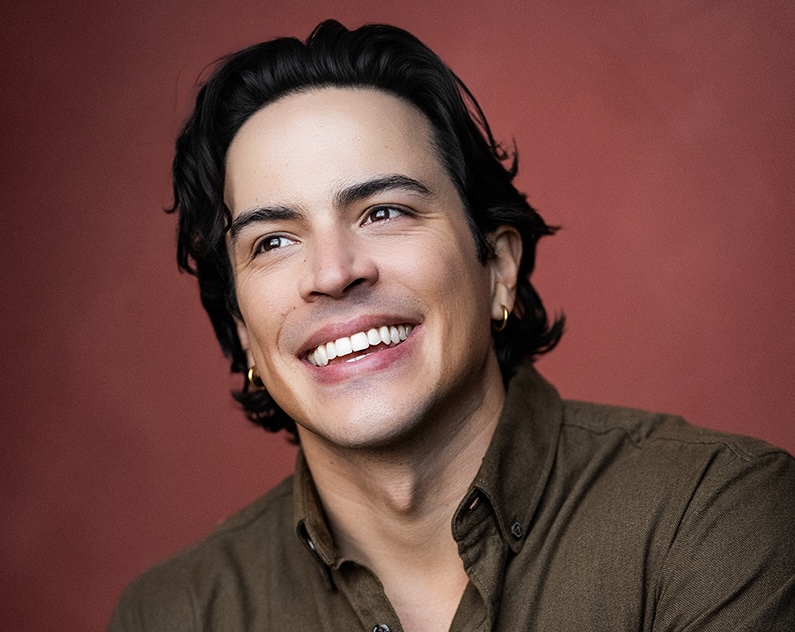
Jacob Dickey doesn't have a to-do list of musical roles. But if he did have a to-do list, he says, "I feel like Sky Masterson would definitely be on that to-do list."
Good thing, then, that he's currently starring as Sky Masterson in the Shakespeare Theatre's vibrant new production of Guys and Dolls, directed by the Washington National Opera's Francesca Zambello.
Romping through Runyonland alongside Rob Coletti as fellow gambler Nathan Detroit, Julie Benko as missionary Sarah Brown, and Hayley Podschun as saucy showgirl Miss Adelaide, Dickey cuts a dashing figure in a role he's practically been preparing for since before his voice changed.
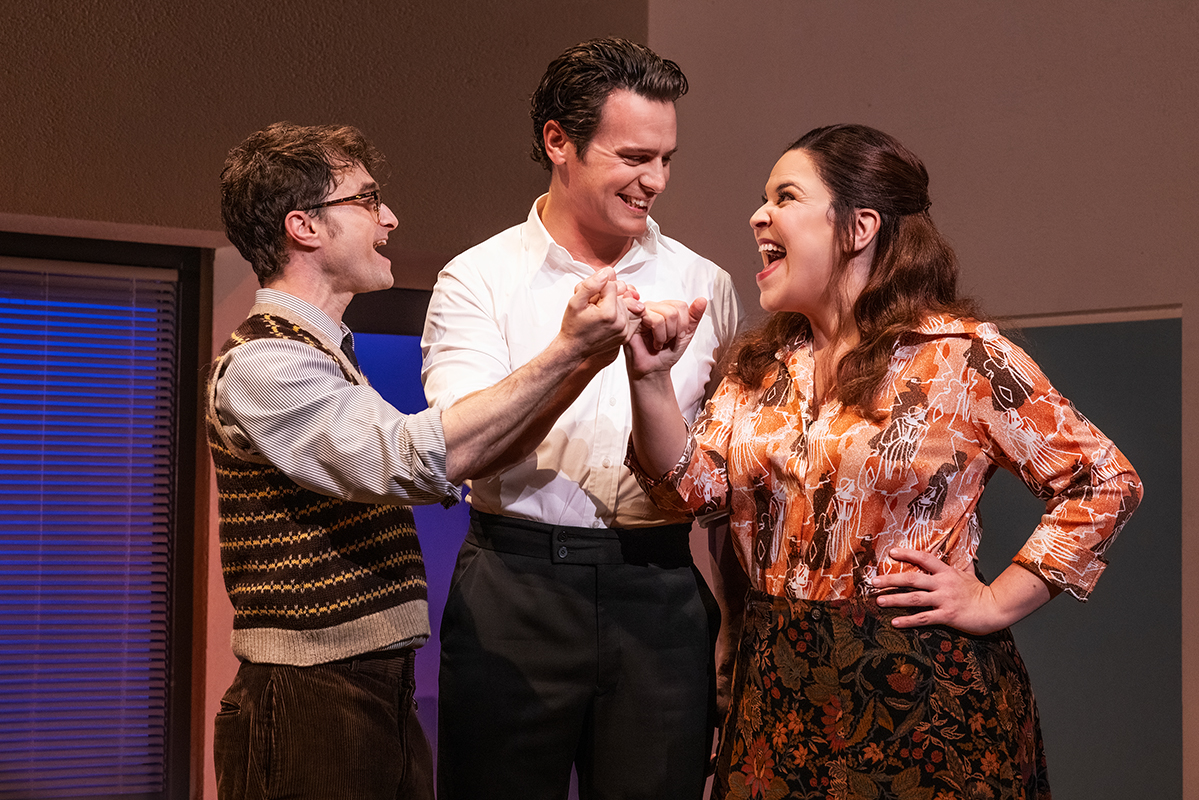
A show about show people tailor-made for people who love a show, Stephen Sondheim’s Merrily We Roll Along hits a musical theater sweet spot.
Accessible as the tale of three friends in showbiz whose love and hate for each other ebbs and flows over several decades, Merrily, which premiered on Broadway in 1981, also reps an intensely personal take on an artist’s life from musical master Sondheim and book writer George Furth, adapting the Depression-era play by George S. Kaufman and Moss Hart.
The score isn’t as catchy as the score for Company, Sondheim and Furth’s collaboration a decade prior, but the songs and book have bite, particularly pertaining to Franklin Shepard, the uber-successful, not-so-scrupulous movie producer at the center of the plot.
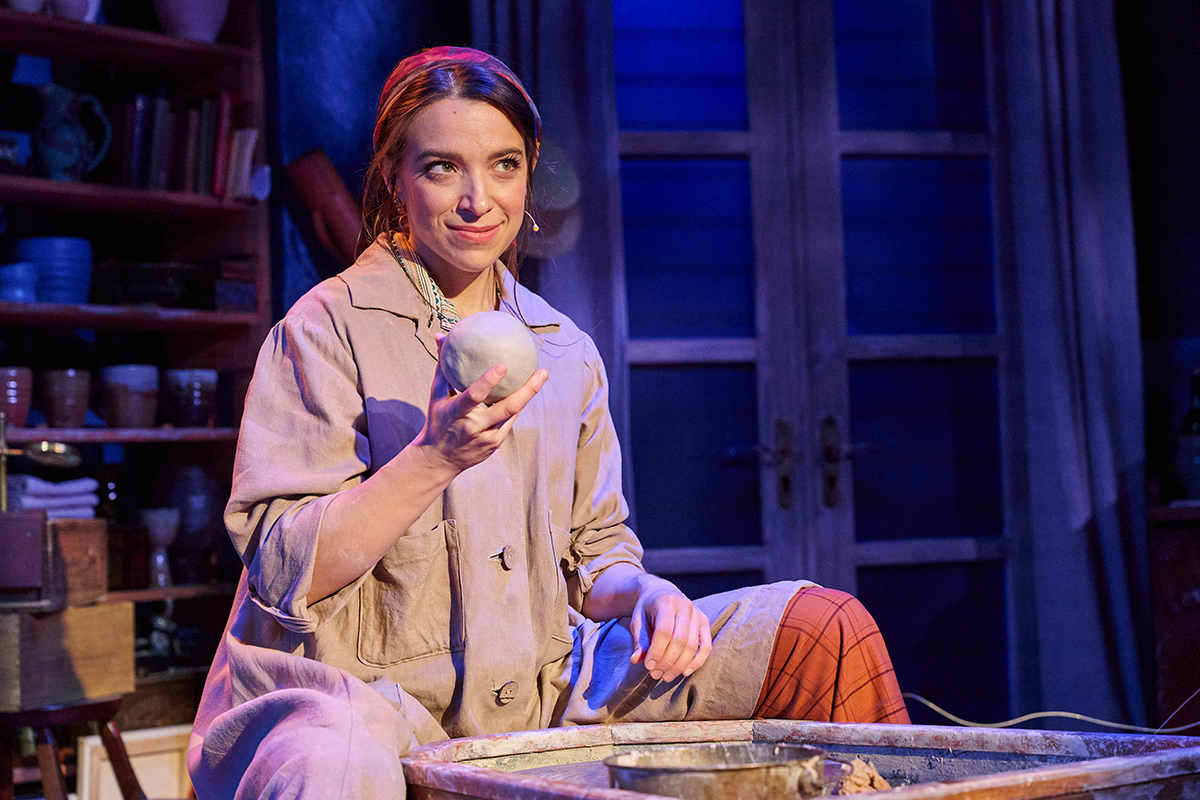
Not since Hedwig and the Angry Inch have I so enjoyed a one-person musical about an internationally ignored female artist overshadowed by her famous male partner as much as I enjoyed Rebecca Simmonds and Jack Miles' enchanting In Clay.
Making its American premiere at Signature Theatre, following sellout runs in London, the jazz-infused portrait of early-20th-century French ceramicist and painter Marie-Berthe Cazin doesn't have too much else in common with hard-rocking Hedwig. Except that both shows are powered by a knockout batch of songs, and the galvanizing force of a woman reclaiming her time, her art, and her story.
These are challenging times for news organizations. And yet it’s crucial we stay active and provide vital resources and information to both our local readers and the world. So won’t you please take a moment and consider supporting Metro Weekly with a membership? For as little as $5 a month, you can help ensure Metro Weekly magazine and MetroWeekly.com remain free, viable resources as we provide the best, most diverse, culturally-resonant LGBTQ coverage in both the D.C. region and around the world. Memberships come with exclusive perks and discounts, your own personal digital delivery of each week’s magazine (and an archive), access to our Member's Lounge when it launches this fall, and exclusive members-only items like Metro Weekly Membership Mugs and Tote Bags! Check out all our membership levels here and please join us today!





You must be logged in to post a comment.