Imagine being a Black man on trial in a segregated courtroom in Depression-era Alabama, accused of raping a local farmer’s daughter, and mounting your defense before an all-white, all-male jury of local farmers.
It’s hard to imagine that man getting a fair trial, even if he were innocent, which happens to be the case in To Kill a Mockingbird (★★★★☆), Aaron Sorkin’s riveting adaptation of Harper Lee’s Pulitzer Prize-winning novel.
At some point in U.S. history, the race, class, and gender dynamics driving Lee’s combustible scenario might feel quaint, laughably antiquated, obsolete. We’re not there yet. Mockingbird‘s Southern-fried courtroom drama still holds plenty of compelling truth in its reflection of racial injustice.
The accused, Tom Robinson (Yaegel T. Welch), a Negro in official ’30s parlance, faces the electric chair — if a lynch mob doesn’t get their hands on him first. And seemingly all that stands between Tom and his worst fate is the most decent and honest white man in the county, a self-described country lawyer named Atticus Finch.
For this smooth-running touring iteration of director Bartlett Sher’s Tony-winning Broadway production, Richard Thomas embodies Atticus in all his goodness, and complex moral reasoning.
Enshrined in the American imagination as an honest and decent country boy, Thomas injects just enough self-doubt and self-awareness into his portrayal to complicate the character’s heroic standing without diminishing him as a model of integrity.
Sorkin’s play — narrated by both Atticus’ precocious daughter, Scout (Melanie Moore), and willful teenage son, Jem (Justin Mark) — draws attention to Atticus’ tendency to excuse the bigotry and racial animus expressed by their “friends and neighbors,” while also encouraging his kids to treat all people equally. Don’t judge a man unless you’ve walked a mile in his skin, he admonishes Jem and Scout.
To Kill a Mockingbird — Photo: Julieta Cervantes
Atticus gets called out on his contradictions by the family’s cook Calpurnia, played with wit and savvy by Jacqueline Williams. Jem, increasingly frustrated with his father’s tolerance of their neighbors’ intolerance, also is critical, deeming Atticus to be meek in the face of corruption and hatred.
Thomas and Mark layer Atticus and Jem’s father-son conflict with love and respect, thus really putting the sting in the boy’s disappointment, or in his dad raising his voice in anger. On the other hand, in moments of deep sympathy between the two, the actors engender a tenderness that heals all wounds.
Moore adeptly juggles Scout’s role as guileless innocent and trusty tour guide to the town, often our eyes and ears on events just partly dramatized. Her Alabama accent wavers — and intentionally or not sounds dead-on like Amy Poehler’s hyper kid character Kaitlin on SNL — but the characterization works.
The Finch family rapport, abetted by Williams as Calpurnia, reinforces their bond with the audience as the household comes under attack, literally and figuratively. The script and direction pace the relevant reveals of the court case with masterful timing, which applies almost equally to the humor, except that a few comic beats are banged too heavily.
There’s nothing heavy at all in Miriam Buether’s graceful scenic design. Pieces glide in, descend softly, or are gently rolled into place, linking to turn a bare stage into a courtroom, or into the front porch of the Finch house. The town comes to life in the setting, as well as in the ensemble.
Yaegel T. Welch as courageous defendant Tom Robinson, Steven Lee Johnson as visiting-for-the-summer Dill, and Richard Poe as shrewd Judge Taylor offer solid approaches in support. Joey Collins’ performance as Bob Ewell, the ornery father of alleged victim Mayella, tips towards parody of a redneck villain, but Arianna Gayle Stucki is fairly mesmerizing as the prevaricating farmer’s daughter.
Mary Badham, who, at age 10, played Scout in the film version (becoming the then-youngest ever Oscar nominee for Best Supporting Actress), gives a feisty turn as crotchety, mean-for-no-good-reason Mrs. Henry DuBose.
Though, as funny as it is watching DuBose rampantly insulting everyone who crosses her path, she’s an eerily potent example of the sort of hatred that keeps this story current, and keeps honest and decent folks fighting for justice.
To Kill a Mockingbird runs through July 10 in the Kennedy Center Opera House. Tickets are $49 to $199. Call 202-467-4600, or visit www.kennedy-center.org.
It's said that "All work and no play makes Jack a dull boy," but what if life is all play and no work? It turns out that the end result can be just as unhinged, if not more so, if the latest thriller from TV super-producer Ryan Murphy is anything to go by.
The Shards opens with a fictionalized version of American Psycho author Bret Easton Ellis (Igby Rigney) watching an early screening of The Shining in 1980s Los Angeles. Bored with little to do, the affluent teen loses himself in fictional worlds, some of his own creation, and others helmed by directors like Stanley Kubrick.
Filmmaker Dean Francis makes B-movie bunk occasionally look alluring in Body Blow, a queer neo-noir about a closeted cop who goes rogue. The journey from good apple to total outlaw, however, is more a short dash for Officer Aiden.
Tim Pocock (X-Men Origins: Wolverine), giving as wooden a performance as you'll ever see, stars as the suburbanite constable, still fresh to the force and reassigned to a unit in Sydney's gay district. Neon-lit and framed like an '80s music video by cinematographer Franc Biffone, it's an impressively seedy side of the city.
Seemingly everybody is in on some form of crime or corruption. That might include Sgt. Steele (Sacha Horler, not wooden but not convincing), the lesbian officer who recruits Aiden to go undercover as a gayer-looking, peak-era Jean-Claude Van Damme.
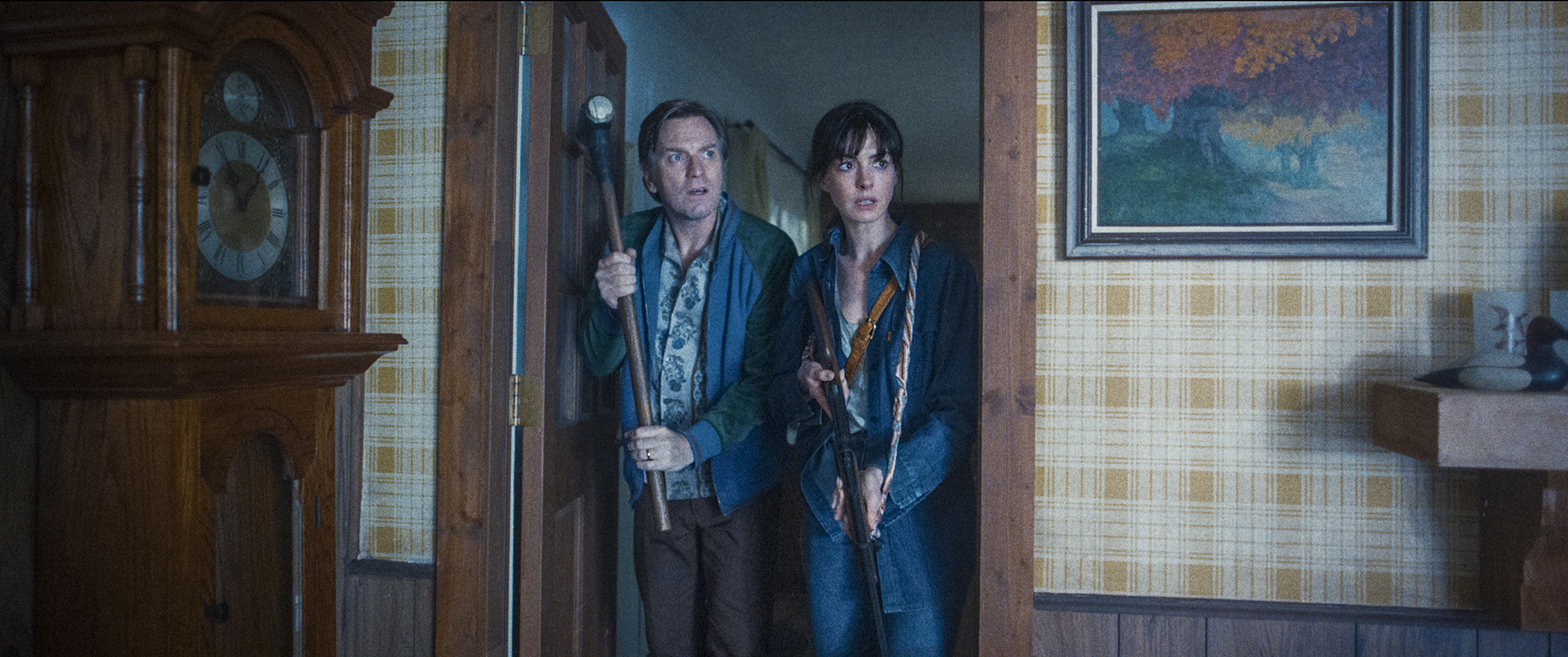
An entertaining mashup of Spielbergian fantasy, '50s sci-fi, and tense domestic dramedy, The End of Oak Street gathers suspense and momentum slowly but surely. Before all hell breaks loose, a well-composed picture comes into view of a Midwest suburban cul-de-sac enjoying the summer of 1982.
Though behind the smiles and good vibes, and the gleeful neighborhood block party with limbo, music, games, and balloons, somebody, somewhere, is quietly suffering. This is the suburbs, after all.
So, it's Denise Platt (Anne Hathaway) we find suppressing her feelings of rage and resentment, despite a seemingly stable life with cheery husband Greg (Ewan McGregor), son Brian (Christian Convery), daughter Audrey (Maisy Stella), and the family's beloved dog Starbuck.
These are challenging times for news organizations. And yet it’s crucial we stay active and provide vital resources and information to both our local readers and the world. So won’t you please take a moment and consider supporting Metro Weekly with a membership? For as little as $5 a month, you can help ensure Metro Weekly magazine and MetroWeekly.com remain free, viable resources as we provide the best, most diverse, culturally-resonant LGBTQ coverage in both the D.C. region and around the world. Memberships come with exclusive perks and discounts, your own personal digital delivery of each week’s magazine (and an archive), access to our Member's Lounge when it launches this fall, and exclusive members-only items like Metro Weekly Membership Mugs and Tote Bags! Check out all our membership levels here and please join us today!











You must be logged in to post a comment.