“The interesting thing about back in those days, there was no contract for it,” says Bill Irwin, recalling the time, decades ago, when “music videos were cutting edge” and also “shown a thousand times a day” on MTV. The legendary multi-genre performance artist first dipped his toes into the proverbial video waters as a performer in 1988. “I got flown to San Francisco where they shot it, but I don’t know that I got paid,” he says. He also didn’t get any residuals, despite heavy rotation on the network.
The video in question? A lighthearted romp featuring Irwin and Robin Williams supporting singer-songwriter Bobby McFerrin in his unique and ubiquitous Grammy-winning, chart-topping a cappella pop hit “Don’t Worry, Be Happy.”
Irwin happily bounced from that project to the next with Williams later the same year: a limited Off-Broadway production of Waiting for Godot directed by Mike Nichols and starring Williams and Steve Martin. Irwin was featured as Lucky, a mostly mute, minor role seemingly custom-made for a physically expressive actor who also dabbles as a professional clown.
That production of Samuel Beckett’s existential tragicomedy and modern stage classic served as Irwin’s professional debut as a performer of works by the acclaimed Irish writer and playwright — just the first of many to come. Ultimately, though, Irwin attributes getting “bitten by the [Beckett] bug” to his award-winning foray a few years later performing from Beckett’s collection of experimental short stories wryly titled Texts for Nothing. “It’s a little corny, but it’s true: My life has never been quite the same since,” he says. “The language, the Irishness of it, the way of looking at the human mind.”
Irwin has long been fascinated by what he’s dubbed the “pronoun energy” that fuels Beckett’s writing. “Beckett’s language is full of pronouns, differently than, say, Shakespeare’s.” Consider, for example, the Bard’s famous soliloquy from Hamlet that begins, “To be or not to be, that is the question.” “He goes on and on, and he’s talking, incredibly, about suicide,” Irwin notes, “but he doesn’t use a personal pronoun for a long time in that speech.”
Beckett, on the other hand, is “often right off the bat talking about ‘I,’ ‘me,’ ‘they.'” Irwin reasons that such frequent, often interchangeable use of personal pronouns is a way of exploring “the different parts of each human mind. All those pronouns rattle around in an effort by Beckett to reflect and hold the mirror up to nature. We’re full of pronouns. We talk within ourselves, we talk to ourselves, we lecture ourselves.” And increasingly, we’re also “reexamining human [gender] identity with pronouns — the pronouns we each use about ourselves.
“I’m doing my best just to share my delight and excitement about that,” adds Irwin, who touches on Beckett’s pronoun energy and its increasing cultural resonance given today’s preferred pronoun bent as part of his one-man show On Beckett, currently at the Shakespeare Theatre Company. Irwin conceived of the show as “a personal evening about my relationship” with Beckett, structuring it around performance excerpts from signature Beckett works that hold special significance to Irwin. In between, Irwin intersperses insightful commentary and poignant reflections. He further enhances the proceedings by incorporating a few amusing, comedic vignettes highlighting his mastery of physical theater, including a few signature clown routines and some light slapstick.
“That’s my mission: to look at Beckett’s language in relation to the language of the body. And it seems to me it’s a rich connection and interplay,” he says. The two-time Tony Award-winning actor makes it all work. Calling On Beckett “an intimate, illuminating, and unexpectedly moving evening,” Metro Weekly critic Kate Wingfield, in a five-star review, touted “Irwin’s facility with Beckett’s free-associating, fragmentary, hidden-treasure language [as] nothing short of Shakespearean.”
For his part, Irwin makes the case for greater appreciation of Beckett’s work, perhaps one day going all the way to canonization akin to the Bard. “Interestingly, I think every generation sort of thinks, ‘Wow, this is weird stuff. This’ll go away soon.’ And yet it outlives generations. I think people will be reading Beckett’s work centuries from now the way they are Shakespeare.”
On Beckett runs through March 15 at the Shakespeare Theatre Company’s Klein Theatre, 450 7th St. NW. Tickets start at $39. Call 202-547-1122 or visit ShakespeareTheatre.org.
For all the pre-release chatter about who Christopher Nolan cast as Helen of Troy in The Odyssey, the casting that matters most in the filmmaker's sweeping adaptation of Homer's epic poem is not the beauty whom legend claims was hatched from an egg.
Odysseus is the part that makes or breaks this movie, and for that, Nolan tapped Matt Damon. So, does the actor's performance evoke "ancient Greek ruler?"
Not really, but Damon wields his no-nonsense, can-do persona dependably well portraying the Greek King of Ithaca whose years-long trek home from the Trojan War sees him crossing swords with countless foes, and crossing paths with a colossal, man-eating Cyclops.
Two years ago, Gretchen Shope was a high school senior in Midland, Michigan, vying for a prize that would change her life. Each year, student thespians around the country participate in the Jimmy Awards, also dubbed "The Tonys for Teens." If selected, finalists go to New York City to compete in a talent showcase. Many have gone on to have successful careers in musical theatre.
Shope chose "The Music That Makes Me Dance" from Funny Girl. "It was made popular, obviously, by Barbra Streisand, but I loved it as a kid because it was in Glee," she says. The song led her to victory, and the win caught the attention of Shaina Taub, who wrote the book, music, and lyrics for the acclaimed musical Suffs.
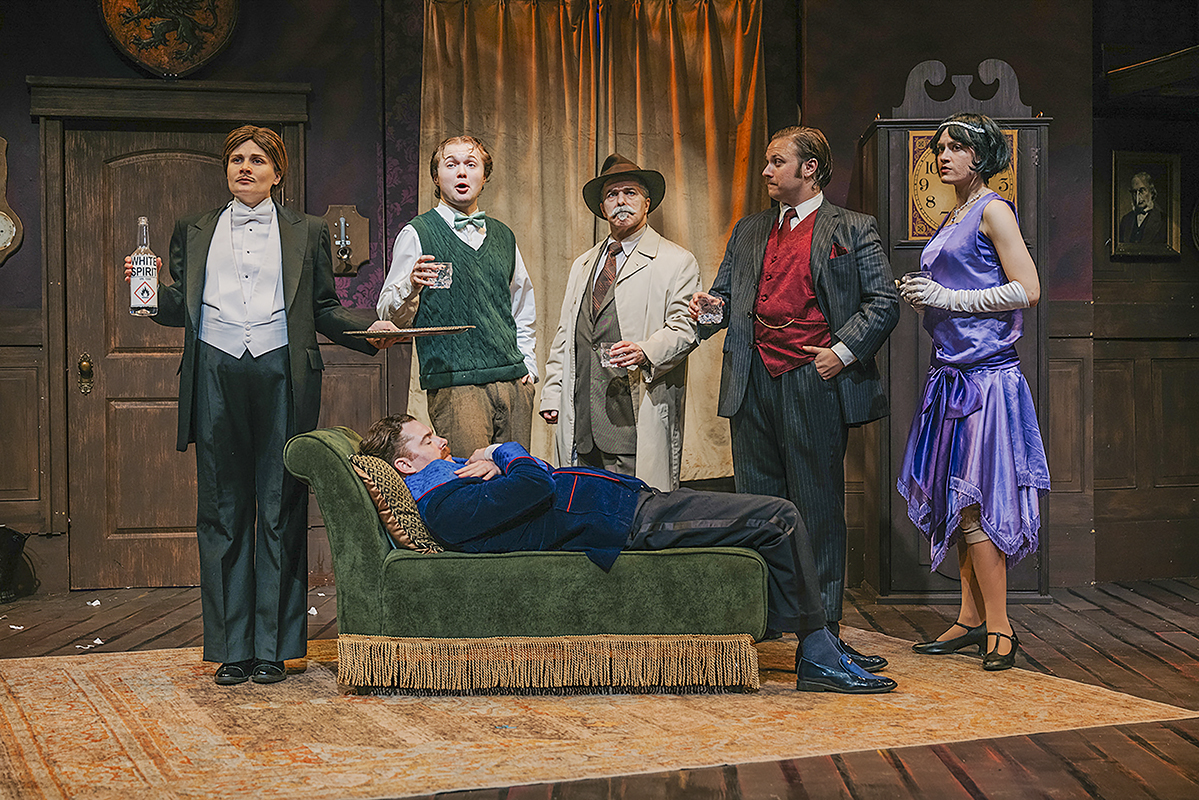
Before it all falls fabulously apart in The Play That Goes Wrong, and every sort of onstage disaster befalls the hapless cast of the play within the play, we have to believe that these members of a local drama society truly believe in their little production that could.
Because they fight hard for it. Even as cues are missed, lines are forgotten, fixtures fall off the walls, and actors are rendered unconscious, this fictional company bands together and wills their show to go on.
That indefatigable determination and showmanship was baked into the comic soufflé by the show's creators Henry Lewis, Jonathan Sayer, and Henry Shields of London's Mischief Theatre Company, and it courses through the gung-ho cast of Keegan Theatre's new production of The Play That Goes Wrong, directed by Michael Innocenti.
These are challenging times for news organizations. And yet it’s crucial we stay active and provide vital resources and information to both our local readers and the world. So won’t you please take a moment and consider supporting Metro Weekly with a membership? For as little as $5 a month, you can help ensure Metro Weekly magazine and MetroWeekly.com remain free, viable resources as we provide the best, most diverse, culturally-resonant LGBTQ coverage in both the D.C. region and around the world. Memberships come with exclusive perks and discounts, your own personal digital delivery of each week’s magazine (and an archive), access to our Member's Lounge when it launches this fall, and exclusive members-only items like Metro Weekly Membership Mugs and Tote Bags! Check out all our membership levels here and please join us today!









You must be logged in to post a comment.