Hamnet: Kemi-Bo Jacobs and Rory Alexander – Photo: Kyle Flubacker
What a hullabaloo. There was the book, then the play, and now there is the movie (with an Oscar-winning performance). Hamnet is, as the iconic VISA ad said, everywhere you want to be.
People, it seems, just can’t get enough of this Shakespeare-adjacent imagining of the Bard’s family life. And the airwaves are veritably humming with the question of what one should read, see, or experience live, first. The truth is, anyone who feels they need to catch the Hamnet wave should be able to start anywhere. Book, film, or play — each should be capable of standing on its own two feet. Unfortunately, the production by the Royal Shakespeare Company, now at The Shakespeare Theatre, is less standing than crawling around on its knees.
Where to begin? From a bird’s-eye view, Lolita Chakrabarti’s adaptation of Maggie O’Farrell’s novel simply fails the remit. Despite nearly three hours of opportunity, it struggles to suggest anything meaningful in three of the biggest lacunae in this backstory: the nature of Will’s relationship with Agnes; why he was so absent from the family home; and a convincing theory on how the death of son Hamnet might have influenced the writing of Hamlet, the play.
This imagining needed to rise above the limits of the material and take some full-throated license. Other than a few theatrically attractive moments, it does not.
The play also insists on hovering around the kind of toe-curling theater foisted on schoolkids, with pointed comments on historical tidbits as if there will be a quiz after. Registers, occupations, and performances for the Queen are mentioned with little pretext. A name change is sky-written with the line, “Mumma, why is father now signing his letters as Will?” Then there are the contrived conversations with language we are meant to believe made its way into the Bard’s work.
Just as galling is the play’s overt messaging on how women were treated back in the day. Who exactly is supposed to be surprised by wedding vows that emphasize a husband’s dominance? And do we really need the cliché that Agnes’ herbs will do a better job than the concoctions of the plague doctor, who arrives and postures like something out of a British pantomime? This is just color-by-numbers stuff that’s been done better by others.
Although the work is clearly meant to put a thumb on the scales for Agnes, there is no escaping the fact that its raison d’etre is Shakespeare and we needed far more of what might have made this man tick. Instead, he is presented as a somewhat out-of-his-depth guy who finds playmaking in London a hell of a lot more stimulating than looking after a brood of children in the countryside with a rather off-piste wife.
But there is nothing to explain his life choices, let alone his inner landscape. Sure, he crushed heavily and later suffered the tragic loss of a child — but so did many other men of his time. What allowed Shakespeare to transfer his life experiences into such art? How could Agnes have triggered or inspired him? Two and two are simply not made into four.
As this young William, Rory Alexander certainly looks the part, but no amount of thousand-yard staring or stunned silence is going to substitute for an investigation this play simply doesn’t do. Matters are not helped by Alexander’s slight penchant for rather actorly acting. There is just a bit too much in every gesture. He runs dramatically on stage enough times that it becomes almost funny, when it definitely shouldn’t be. And although it’s not his fault that director Erica Whyman thought it was a good idea to make an outlandishly silly tableau out of his first time getting it on with Agnes, his flair for the somewhat over-dramatic certainly doesn’t help.
In direct and glaring counterpoint to this is the understated performance of Troy Alexander as Agnes’ brother, Bartholomew. Yes, he is meant to be a no-nonsense character, but this Alexander commands the stage without puffery. He doesn’t display his character, he exudes it. It’s a shame that, unlike the plague, it isn’t more contagious.
Another challenge is protagonist Agnes, played with almost consuming conviction by Kemi-Bo Jacobs. Deeply charismatic and at times almost compelling, Jacobs is ultimately let down by an inability to moderate her tone. Like (Rory) Alexander, she is just too actorly, with every word delivered as if she is railing against the gods atop the battlements. It may serve as a touchstone for the intensity of Agnes’ experiences, but it becomes too much of a good thing. By the time she’s howling in labor, it feels like there is nowhere left to go. To be fair, Jacobs may have felt this was the only way to bring Agnes to life since Chakrabarti (by way of O’Farrell) delivers Agnes as more 16th-century earth mother than a real and convincing woman.
As Hamnet, the obviously-not-eleven Ajani Cabey is memorable for his rather Puckish demeanor, but he never feels like a young boy, and his delivery as an actor later playing Hamlet doesn’t move the needle. Other problem roles are Nigel Barrett’s John (Will’s father) and Nicki Hobday’s Joan (Agnes’ stepmother). Written as almost cartoonish villains, both play it to the rafters, either by choice or because everyone has run out of ideas as to how to bring any kind of dimension to these stock figures.
If there is any good news in the smaller roles, Penny Layden as William’s mother, Mary, keeps it mercifully toned down, while Ava Hinds-Jones and Saffron Dey as Agnes’ daughters Susanna and Judith deliver their gentle girls with charming integrity. They are the bright lights here.
But that’s enough praise. You may have Hamnet fever, but a dose of this version is most certainly not the cure.
Hamnet (★★☆☆☆) runs through April 12 at the Shakespeare Theatre Company’s Harman Hall, 610 F St. NW. For tickets, visit shakespearetheatre.org.
Set in the not-quite-literal shadow of the Capitol, the Folger's young and zingy As You Like It delivers Shakespeare's rom-com amid the people of D.C., not the politicians. It's a pointed nod to the fact that Washington may be the nation's capital, but it's also a living, breathing city with its own microcosm of love, lives, and family hierarchies.
Artistic director Karen Ann Daniels' vision, directed by Timothy Douglas, delivers the kind of intimate, gently interactive theater that pairs so well with the Folger space, one that says, "Come right in, this is for you."
Even better is the team's decision to go full-bore classical and keep the adaptation cute but judicious. There is no question this is set in today's world with scenic designer Gisela Estrada's painted city murals and Celeste Jennings' costuming, but this is Shakespeare without compromise, and it deeply respects its audience.
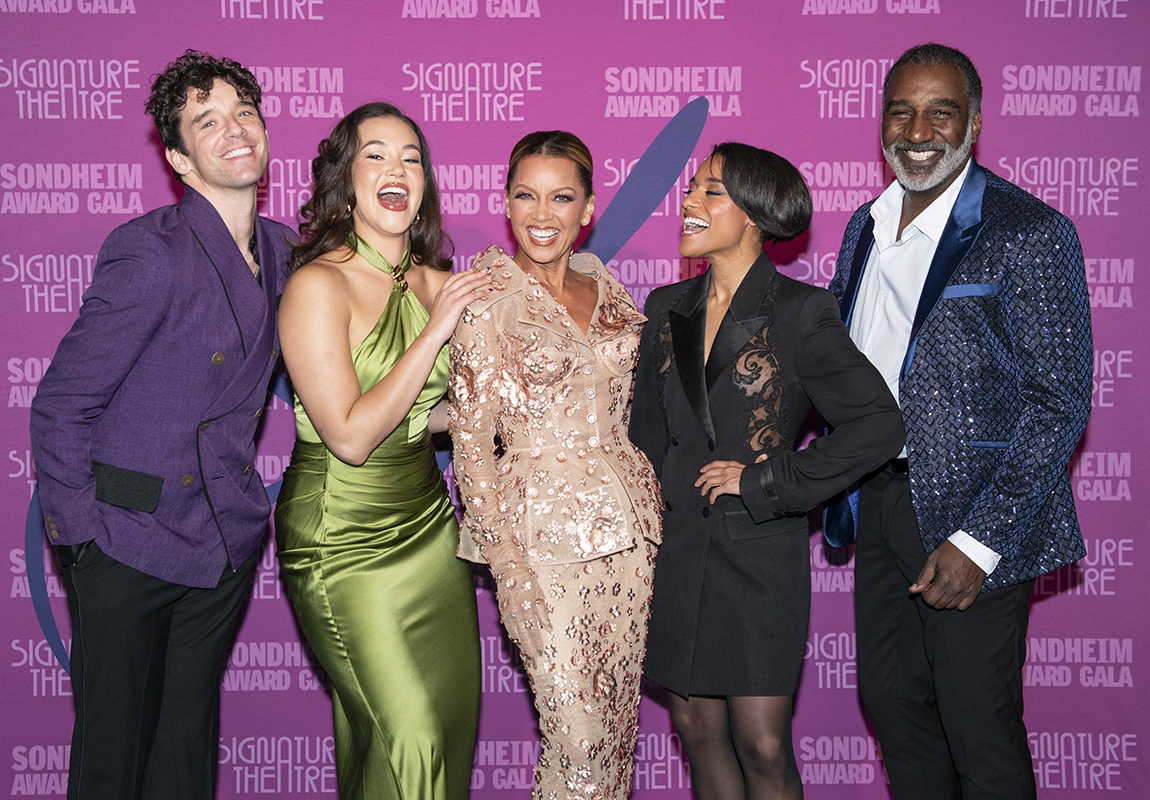
As Vanessa Williams, radiant as ever in sparkling gold, rose to accept her award as Signature Theatre's 2026 Sondheim Award honoree, a question came up at our table: "Do you think they'll hold the plane for her?"
The audience at Monday's black-tie Sondheim Award Gala, held for the fourth year at the Anthem on the Wharf, had already been informed Miss Williams had a plane to catch -- and soon. Currently starring as the ruthless Miranda Priestley in the West End production of the new musical The Devil Wears Prada, Williams needed to make that British Airways flight from Dulles to London in order to go on with the show the following night.
Dead men tell no tales, they say, but that might just depend on who's listening. In Angelle Whavers' dramedy John Doe, a grieving young woman, Zia (Ariana Caldwell), lends an ear to a dead man with plenty to tell, though with no memory of who he was or how he died.
So Zia calls him John Doe (Mitchell Alexander). He doesn't know his own name, yet he's certain somebody killed him. "Something or someone caused my death," he insists, in the hope Zia can help him find justice or exact revenge. But first, as the only person who can see his ghostly form, she'll have to solve the mystery of his identity and the nature of his demise.
These are challenging times for news organizations. And yet it’s crucial we stay active and provide vital resources and information to both our local readers and the world. So won’t you please take a moment and consider supporting Metro Weekly with a membership? For as little as $5 a month, you can help ensure Metro Weekly magazine and MetroWeekly.com remain free, viable resources as we provide the best, most diverse, culturally-resonant LGBTQ coverage in both the D.C. region and around the world. Memberships come with exclusive perks and discounts, your own personal digital delivery of each week’s magazine (and an archive), access to our Member's Lounge when it launches this fall, and exclusive members-only items like Metro Weekly Membership Mugs and Tote Bags! Check out all our membership levels here and please join us today!








You must be logged in to post a comment.