
‘Nixon in China’ Review: Gorgeous Sound, Elusive Story
Washington National Opera’s Nixon in China pairs John Adams’ hypnotic score with a libretto that keeps its audience at arm’s length.

There will be two kinds of audience for the Washington National Opera’s Nixon in China: the primed and the curious. For students and lovers of modern opera, this is a rare chance to see a take-no-prisoners piece in which composer John Adams’ riveting score is paired with a libretto by poet Alice Goodman. For everyone else — the interested but uninitiated — there may be a fair amount of what the hell is going on and why should I care?
But don’t write it off just yet. President Nixon’s 1972 visit to China was genuinely historic. China had been, until then, closed to the West and Nixon (along with wife Pat and then-National Security Advisor Henry Kissinger) was making the geopolitical equivalent of a lunar landing in this attempt to jump-start cooperation. The results were complicated: although the goal of opening trade worked (we have all the cheap flip-flops we could ever want), hopes that China would democratize have obviously never materialized.
Just as much drama lies in the diametrically-opposed backstories of the key players. Nixon was making nice with Mao Tse-tung, the leader of a murderous reign of terror. At the other end of the spectrum was Nixon himself, a former Commander in the Naval Reserve who exulted in America’s values and way of life (this was pre-Watergate). Their wives also couldn’t have been more different: Chiang Ch’ing was an actress-turned-dictator’s wife, while Pat Nixon had been raised on a farm. Put it all together and you can see why it stimulated Adams’ artistic juices even fifteen years after the event took place.
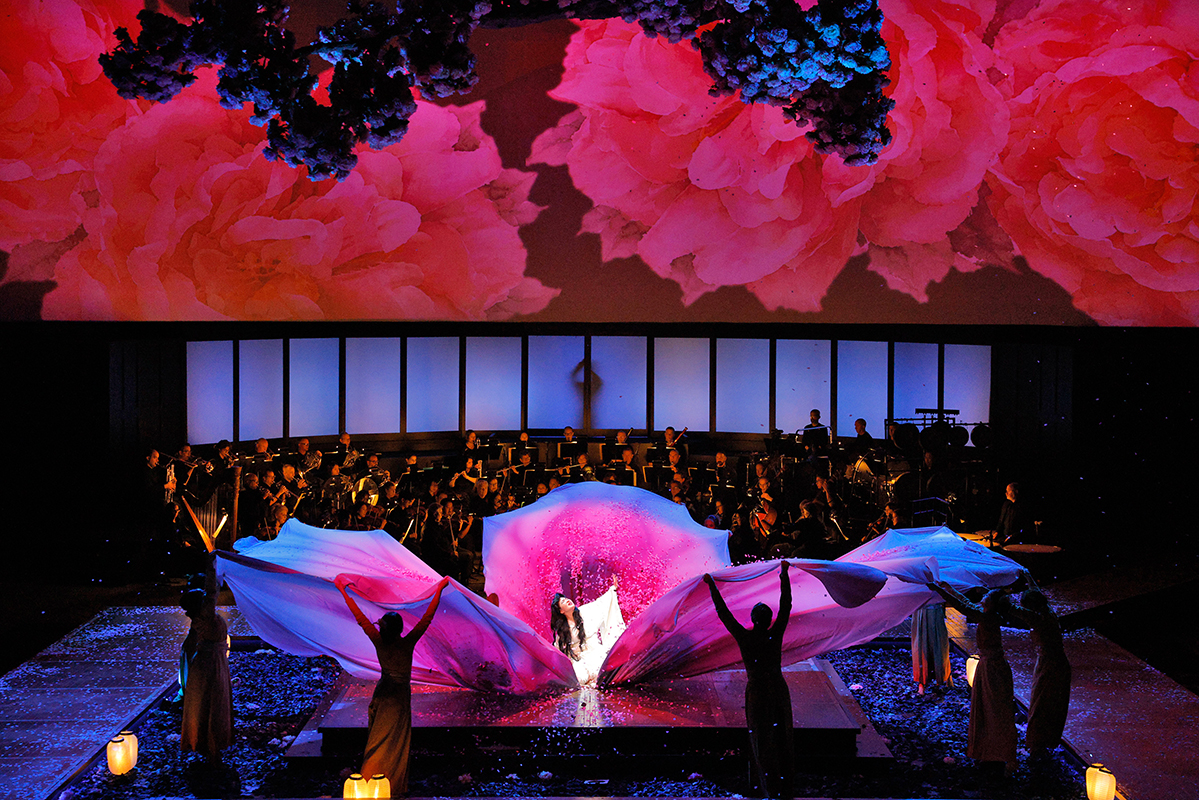
Of course, the question is what Adams and Goodman bring to these potentials. First the positives. For anyone approaching with an open mind, this rather surreal, somewhat eccentric look-back into East meets West can make for an intriguing evening’s journey. Adams’ score is a thrumming, mesmerizing clockwork of beautiful, tense, ringing sound, sumptuously conducted by Robert Spano. It pairs exceedingly well with filmmaker Bill Morrison’s projections which, pulled from actual footage of the trip, deliver by turns nostalgic, haunting, and vaguely sinister impressions.
And the imagery is carefully juxtaposed with the action: for example, bursts of propaganda on stage contrast with long takes of a person riding a bike in the snow, no doubt heading to a Chinese factory to work for a pittance. Some of the projections have such import and presence they move into the realm of installation art.
The unity of music and image leads to thoughts of Godfrey Reggio’s incomparable Koyaanisqatsi, one of the greatest documented contemplations of humankind put to film, which is inextricably bound to Philip Glass’s extraordinary accompanying score. First released in 1982, it’s hard to believe it didn’t influence the later Nixon.
All of which is to say that this is an opera of impressions. And when it comes to its narrative, this is where it may stump the viewer. There is certainly an interesting emphasis on how the Chinese receive the Westerners, offering them a propaganda-based dance performance on the one hand while delving into their more private ruminations on the other. Nixon and wife Pat also hold forth, but there is no sense of conversations or connections with their Chinese counterparts. This leaves a dramatic vacuum: everyone talks into the ether, but not to each other. A good part of this is the poetical style of librettist Goodman who embraces the word oblique like they were separated at birth. Put another way, she’s never met a metaphor, allegory, or allusion she didn’t like.
As intriguing as some of her language is, one ends up second-guessing one’s second-guessing. Are things going well or badly? Does anyone have the upper hand? Could Pat Nixon really have been that moronic or is this supposed to be funny? And what are we to make of the opera’s somber conclusion which is filled with reminiscences and vague angst? How do Nixon’s fond memories of American life (and his war experience) speak to this reach across a vast, hard-to-read cultural divide?
Thus, the approach may be imaginative, but if we’re being honest, it can be frustrating. It’s also never a good sign when those with historical knowledge are scratching their heads and the production’s program does the heavy lifting. The truth is, many will leave this opera with a mood and an impression, but not much insight.
In the role of Nixon, baritone Thomas Hampson sings the man with integrity, but his voice is not always complemented by the miking and there are a few off-piste vibes. Embodying Pat with grace is Renée Fleming who largely delivers a lovely soprano. But one of the real knockouts here is a charismatic Kathleen Kim as Chiang Ch’ing who suggests the ruthlessness and also the hypocrisy the Communists brought to their regime — a reality which one wishes was less submerged. She brings her soprano to striking, laser-precise heights, adding some genuine intensity to Adams’ pulsing score.
Other standouts are John Matthew Myers’ Mao Tse-tung and Joo Won Kang’s Chou En-lai who each evoke some complexity in their characters, even if there is little to learn from Goodman’s telling. Myers has a pleasingly smooth tenor and a keen sense of the music, while Kang delivers a gratifying baritone (again, not helped by the miking). Mention must also be made of dancers Kayla Mei-Wan Thomas and Jaryd Farcon who bring full and fluid expression to their performances.
The bottom line is that with its obtuse, attenuated, and dreamlike emphasis, this shouldn’t be anyone’s first opera. However, for those open to admiring the deconstruction of the event, contemplating the questions it raises, and enjoying the immersion in its compelling sound and imagery, this could be the opera equivalent of trying broccoli and realizing you really like it.
★★★☆☆
Nixon in China has a final performance Saturday, Nov. 21, at 2 p.m. at DAR Constitution Hall, 1776 D St. NW. Tickets are $57.60 to $329, including fees. Sung in English with projected English surtitles. Visit washnatopera.org.
More from Metro Weekly:




You must be logged in to post a comment.