A pair of Texas Democrats have introduced bills to repeal the state’s ban on gay sex, which has remained on the books for decades even though the U.S. Supreme Court struck it down in 2003.
Out gay state Rep. Venton Jones (D-Dallas) has filed House Bill 653 ahead of the 2027 legislative session. The two-page bill contains four sections, the first of which explicitly repeals Section 21.06 of the state’s Penal Code.
As currently written, the anti-sodomy provision in the Penal Code makes “deviate sexual intercourse” with someone of the same sex — defined as oral or anal sex, or penetration with an object — a Class C misdemeanor, punishable by a fine of up to $500. There is no enhanced penalty for repeat offenders.
Jones’ bill would also remove provisions requiring teachers to tell students under 18 that same-sex relations are illegal under Texas law.
However, as currently written, it would leave in place language in the state’s Health and Safety Code requiring sex education for minors to emphasize abstinence and state that “homosexual conduct is not an acceptable lifestyle,” Gayety reported.
The bill would also leave in place language requiring HIV and sex education materials for students under 18 to state that “homosexuality is not a lifestyle acceptable to the general public.”
Jones told Austin-based NBC affiliate KXAN that the bill mirrors legislation he introduced in past sessions, which was written to build support for repeal among Republicans in a GOP-controlled legislature. But now that Democrats have won control of the Texas House in this year’s midterms, he plans to change the sex-education language.
The companion bill to Jones’ legislation, Senate Bill 143, introduced by state Sen. José Menéndez (D-San Antonio), goes further: it removes any references to moral judgments about same-sex activity, as well as any mention of criminality, from the Penal Code, the Health and Safety Code, and the instructional requirements for HIV and sex education.
The law has technically been unenforceable since 2003, when the U.S. Supreme Court struck down laws criminalizing same-sex conduct in Lawrence v. Texas. But Texas Republicans have traditionally opposed removing the language from the law as a signal of moral disapproval of same-sex conduct.
However, in recent years, some Republicans have begun to buck the party’s position. U.S. Sen. Ted Cruz (R-Texas) has called for its repeal, and Supreme Court Justice Clarence Thomas — despite arguing that Lawrence was wrongly decided — has called the law “uncommonly silly” and said that if he were a member of the Texas Legislature, he’d vote to repeal it.
Some conservatives, including outgoing Texas Attorney General Ken Paxton, believe the anti-sodomy prohibition should remain in place so it would immediately become enforceable again if the Supreme Court ever overturns Lawrence.
Last year, the GOP-controlled Texas House voted 72-55 for a bill sponsored by Jones and far-right state Rep. Brian Harrison (R-Midlothian) to repeal the anti-sodomy law.
In a floor speech, Jones urged his fellow lawmakers to vote for the bill, arguing that he wasn’t asking conservatives or strict constitutionalists to endorse the Lawrence decision, only to remove restrictions that don’t treat all individuals equally under the law.
“I’m asking you to vote for a law that upholds the principles that Texans should have the freedom and ability to make their own private decisions without unwarranted government interference,” he said at the time.
As reported by the Texas Tribune, Harrison made similar comments, saying, “Criminalizing homosexuality is not the role of government, and I support repealing [the law],” and adding that he would “continue consistently fighting for limited government and individual liberty.”
Twelve Republicans ultimately voted in favor of repealing the now-defunct law.
While Jones’ bill is likely to pass the Texas House overwhelmingly — without needing any Republican votes, now that Democrats control the chamber — the biggest stumbling block to eliminating the anti-sodomy provision is the Texas Senate, which Republicans control by a 19-12 margin.
While some Republicans and anti-LGBTQ advocates have argued that the law doesn’t need to be repealed, and have chastised Democrats for pushing bills like Jones’ and Menéndez’s, the statute has occasionally been used to justify anti-LGBTQ discrimination. In 2009, police kicked two gay men out of an El Paso restaurant for kissing, citing the law, the Houston Chronicle reported.
The men were never charged, but Dale Carpenter, a constitutional law professor at Southern Methodist University, said that refusing to remove the provision from the Penal Code sends a message to LGBTQ Texans.
“I call these laws kind of like an unused whip,” Carpenter told the Houston Chronicle in 2025. “They just lay there and they can be picked up by the police and others who aren’t even aware of what the precise contours are, but they just serve as a general condemnation of same-sex affection.”
For months, political prognosticators and so-called "election nerds" have looked forward to November 3, 2026, the day of the midterm elections. Based on historical trends for the sixth year of a presidency, the party occupying the White House is expected to suffer electoral losses as the political pendulum swings back. Add to the mix inflation, high gas prices, a war in Iran, and the impact of Donald Trump’s tariffs, and the mood of the country is fairly sour.
Throughout the night, as polls in various states close, analysts will try to determine how strong the backlash to the incumbent president is -- prompting predictions of a "blue wave" or even a "blue tsunami." Below are several races to watch as each hour passes, and what certain outcomes could signal about the national political environment.
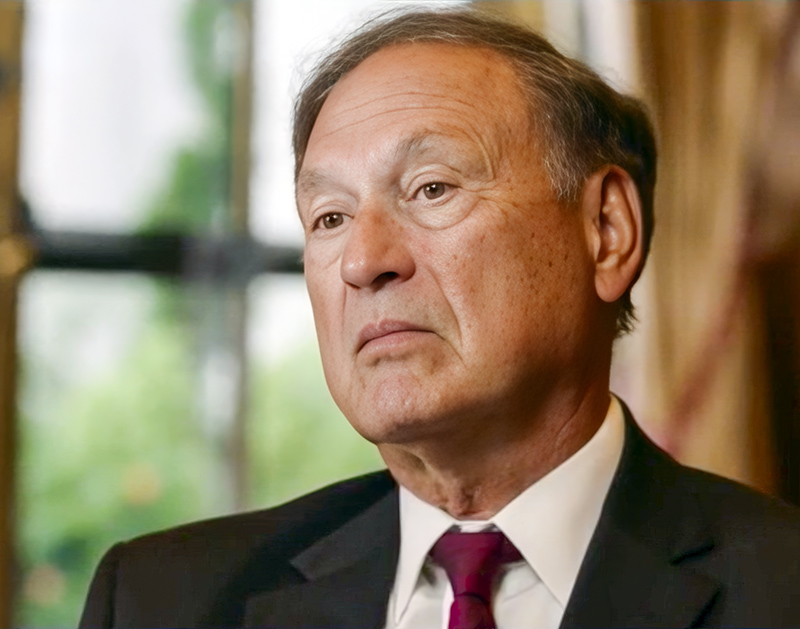
U.S. Supreme Court Justice Samuel Alito, a Catholic who is one of the high court's most doctrinaire conservatives, says in a new book that the court's decision extending marriage rights to same-sex couples was "perhaps the decisive point in our nation's turn against religious liberty."
Alito, who dissented in the 2015 Obergefell v. Hodges case, made the claim in a speech at Catholic University of America (CUA) three years after the decision. The remarks were published in So Ordered, a collection of the justice's speeches that he says reflect his judicial philosophy and views of the United States.









You must be logged in to post a comment.