Ruby Corado is set to plead guilty to a reduced charge of federal wire fraud after the government accused her of diverting $150,000 in pandemic relief funds to her personal bank accounts.
On May 31, the 53-year-old Corado was charged in a new 11-page “criminal information” with one count of wire fraud related to offenses alleged in an earlier six-count complaint that led to her arrest in March.
The new information includes a criminal forfeiture requiring Corado to surrender all proceeds traceable to the offense.
A “criminal information” is a type of charging document that can be used in felony cases only when a defendant has waived the right to indictment. It typically implies that the defendant has entered a plea deal with prosecutors and is slated to plead guilty. However, any plea or agreement ultimately must be approved by a judge.
“It was the purpose of the scheme and artifice that [Corado] would obtain money and other property from government-supported pandemic relief programs on behalf of Casa Ruby and misappropriate those funds for her own personal benefit,” the charging documents read.
Corado, the former executive director of the nonprofit community center Casa Ruby, is next scheduled to appear in D.C. federal court on July 17 for a plea hearing before U.S. District Court Judge Trevor McFadden.
A guilty plea would mark Corado’s fall from grace from several years ago when she was held in relatively high esteem and was praised for her nonprofit’s work with homeless LGBTQ youth, transgender and gender-nonconforming individuals, and LGBTQ immigrants.
At the height of its popularity, just prior to the start of the COVID-19 pandemic, Casa Ruby employed approximately 50 individuals — many of them transgender people of color — and served 6,000 clients a year.
Corado stepped down as Casa Ruby’s executive director in 2021 after an $840,000 grant from the D.C. Department of Human Services was not renewed. This put Casa Ruby’s transitional and low-barrier shelter housing at risk and forced the organization to seek financial support in the form of donations.
The following year, Casa Ruby shut its doors and scuttled all of its emergency shelter and housing programs after several employees alleged they had not been paid for past work.
Additionally, multiple landlords claimed that Casa Ruby had failed to pay rent for properties where the center’s clients were being housed.
The D.C. Attorney General’s office asked a D.C. Superior Court judge to freeze Casa Ruby’s bank accounts to prevent Corado — who still retained control over them, even after her resignation — from withdrawing further funds.
Then-Attorney General Karl Racine filed a lawsuit against Corado later that year, accusing her of diverting hundreds of thousands of dollars in District of Columbia grant money into her personal bank accounts, paying workers less than minimum wage, and failing to compensate workers for the work they’d done.
That lawsuit remains ongoing.
The Wanda Alston Foundation, another nonprofit that works with LGBTQ homeless youth, which was appointed as the receiver for Casa Ruby following its closure, recommended dissolving Casa Ruby, finding its financial debts far exceeded its assets.
The foundation also sued Casa Ruby’s board, alleging that the lack of oversight from board members enabled Corado to embezzle more than $800,000 in total, increase her own personal salary, and open a Casa Ruby affiliate in El Salvador without seeking permission from the board.
In March, federal prosecutors charged Corado with fraud and money laundering for allegedly diverting $150,000 — out of $1.3 million received through pandemic-era relief programs for small businesses and nonprofits, including the Paycheck Protection Program (PPP) and the Economic Injury Disaster Loan (EIDL) program — into personal bank accounts held in El Salvador under her birth name.
Prosecutors claim Corado passed the money through her consulting company, TIGlobal, in an attempt to circumvent the Small Business Administration’s earlier denial of her EIDL application.
The FBI arrested Corado at a hotel in Laurel, Maryland, on March 6.
She was temporarily jailed and placed in solitary confinement for her own protection, until a federal judge decided to release Corado and placed her under house arrest at the home of a niece in Rockville, Maryland. She is currently being subjected to GPS monitoring and is barred from accessing her passport, visiting El Salvador, or any consulate office of El Salvador.
If convicted of the wire fraud charge, Corado could face up to 20 years in prison, but could obtain a much lower sentence by pleading guilty to reduced charges.
As a first-time offender accused of nonviolent charges, Corado could ultimately end up serving less than two years in prison.
A Delaware man is suing the state's attorney general and the University of Delaware for allegedly failing to take sufficient action against his former partner for domestic assault.
He claims their handling of the case may have been motivated by racism and homophobia, as both he and his ex are gay and Black.
Tymothy "Ty" Moyer claims that his former partner, Michael Uzu, attacked him in February 2024, leaving him with permanent brain damage, which forced him to resign from his position as a financial compliance associate with the BlackRock asset management company.
The King George County School Board in Virginia has revised its student-organization policy and adopted new guidelines allowing middle schoolers to form non-curricular clubs, clearing the way for a Genders and Sexualities Alliance that students sued the district to establish.
The change extends equal-access protections to middle school students, allowing them to meet without discrimination based on the religious, political, philosophical, or other content of their speech, according to the Fredericksburg Free Press..
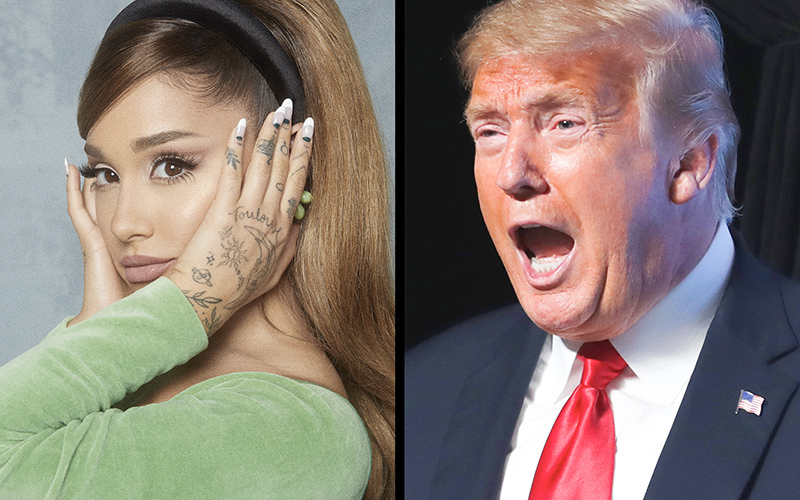
For the second time this summer, Ariana Grande has rebuked President Donald Trump's administration for using her music in a social media post.
The latest dispute erupted after the Team Trump account added Grande's 2024 hit "We Can't Be Friends (Wait for Your Love)" to a TikTok post that repurposed one of its lyrics.
The post quotes the lyric "Me and my truth we sit in silence..." before adding: "...men can't have babies and should never compete in women's sports."








You must be logged in to post a comment.