My English Persian Kitchen: Dina Soltan – Photo: Chris Banks
Powered by Dina Soltan’s agile solo performance, Chris White’s arresting production of My English Persian Kitchen conjures a vivid world of oppression and resistance inside a mostly bare black box theater.
Bare, save for a well-stocked kitchen island with a stovetop in the center of the space. A midsize fridge a few feet away completes set designer Pip Terry’s spare but effective concept of the kitchen where an unnamed Woman, portrayed by Soltan, prepares a traditional Persian dish for expected guests.
As she chops, cooks, and stirs, she shares the tale of how she got from her volatile life in Tehran to this comfy kitchen in London. Pilot and passenger for the turbulent journey, the Woman narrates her story, steering the audience through her extraordinary 2007 escape from Iran — and from the man who would have kept her there — while also re-enacting (or in some cases reliving) the harrowing events.
A Solas Nua production in association with Mosaic Theater Company, this North American premiere marks the third play by Irish-Palestinian playwright Hannah Khalil to open in D.C. this season, following Spooky Action Theater and Solas Nua’s beguiling feminist fable Hakawatis: Women of the Arabian Nights.
My English Persian Kitchen, from a story by Iranian author and nutritional therapist Atoosa Sepehr, furthers Khalil’s clear commitment to giving a sharp-tongued voice to women, particularly those of the Middle East, who might not feel heard, even in their own homes. Her characters don’t skirt around the sexist oppression they experience as a matter of culture, religion, history, and the plain contempt shown by men.
The Woman here explains that she was an educated business owner back in Tehran who tenaciously resisted assuming the duties and expectations that went with becoming any man’s wife. Then, as she describes it, she “sleepwalked” into marriage with Him, the callously diminishing chauvinist husband who sought to control her.
She’d spent her whole life determined not to end up trapped in a kitchen cooking for a man, so she didn’t cook at all, she tells us. Now, she’s cooking on her own terms, we can see, as she cheerily preps the parsley, mint, chives, dill, spinach, and spring onions to make her beloved Persian noodle soup, Ash-e-reshteh.
The real-time act of food preparation, executed with flair by Soltan and complemented by the savory, herbaceous aromas, is naturally absorbing.
White, a frequent collaborator of Khalil’s who also directed productions of Kitchen in England, Scotland, and Ireland, makes a play for all five senses, employing Dan Balfour’s dynamic sound design and Marty Langthorne’s precise lighting to pulse-pounding effect.
Occasionally, the Woman passes around an herb or spice so audience members can enjoy a whiff, or even rub the ingredients between their fingers. Food, as a source of sustenance and connection, a pillar of family and community, a form of caring and expression, becomes a silent co-star.
The combined sensory effect aids in transporting us into the Woman’s evolving reality. Of course, Soltan’s vibrant performance does most of the heavy lifting.
Whether joyfully recalling how her aunt read her Wuthering Heights, translating the English into Farsi, or looking haunted as she alludes to a past traumatic event that left her in physical pain, Soltan takes us along with this Woman on her journey toward freedom.
She and White find a measured urgency in unfolding the Woman’s story, which shifts between narration, her inner monologue, and stirring action. In one chillingly claustrophobic scene, she climbs inside the kitchen fridge, which doubles as a holding cell, lending a palpable tension to her depiction of confinement.
The production also taps into the Woman’s constant fear, after escaping the tyranny of her marriage, that He might yet show up in London to forcibly take her back to Iran. Would anyone notice if she vanished from this new place where no one knows her?
In their marriage, He wore down her sense of self-worth. In her new country, she wants to be seen. In this play, we can readily imagine seeing her, meeting her, and breaking bread at her table, tasting a meal she made with love. The audience at the press performance did get to take home a bowl of Ash-e-reshteh (prepared by award-winning Persian restaurant Joon, of Tysons Corner), and it was delicious, a cultural connection to warm the palate and the heart.
★★★★☆
My English Persian Kitchen runs through Dec. 13 at Atlas Performing Arts Center, 1333 H St. NE. Tickets are $42 to $75, with discount options and rush tickets available for each performance. Call 202-399-7993, ext. 2, or visit www.mosaictheater.org or www.solasnua.org.
AIDS United has opened registration for AIDSWatch 2027, the nation's largest federal HIV advocacy conference, scheduled for March 15-17, 2027, in Washington, D.C.
The annual event brings together people living with HIV, community advocates, health and policy experts, and allies to discuss and advocate for policies and federal funding decisions that affect their communities. First-time attendees and longtime organizers alike are encouraged to share their experiences and expertise while building relationships with HIV advocacy organizations in other states.
At this year's AIDSWatch, held in March, nearly 600 advocates from 42 states and territories gathered for three days of policy education and political engagement, including meetings with nearly 250 congressional offices on Capitol Hill. The conference provided an opportunity for advocates to lobby lawmakers on their priorities in combating and preventing the spread of HIV.
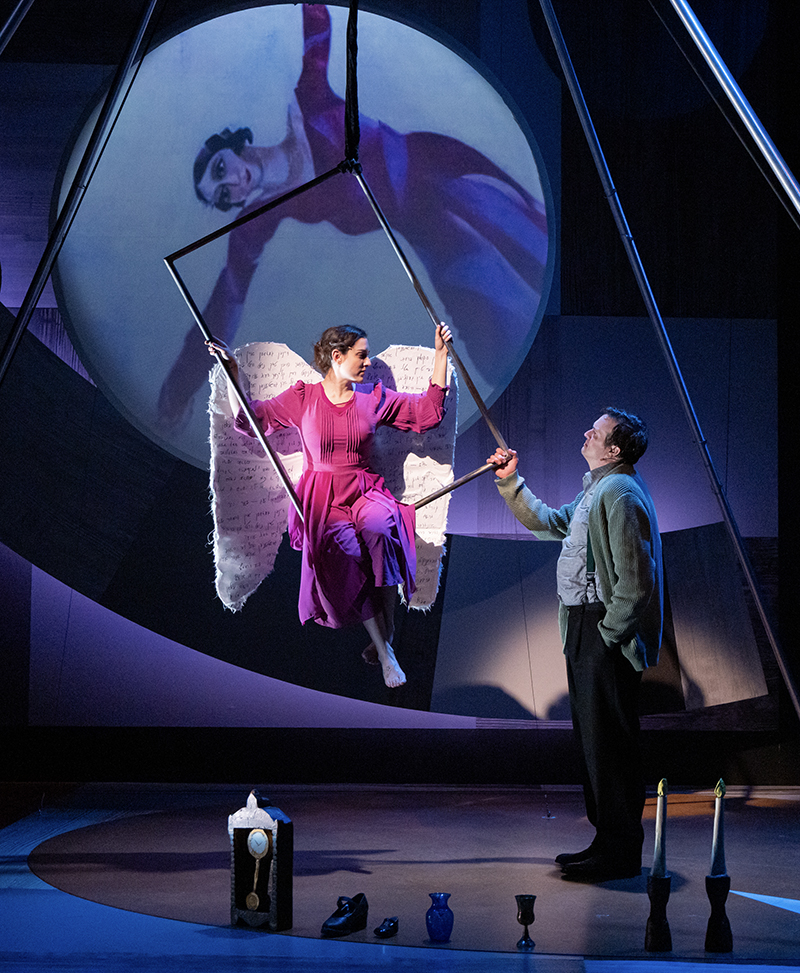
On his path to greatness as one of the preeminent painters of the 20th century, Marc Chagall found an enthralling muse in Bella Rosenfeld, who would become his (first) wife.
The Flying Lovers of Vitebsk, written by Daniel Jamieson, with music by Ian Ross and Sarah O’Halloran, recounts the couple’s romance, making a credible case that Chagall’s ultimate renown as “the quintessential Jewish artist of the 20th century” might only have been achieved with Bella’s love and support. There are many such cases.
As told to the audience by Chagall and Bella themselves in the play, she would devote herself to ensuring he could enjoy and express his gifts to the fullest while largely neglecting her own. The play relates that story with a sound sense of completeness that’s conveyed in Theater J’s production directed by Hayley Finn.
Ever-adventurous in transforming unconventional spaces for immersive theatrical experiences, Rorschach Theatre takes audiences back in time with its new, original production SPARKED: The Vanishing at Buzzard Point.
Inspired by the real, rough-edged history of Buzzard Point -- the Southwest D.C. neighborhood Rorschach now calls home -- SPARKED concerns a young couple in 1933 who go missing during a savage storm. The denizens of the Five Dead Horse Tavern, “a bar out of time,” relate the tale to the audience, but only after attendees are split into separate groups and guided along different paths through scenes of the story.








You must be logged in to post a comment.