Mississippi Gov. Phil Bryant – Photo: U.S. Department of Agriculture, via Wikimedia.
Mississippi Gov. Phil Bryant’s legal team is defending a “religious freedom” bill that seeks to allow discrimination against LGBT people by arguing it is Christians who are being persecuted for their beliefs, and that being gay or transgender is a choice. In a brief submitted to the 5th U.S. Circuit Court of Appeals, lawyers defending the Magnolia State also insist that the law, HB 1523, does not violate the First Amendment by favoring one set of beliefs over another.
As first reported by Slatemagazine, the attorneys appointed by Bryant to defend the law offer several arguments that contradict the text of the bill in order to justify its legality. Chief among those arguments is that the bill does not violate the First Amendment because it does not “endorse a specific religious belief.” However, the text of the bill singles out three beliefs in particular that are worthy of protection under the law: 1) that marriage should be only recognized as the union of one man and one woman; 2) that sexual relations are properly reserved only to a marriage of a man and a woman; and 3) that the terms “man” and “woman” refer to a person’s biological or assigned sex at birth.
Additionally, Bryant’s legal team argues, the court should not take into account the fact that legislators who voted for HB 1523 cited their religious beliefs as justification for the law, arguing “it is common and perfectly constitutional for individual lawmakers to invoke Christian doctrine as a reason for supporting a law.”
The state’s attorneys also claim that opponents of HB 1523 are exaggerating the effect that it would have on LGBT people’s lives. Rather, they argue “federal courts must defer to limiting constructions of statutes adopted by state officials and the lawyers who represent them in court.”
“The plaintiffs make false and exaggerated claims about the scope of HB1523 — asserting, for example, that the statute will allow restaurants and taxi-cab drivers to turn away homosexual couples and allow businesses to deny services to any opposite-sex couple that ever had sex before marriage,” the state’s brief says. “The plaintiffs’ efforts to misrepresent the scope of HB1523 are understandable; others have successfully used tactics of this sort to derail religious-freedom legislation proposed in other states.”
In essence, the lawyers for the state argue, it must be left to Mississippi officials to reasonably interpret and enforce the law.
“HB 1523 will not protect someone who decides to murder or assault another person because of a belief that marriage is between only a man and a woman, nor will it protect someone who de-frauds another person or breaches a contract on account of a section 2 belief,” the brief continues. “Suffice it to say that the appellants will not, under any circumstance, interpret HB 1523 to shield restaurateurs that refuse to seat homosexual couples; foster parents who inflict child abuse; counselors who fail to take appropriate steps to prevent suicides; boisterous or disruptive state employees; county clerks who fail to recuse themselves in the manner specified by section 3(8); or jewelers who refuse to sell engagement rings to cohabiting couples.
“And the State declares unequivocally that it will not construe section 3(5) to authorize any business to discriminate against homosexuals or transgendered people in employment, housing, or access to places of public accommodation. Section 3(5) protects businesses only from being compelled to participate in, or lend direct assistance to, a marriage ceremony between people of the same sex — if (and only if) such participation or direct assistance would violate the owners’ religious or moral beliefs. Serving a meal to a couple on a date is not a ‘marriage-related service’ under any reasonable understanding of that term.”
Yet U.S. District Court Judge Carlton Reeves, who in July halted the law from going into effect and declared it unconstitutional, did not find such arguments convincing, leaving it an open question of whether the Fifth Circuit will. Reeves also rejected the implicit assumption made in HB 1523 that “any act which brings [a believer] into contact with same-sex marriage or same-sex relationships makes the believer complicit in the same-sex couples’ sin, in violation of the believer’s own exercise of religion.”
Lastly, the brief argues, homosexuality is not immutable and can be changed, because sexuality is fluid. The brief also refers to transgenderism as a “behavior” rather than an identity, arguing that one’s biological sex is immutable.
Lawyers for the state also argue that because “homosexuals have enormous political clout, especially in the Democratic Party,” for a court to rule that LGBT people are “politically powerless” would be “farcical.” Citing the threat of boycotts against states that have passed laws restricting LGBT rights — as well as lamenting over and attempting to re-litigate former U.S. Attorney General Eric Holder’s refusal to defend the Defense of Marriage Act — Mississippi’s defense team argues: “The far more plausible candidate for ‘political powerlessness’ would be the devout Christian mom-and-pop-shop owners who are being bullied by ideologues in the political and business worlds.”
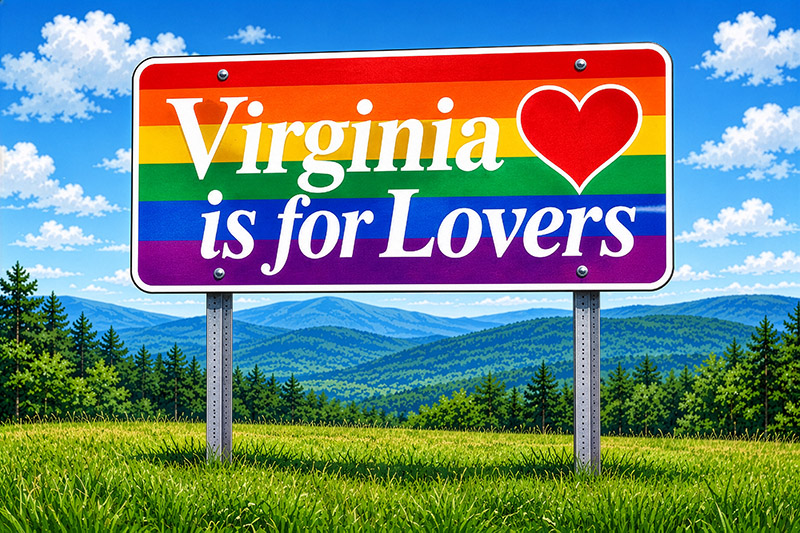
On November 3, Virginia voters repealed the Marshall-Newman Amendment, a 2006 constitutional amendment that barred the Commonwealth from recognizing same-sex marriages or granting legal recognition to same-sex relationships. The measure passed with 57% support and enshrines language in the constitution requiring all legally valid marriages to be treated equally under the law, regardless of the spouses' identities.
The ballot measure was fueled by strong support from Democratic-leaning counties, college towns, and other liberal areas, as well as a handful of "swing" counties and independent cities. The amendment received 87% support in Charlottesville, 85% in Arlington, 83% in Alexandria and Richmond, 76% in Williamsburg, 73% in Albemarle County, 72% in Fredericksburg, 71% in Harrisonburg, and 70% in Fairfax County.
A Northern Virginia pastor filed a lawsuit seeking to block a ballot measure that would repeal the Marshall-Newman Amendment, a 2006 voter-approved amendment banning state recognition of same-sex marriages or similar relationships.
The Founding Freedoms Law Center filed the lawsuit on behalf of Pastor Ben Purves.
The complaint alleges that state and local clerks failed to distribute and publicly post copies of the proposed amendment at Virginia courthouses at least three months before the November 4, 2025, House of Delegates election, as required by state law. It asks the court to invalidate the amendment, even if voters approve it.
Montana House Democrats have chosen state Rep. SJ Howell as minority leader, making Howell the first nonbinary lawmaker in the nation to hold a top legislative post. The caucus also named transgender state Rep. Zooey Zephyr one of its three whips.
Democrats picked up two seats in this year's midterms, giving them 44 in the chamber.
Howell, chosen unanimously by the caucus, will step into the role in January, when the new legislative session begins.
Before winning office in 2022, Howell was a lobbyist and advocate on women's and LGBTQ issues and served as executive director of Montana Women Vote, an economic justice nonprofit for women, LGBTQ people, and Native American women.







You must be logged in to post a comment.